DCPulse
Artificial intelligence is becoming a core part of the global digital infrastructure ecosystem. Data centers, cloud platforms, high-performance computing facilities, and enterprise networks are increasingly being designed to support AI workloads. As organizations expand their AI capabilities, the focus is shifting beyond computing power, storage capacity, and network performance toward how AI systems are managed, secured, monitored, and controlled.
AI governance is emerging as an important part of this transition. Traditionally, governance has been treated as a policy and compliance responsibility handled by legal, risk, and corporate management teams. However, the growing dependence on AI infrastructure is making governance an operational concern. Decisions about data access, model deployment, cybersecurity, energy consumption, computing resources, and system monitoring directly influence how digital infrastructure is designed and operated.
For data center operators, cloud providers, and infrastructure developers, AI governance is no longer simply a framework for responsible technology use. It is becoming a strategic requirement that must be considered during infrastructure planning, investment, deployment, and daily operations.
AI Growth Is Changing Infrastructure Requirements
The expansion of AI applications is changing the technical requirements of digital infrastructure. AI training and inference workloads require computing environments capable of supporting high-performance processors, specialized accelerators, high-speed networking, and large-scale data storage.
These requirements introduce new operational complexities. Infrastructure operators must manage workload allocation, data movement, computing availability, system performance, and access controls across increasingly sophisticated environments.
AI governance adds another layer to these responsibilities. Organizations need clear policies governing which systems can access particular datasets, how models interact with enterprise applications, where sensitive information is processed, and who is responsible for monitoring AI-generated outputs.
Such requirements influence infrastructure architecture from the beginning. Data center operators and cloud providers must consider governance alongside capacity planning, hardware selection, network architecture, and cybersecurity. Infrastructure that cannot support appropriate oversight may create operational and compliance challenges as AI adoption expands.
Data Centers Must Support Governance by Design
Data centers provide the physical foundation for AI systems. Their infrastructure decisions determine how computing resources, storage environments, networks, and security controls operate together.
As AI workloads become more integrated into business operations, governance requirements must be reflected in the design of these facilities and their supporting platforms.
Access management is one important consideration. AI systems may interact with sensitive enterprise information, proprietary datasets, and confidential business applications. Infrastructure operators must support clearly defined access permissions and appropriate separation between users, workloads, and environments.
Data management is equally important. Organizations need visibility into where information is stored, how it moves between systems, and which applications are permitted to process it. This becomes particularly relevant when AI workloads operate across multiple data centers, cloud environments, and geographically distributed infrastructure.
Monitoring capabilities also require attention. Infrastructure teams need tools to observe system activity, identify unusual behavior, maintain operational records, and investigate potential security incidents.
A governance-oriented data center strategy therefore combines physical security, digital access controls, infrastructure monitoring, and data management into a coordinated operational framework.
Cloud Infrastructure Faces Greater Governance Complexity

Cloud computing has made AI infrastructure more accessible by allowing organizations to deploy computing resources without managing every underlying physical component. However, distributed cloud environments also introduce governance challenges.
Enterprise AI applications may operate across private data centers, public cloud platforms, hybrid environments, and third-party services. Each environment can have different security configurations, data access policies, and operational responsibilities.
This complexity makes consistent governance difficult. Organizations must understand where AI workloads are running, which providers process their data, and how information is transferred between different environments.
Cloud providers consequently have an important role in supporting governance through infrastructure-level capabilities. These include identity and access management, encryption, workload isolation, audit logging, data residency controls, and monitoring tools.
Hybrid cloud infrastructure adds another consideration. Enterprises may choose to retain sensitive information within private environments while using public cloud resources for selected AI workloads. Governance frameworks must account for these arrangements without creating unnecessary operational barriers.
For infrastructure providers, the ability to support transparent and manageable AI environments could become an important consideration in enterprise technology decisions.
Cybersecurity and Data Protection Become Central Priorities
AI systems introduce security considerations that extend beyond conventional infrastructure protection. Risks can involve unauthorized data access, compromised model interfaces, manipulated inputs, insecure integrations, and inappropriate use of AI-generated information.
Data centers and cloud platforms must therefore connect AI governance with established cybersecurity practices.
Network segmentation, privileged access management, encryption, vulnerability management, and continuous monitoring remain important elements of infrastructure security. These controls can help limit unauthorized access and reduce the potential impact of compromised systems.
AI-specific security measures also require consideration. Organizations need processes for evaluating model access, managing training data, monitoring inference environments, and controlling connections between AI applications and external systems.
The responsibility is shared across infrastructure providers, AI developers, enterprise customers, and cybersecurity teams. Clear operational boundaries are necessary to establish who manages particular risks and who responds when security incidents occur.
For data center operators, governance should also address the security of the physical environment, including access to servers, networking equipment, storage systems, and critical operational technology.
Energy and Resource Management Must Be Included
The infrastructure requirements of AI also create a connection between governance and resource management. High-performance computing environments require coordinated planning for electricity, cooling, equipment utilization, and facility capacity.
AI governance should consider how computing resources are allocated and whether workloads are being operated efficiently. Organizations need visibility into the infrastructure resources consumed by different AI applications, particularly when workloads compete for limited computing capacity.
Power availability and cooling requirements are especially important when planning facilities for AI-intensive operations. Data center developers must evaluate the relationship between computing density, electrical infrastructure, cooling technologies, and long-term operational requirements.
Governance frameworks can support these decisions by establishing accountability for resource allocation, operational efficiency, and environmental reporting.
This approach also encourages organizations to consider the infrastructure implications of AI deployment before workloads are introduced at scale. Computing capacity should be aligned with actual operational requirements rather than treated as an unlimited resource.
Regulatory Requirements Are Influencing AI Infrastructure Planning
The regulatory environment surrounding artificial intelligence is developing across different markets. Frameworks such as the European Union's AI Act demonstrate how governments are establishing requirements for certain AI systems, including obligations related to transparency, risk management, documentation, and human oversight.
For global infrastructure operators, these developments create additional planning considerations. AI applications may serve customers across multiple jurisdictions, while their supporting data and computing resources may be distributed across different countries.
Data residency, privacy requirements, security obligations, and sector-specific regulations can influence where workloads are deployed and how information is processed.
Infrastructure providers must understand the responsibilities associated with the services they deliver. Although regulatory obligations differ according to the system, organization, and jurisdiction, governance capabilities can help customers manage their compliance requirements.
Data center location strategies may also become more closely connected to regulatory considerations. Organizations need to evaluate jurisdictional requirements alongside power availability, connectivity, land access, and operating costs when selecting infrastructure locations.
Infrastructure Operators Need Stronger Governance Frameworks
The transition toward governance-led AI infrastructure requires coordination between several operational teams. Data center engineers, cloud architects, cybersecurity specialists, compliance professionals, and AI development teams must work within clearly defined responsibilities.
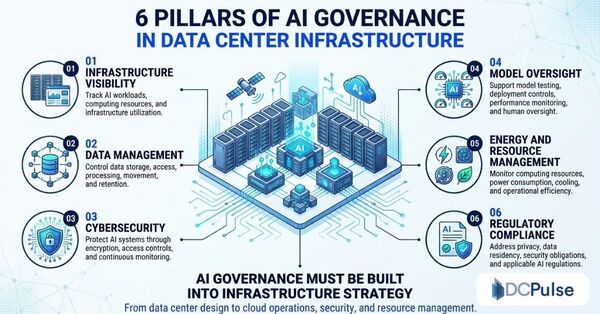
A practical governance framework should address several areas:
-
Infrastructure visibility: Maintaining an understanding of where AI workloads operate and which computing resources they consume.
-
Data management: Establishing controls for data storage, processing, movement, retention, and access.
-
Security management: Applying consistent identity controls, encryption, network protection, and monitoring.
-
Model oversight: Supporting appropriate testing, deployment controls, performance monitoring, and human intervention.
-
Operational accountability: Defining responsibilities for infrastructure providers, AI developers, customers, and service operators.
-
Regulatory alignment: Considering applicable privacy, cybersecurity, and AI-related requirements during infrastructure planning.
These measures should be integrated into existing infrastructure management processes rather than treated as separate administrative activities.
AI Governance Will Influence Future Infrastructure Investment
The growing importance of AI governance could influence how organizations evaluate future investments in data centers, cloud infrastructure, and digital platforms.
Computing performance and facility capacity will remain important considerations. However, enterprises also need infrastructure that can support secure data handling, operational transparency, workload control, and regulatory requirements.
For data center developers, this creates an opportunity to incorporate governance-related capabilities into facility and service design. Cloud providers can strengthen their offerings through improved visibility, security controls, and workload management capabilities. Enterprise customers can benefit from infrastructure environments that make AI systems easier to monitor and manage.
The long-term direction of AI infrastructure will depend not only on the availability of advanced computing resources but also on the ability to operate those resources responsibly.
AI governance is therefore becoming an infrastructure strategy rather than an isolated corporate policy function. Its integration into data center design, cloud architecture, cybersecurity, energy management, and operational planning will be important as AI becomes more deeply embedded in the global digital economy.