DCPulse
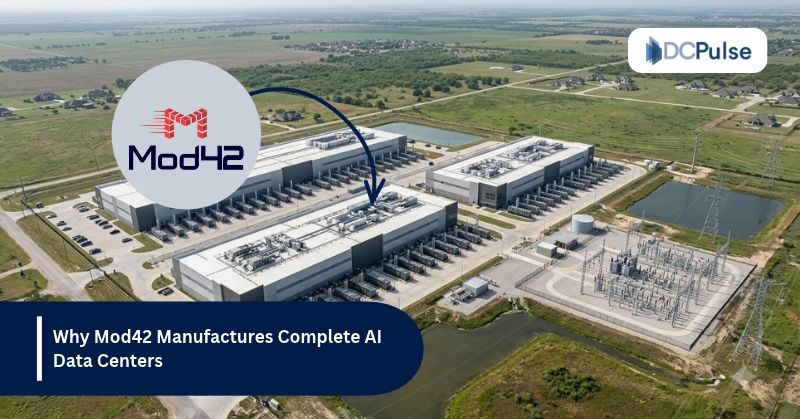
The growing demand for artificial intelligence infrastructure is putting pressure on traditional data center development models. Hyperscale operators, cloud providers, and AI companies are seeking additional computing capacity, but conventional construction timelines, skilled labor shortages, equipment availability, and power infrastructure constraints can complicate deployment. As a result, manufacturers and infrastructure developers are exploring alternative approaches to delivering data center capacity.
One company pursuing this shift is Mod42. The company is positioning modular construction as a manufacturing-led approach to building complete data center facilities rather than simply placing IT equipment inside converted shipping containers. Its model uses volumetric modular construction, in which purpose-built sections of a data center are manufactured off-site and transported to the deployment location for assembly.
The distinction reflects a broader change in how digital infrastructure can be developed. Instead of treating modularity as a way to package individual systems, Mod42 is applying manufacturing principles to the entire facility, including its structural, electrical, mechanical, cooling, and protection systems.
For the AI infrastructure market, this approach raises an important question: Can manufacturing-led construction deliver the speed and repeatability required by modern AI workloads while retaining the characteristics of permanent, operational data center buildings?
Moving Beyond Container-Based Data Center Designs
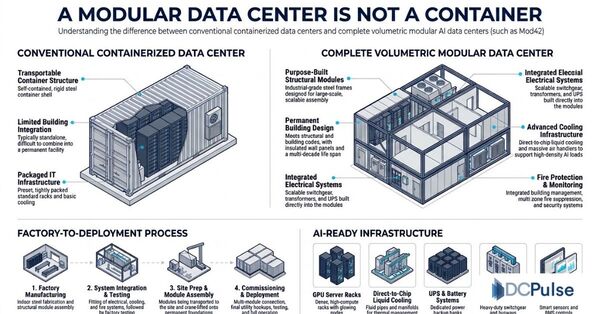
Containerized data centers have played an important role in modular infrastructure development. Their standardized enclosures offer a practical way to deploy computing, power, and cooling equipment in locations where conventional construction may be difficult or time-consuming. However, a container is only one possible format within the wider modular construction category.
Mod42 takes a different approach through volumetric modular construction. Rather than adapting a shipping container to accommodate data center equipment, the company manufactures complete building sections specifically designed for data center applications.
These modules use structural steel frames and insulated walls and roofs, with integrated building infrastructure. The platform incorporates electrical distribution, mechanical systems, cooling, fire protection, and monitoring capabilities. The completed modules are assembled into a permanent facility at the deployment site.
This distinction is significant for operators planning long-term infrastructure investments. Permanent data centers must accommodate maintenance activities, structural requirements, equipment replacement, operational safety, future expansion, and evolving technology requirements. A purpose-built modular building can be designed around these requirements rather than being constrained by the dimensions and structural characteristics of a transportation container.
Mod42's approach therefore places the emphasis on manufacturing the building itself, not simply prefabricating equipment packages.
Factory Manufacturing Changes the Construction Sequence
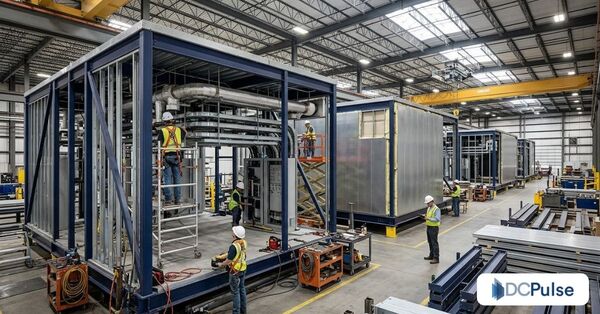
The central proposition behind Mod42's model is that deployment speed comes from manufacturing and parallel execution rather than the physical size or shape of a module.
Conventional data center development frequently involves multiple sequential activities. Site preparation, foundations, building construction, mechanical and electrical installation, equipment integration, and commissioning must be coordinated before a facility can become operational.
A manufacturing-led approach changes how these activities are organized.
While civil works, foundations, and utility infrastructure are progressing at the deployment site, building modules and integrated systems can be manufactured and tested in a controlled factory environment. Both workstreams can therefore advance simultaneously rather than waiting for the completion of one phase before starting another.
This approach can reduce the amount of construction and equipment integration required at the final location. Factory production also creates opportunities for standardized quality checks, repeatable installation procedures, and more consistent coordination between engineering and fabrication teams.
Mod42 states that more than 90% of construction takes place in a controlled manufacturing environment and promotes deployments in less than seven months. These are company-stated delivery targets, not a guarantee that every project will meet the same schedule. Land readiness, permitting, utility interconnection, transportation, and commissioning remain important factors affecting actual deployment timelines.
AI Workloads Are Changing Infrastructure Requirements
The expansion of generative AI, large language models, and high-performance computing is changing the technical requirements of data center facilities. Modern AI deployments increasingly depend on high-density computing environments, advanced power distribution, and sophisticated thermal management systems.
These requirements make flexibility an important consideration in modular infrastructure design. A facility designed around one generation of server hardware may face limitations as GPU architectures, rack configurations, and cooling technologies evolve.
Mod42 describes its platform as AI-native and technology-agnostic, with configurations intended to accommodate changing compute requirements. Its published platform specifications include support for direct-to-chip liquid cooling, chilled-water systems, and hybrid cooling strategies.
The ability to integrate different cooling approaches is particularly relevant to AI infrastructure. High-density GPU deployments can create thermal loads that require more advanced cooling arrangements than conventional air-cooled server environments. Liquid cooling systems, including direct-to-chip solutions, are increasingly important considerations for facilities designed to support these workloads.
Power architecture is another critical component. Mod42's platform is designed to accommodate different utility connections, UPS configurations, battery systems, generators, and electrical distribution strategies according to project requirements.
For data center operators, the advantage of this configurability is the potential to align facility infrastructure with the specific computing hardware and operational model being deployed. However, actual performance will depend on engineering design, equipment selection, site conditions, and the electrical capacity available at each location.
Standardization Could Support Larger AI Infrastructure Deployments
Beyond individual facilities, manufacturing-led modular construction could influence how operators approach large-scale AI campus development.
Traditional data center projects often require substantial engineering and coordination for each new development. Although designs may share common elements, differences in site conditions, building layouts, power infrastructure, and cooling requirements can introduce additional complexity.
Mod42's strategy is based on a standardized modular platform that can be configured for different deployment requirements. Its published capacity range extends from 5 MW to 1 GW, with modular building blocks intended to support smaller AI and inference deployments as well as larger AI factory campuses.
The concept is based on repeating standardized designs instead of engineering every facility independently. This could help manufacturers establish more predictable production processes, coordinate procurement, and reduce repeated design work.
For hyperscale operators, repeatability may be particularly valuable when capacity must be added across multiple locations. Standardized building systems could simplify engineering coordination and make phased expansion easier to plan.
Nevertheless, scaling factory production to gigawatt-level deployments involves more than manufacturing capacity. Power availability, grid connections, land acquisition, equipment supply chains, logistics, and regulatory approvals remain fundamental requirements. Modular construction can address parts of the development process, but it cannot independently resolve these external infrastructure constraints.
Factory Integration and Infrastructure Quality
Quality control is another important consideration in the shift towards manufacturing-based data center construction.
Traditional on-site construction involves multiple contractors installing and integrating different building systems. The coordination of electrical distribution, cooling equipment, fire protection, monitoring, and structural components can create challenges, particularly when several activities occur simultaneously.
Factory integration offers an opportunity to bring these systems together under controlled production conditions. Components can be installed, inspected, and tested before transportation, potentially reducing the amount of field integration required after delivery.
Mod42's platform describes integrated electrical, mechanical, cooling, monitoring, and fire protection systems as part of its complete-building approach. It also identifies compatibility with data center infrastructure management (DCIM) and supervisory control and data acquisition (SCADA) systems.
For operators, these capabilities are relevant because a data center is not simply a building containing computing equipment. It is a coordinated environment in which power, cooling, monitoring, and safety systems must operate together to support continuous workloads.
However, factory testing does not eliminate the need for site-level acceptance testing, commissioning, and operational validation. Utility connections, external infrastructure interfaces, and environmental conditions must still be verified before a facility can enter service.
Implications for Data Center Developers and Operators
The manufacturing-led model could offer several advantages for companies facing pressure to bring AI computing capacity online quickly.
For developers, parallel factory production and site preparation may provide greater control over construction schedules. For operators, standardized building modules could support phased capacity expansion without requiring every additional facility to begin with an entirely new construction process.
The approach may also influence site development. Mod42 highlights reduced land disturbance, smaller infrastructure footprints and lower on-site construction requirements as potential benefits of its platform. The company reports targets of up to 40% lower capital expenditure and 80% less land disturbance compared with traditional development approaches. These figures represent company-reported performance claims and should be evaluated against individual project designs and comparable construction methods.
Geographical flexibility is another consideration. Factory-built facilities could potentially serve greenfield campuses, existing properties and locations where conventional construction presents logistical challenges. Nevertheless, transportation limitations, local building codes, permitting requirements and access to sufficient electrical power will influence where the approach is commercially practical.
Manufacturing Could Become a Bigger Part of AI Infrastructure Development
The distinction between containerized infrastructure and complete modular buildings highlights a broader evolution in data center construction. As AI computing requirements expand, infrastructure providers are increasingly examining ways to make facility development more standardized, repeatable and less dependent on sequential on-site construction.
Mod42's strategy reflects this transition by treating the data center as a manufactured infrastructure product rather than a conventional building assembled entirely at the deployment site. Its emphasis on complete volumetric buildings, integrated infrastructure systems and parallel production is designed to address some of the delivery challenges facing AI infrastructure developers.
The longer-term significance will depend on how effectively this model performs across different power environments, site conditions, cooling requirements and operational demands. Manufacturing capacity must also keep pace with the equipment and supply chains required for large-scale deployments.
For the wider data center industry, the opportunity extends beyond faster construction. Manufacturing-led development could change how facilities are designed, replicated and expanded as AI workloads continue to reshape digital infrastructure demand.