DCPulse

Miami's position as a connectivity gateway between North America, Latin America, and the Caribbean makes it an important location for businesses seeking regional network access and digital infrastructure. However, companies looking to place a handful of servers in a professional data center can face a different set of economic considerations from those encountered by hyperscale cloud providers and large enterprise customers.
The central challenge is not simply the price of rack space. Colocation pricing can depend on committed power capacity, network connectivity, installation fees, technical support, contract duration, and the amount of infrastructure a customer actually needs. For a small business with limited hardware and predictable computing requirements, these components can make a seemingly attractive quotation considerably more expensive than expected.
Miami's connectivity ecosystem offers genuine advantages. Facilities operated by companies such as Equinix provide access to networks, cloud connectivity, and subsea cable infrastructure serving international markets. Those capabilities can be valuable for financial services, telecommunications, content delivery, and businesses operating across the Americas.
Yet the commercial model that supports large-scale infrastructure is not always the most economical choice for a company requiring one server, a few rack units, or a modest private cabinet.
Why Hyperscale Economics Do Not Always Work for Small Customers

Hyperscale data center development is built around large amounts of computing capacity, substantial power requirements, and infrastructure designed to support extensive deployments. Large customers may negotiate customized commercial agreements based on capacity commitments, deployment schedules, and longer-term requirements.
Small businesses generally have different needs. A software company might require a few servers for production applications, while a regional service provider could need a compact deployment to improve latency for customers in the Caribbean or Latin America.
These customers may not have sufficient demand to justify wholesale capacity commitments or large multi-year contracts. They still need reliable power, physical security, cooling, connectivity, and technical support, but their smaller deployments spread fixed operational costs across less infrastructure.
Retail colocation addresses this gap by offering smaller allocations of space and power. However, retail pricing is not always directly comparable with wholesale pricing because the services included, power allowances, connectivity arrangements, and support commitments can differ.
For smaller companies, the relevant question is therefore not whether a hyperscale facility offers a low headline rate. It is whether the complete service package matches the company's technical requirements and budget.
The Hidden Cost of Power Commitments
Power is one of the most important components of a colocation quotation. Depending on the provider, electricity-related charges may be bundled into a recurring fee, calculated from actual consumption, or based on the capacity of a dedicated electrical circuit.
These arrangements can produce substantially different costs for customers with similar equipment.
A business operating one or two conventional servers might consume considerably less electricity than the capacity reserved for its installation. If the contract charges according to the allocated circuit rather than actual consumption, unused capacity can still contribute to the monthly bill.
Additional questions concern redundant power feeds, maximum supported rack density, and charges for exceeding an agreed power allocation. A customer comparing quotations without understanding these details may underestimate the true cost of operating its equipment.
For small businesses, a useful comparison should identify the contracted power capacity, expected consumption, billing method, redundancy arrangements, and any additional charges. High-density AI deployments have different requirements from conventional business applications, so paying for infrastructure designed around workloads the customer does not operate may offer little practical benefit.
Connectivity Can Turn a Low Rack Price Into an Expensive Contract
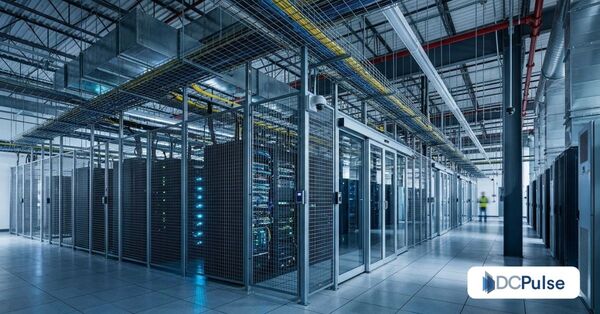
Miami's network infrastructure is one of its strongest attractions for organizations that require international connectivity. Equinix identifies its Miami facilities as an interconnection point for businesses connecting with Latin America through subsea cable systems, networks, and cloud services.
However, access to a well-connected building does not mean every network service is included in the colocation fee.
Cross-connects, internet transit, dedicated bandwidth, cloud connections, and additional carrier services may carry separate charges. Installation fees can also apply when a new physical connection is required.
A company that initially needs one internet connection might later require separate network paths for redundancy, private connectivity to a business partner, or access to a cloud platform. Each additional requirement can change the economics of the deployment.
Bandwidth pricing introduces another consideration. Some providers offer a fixed port with an agreed transfer allowance, while others use different models for unmetered connectivity or traffic-based billing. The suitability of each arrangement depends on traffic volume, burst patterns, and service-level requirements.
Small businesses should therefore evaluate the complete network package rather than selecting a facility based solely on its rack-space price. A more expensive location may be justified when it provides essential interconnection options, but those benefits need to be weighed against the actual requirements of the workload.
Remote Hands and Support Add to the Total Cost
Physical infrastructure requires maintenance even when most business operations are managed remotely. Replacing failed hardware, checking cabling, installing equipment, and troubleshooting physical connections can require assistance from technicians working inside the data center.
These services are commonly described as remote hands or smart hands. Their commercial terms can vary, including hourly rates, minimum billing increments, after-hours charges, and the number of support hours included in a contract.
For a small business without employees near Miami, technician availability can be particularly important. A server failure may require physical intervention even when remote monitoring and management tools are available.
A low monthly colocation fee can become less attractive if every hardware change or troubleshooting request generates a separate service charge. Conversely, a provider that includes a suitable allowance of technical support may offer better overall value despite a higher headline price.
Contract negotiations should establish which activities are included, how emergency requests are billed, and whether the facility can support equipment installation, replacement, and shipping requirements.
Contract Flexibility Matters as Much as the Monthly Rate
Small businesses rarely have the same infrastructure planning horizon as major hyperscale operators. Their workloads can expand gradually, technology requirements can change, and revenue may not grow at the same pace as computing demand.
A long-term contract can offer commercial advantages, but it may also introduce risks when a company commits to more power or space than it needs. Early termination provisions, annual price increases, minimum commitments, and expansion conditions can affect the total cost over the contract period.
Businesses should also consider whether they can add rack units, increase power capacity, or introduce additional network connections without relocating their equipment.
Miami's colocation market includes different facility types and service models, so contract flexibility and the ability to scale should be evaluated alongside location and connectivity.
A smaller initial deployment with clearly defined expansion options may be more appropriate for a growing company than an agreement built around capacity it does not yet require.
Retail Colocation Offers an Alternative to Wholesale Capacity
Retail colocation can provide a more practical entry point for organizations that need physical infrastructure without leasing a large amount of data center capacity.
Published Miami-area offers illustrate the range of available service models. For example, Capa7 advertises individual server colocation capa7 with specified power, connectivity, and support arrangements, while Air Link Communications lists smaller rack-space and power options at a Miami facility. These are examples of provider-specific offers, not universal market prices or guarantees of availability.
The distinction matters because retail packages vary. A low-priced server slot may have limited power or bandwidth, while a more comprehensive package may include redundant power, network capacity, and management features.
Small businesses should compare equivalent specifications and ask providers to itemize recurring and one-time charges. A fair comparison includes rack space, usable power, connectivity, setup, remote hands, support, and contract terms.
Some workloads may also be better suited to public cloud, managed hosting, or dedicated servers. Colocation becomes more compelling when an organization needs control over its own hardware, specialized equipment, predictable infrastructure access, or a particular network environment.
What Miami Colocation Providers Need to Address
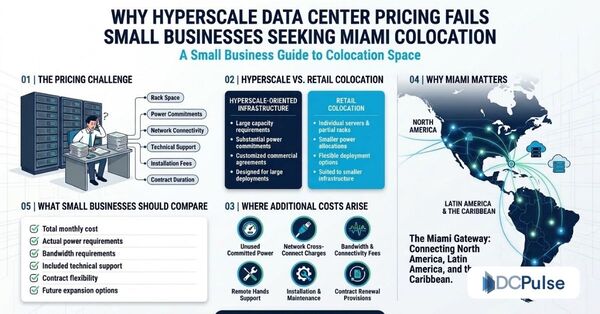
The opportunity for providers is not limited to competing on the lowest advertised price. Smaller customers need transparent packages, understandable power billing, flexible deployment options, and clear explanations of which network and support services are included.
Standardized pricing for single servers, partial cabinets, and modest power allocations can help customers evaluate options more efficiently. Clear information about installation fees, bandwidth allowances, cross-connects, support rates, and renewal terms can also reduce uncertainty during procurement.
For businesses operating across the Americas, Miami's connectivity advantages may justify paying a premium when those connections directly support customer experience or business operations. For organizations with less demanding network requirements, a simpler retail service or an alternative location may provide better value.
The Bottom Line
Hyperscale data center pricing can fail small businesses when commercial arrangements prioritize large capacity commitments over the flexibility and service mix that smaller deployments require. In Miami, the challenge is particularly relevant because connectivity-rich facilities can offer substantial strategic value while also presenting additional costs for power, networking, and technical support.
The most effective purchasing decision starts with a detailed assessment of workload requirements, not a headline rack rate. By comparing complete service costs, contract flexibility, connectivity needs, and support arrangements, small businesses can identify colocation options that fit both their operational priorities and their budgets.