DCPulse
Canada’s data center sector is navigating a period of changing infrastructure requirements as enterprises expand their cloud environments, artificial intelligence (AI) applications increase computing demands, and connectivity becomes more central to digital business operations. Within this environment, the role of colocation providers extends beyond housing servers to delivering the network access, infrastructure resilience, and interconnection capabilities that organizations need to operate digital services.
Andy Fenton, Vice President of Sales and Marketing at Telehouse Canada, works at the intersection of customer requirements, commercial strategy, and digital infrastructure. His professional background spans telecommunications and data center services, giving him experience across the connectivity ecosystem that underpins enterprise IT and cloud adoption. Telehouse Canada lists Fenton among its senior management team, where he leads the company's sales and marketing function.
His role provides a useful perspective on how data center operators position their infrastructure in a market where customers must consider connectivity, power, resilience, and the changing technical demands of their workloads.
From Telecommunications to Colocation Infrastructure
Fenton's career has included senior commercial responsibilities across telecommunications and data center businesses. According to his published professional profile, he previously held positions at PSINet and Bell Canada before spending 14 years at Cogeco, where he led carrier and strategic accounts. His experience includes working with telecommunications and technology organizations across enterprise and carrier markets.
That background reflects the close relationship between telecommunications networks and modern data centre infrastructure. Enterprise applications, cloud platforms, and digital services depend on the physical facilities that house computing equipment, but their performance also relies on reliable connections between networks, service providers, and end users.
For data center customers, these requirements increasingly overlap. An organization evaluating colocation must consider not only the facility itself but also how easily it can connect to cloud providers, telecommunications carriers, business partners, and other infrastructure locations.
Fenton's commercial role at Telehouse Canada sits within this broader market. Sales and marketing teams must understand the technical and operational requirements behind customer decisions, particularly when organizations are selecting infrastructure intended to support critical business applications over extended periods.
Telehouse Canada's Position in Toronto
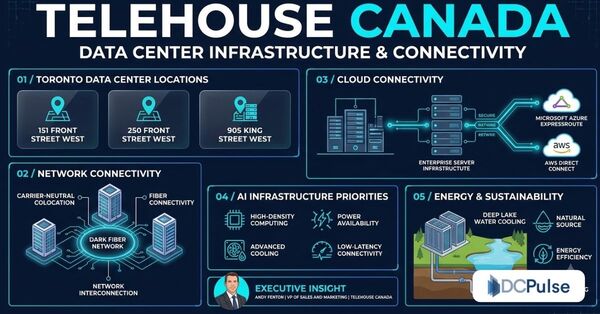
Telehouse Canada operates three data centers in downtown Toronto at 151 Front Street West, 250 Front Street West, and 905 King Street West. The company connects these facilities through a dark fiber network, creating an interconnected environment for colocation customers and network providers.
Toronto's concentration of telecommunications networks, enterprises, and digital services makes connectivity an important consideration for organizations deploying infrastructure in the city. Telehouse Canada provides carrier-neutral colocation, allowing customers to access multiple network providers rather than relying on a single telecommunications operator.
The company's facilities also provide access to the Toronto Internet Exchange (TorIX) and established connections to cloud services, including Microsoft Azure ExpressRoute and Amazon Web Services Direct Connect. These options are relevant to enterprises operating hybrid IT environments in which workloads and data move between private infrastructure, colocation facilities, and public cloud platforms.
For customers, the value of this arrangement lies in the ability to establish direct network connections within a shared infrastructure environment. Such interconnection can simplify network architecture, provide additional routing options, and support communication between applications, cloud services, and business partners.
The commercial challenge for an operator is to communicate these technical advantages in terms that reflect customers' operational priorities. Network diversity, access to cloud platforms, and the ability to connect with other organizations can influence infrastructure decisions alongside conventional considerations such as facility location, available capacity, and service reliability.
AI Infrastructure Brings New Questions About Power and Connectivity

Artificial intelligence is adding new dimensions to data center planning. Training and inference workloads can impose different demands on power delivery, cooling systems, network capacity, and infrastructure location. For operators and their customers, the challenge is to match facilities to the technical requirements of each workload rather than assume that every application needs the same environment.
Fenton has addressed these issues publicly. In February 2025, he co-authored a Telehouse article on scaling data centers for AI alongside executives from the company's operations in Thailand and France. The article examined how AI deployment is influencing infrastructure design, including the need for high-density computing, adaptable cooling, and direct connectivity to cloud platforms.
The distinction between AI training and inference is particularly important. Training can require substantial computing resources, while inference applications often depend on responsive connections to users, applications, and data sources. Workloads supporting financial services, interactive applications, or real-time decision-making may therefore have different location and connectivity requirements from large-scale model training.
These differences have commercial implications for colocation providers. Customers need to understand the available power capacity, supported rack densities, cooling configurations, and network options before committing workloads to a facility. Infrastructure roadmaps must also account for how quickly those requirements may change.
For Fenton's sales and marketing function, these developments make technical understanding an increasingly important part of customer engagement. Infrastructure decisions involve longer-term operational considerations, and customers need clear information about what a facility can support today and what upgrades may be possible in the future.
The broader industry question is whether existing data center infrastructure can accommodate new AI workloads without compromising reliability, efficiency, or connectivity. The answer depends on individual facilities, their power and cooling capabilities, and the requirements of the applications being deployed.
Energy Availability and Sustainable Data Centre Growth
Power availability has become another central issue for Canada's digital infrastructure sector. Ontario's expanding interest in AI computing creates opportunities for data center investment, but it also raises questions about electricity demand, grid capacity, infrastructure planning, and the environmental effects of additional consumption.
Fenton participated in the Future of Data Centres in the Greater Toronto and Hamilton Area and Ontario workshop, hosted by MaRS and Mantle Climate. A March 2026 update published by Telehouse Canada described the workshop's focus on balancing AI infrastructure growth with the province's energy requirements. The discussions considered approaches including energy storage, demand response, clean power purchase agreements, waste heat recovery, and on-site generation.
The subject matters because data centers operate continuously, while AI expansion can increase demand for both computing equipment and the supporting electrical and cooling infrastructure. New projects consequently require coordination among data center developers, utilities, policymakers, and local communities.
For operators, energy strategy affects more than sustainability reporting. Electricity availability and pricing influence where infrastructure can be deployed, how much capacity can be supported, and whether future expansion is commercially viable. Cooling requirements and energy efficiency also influence operating costs over a facility's lifetime.
Telehouse Canada's Toronto facilities illustrate one approach to managing some of these challenges. The company uses Enwave's Deep Lake Water Cooling system, which draws on cold water from Lake Ontario through Toronto's district cooling infrastructure. Telehouse has described this arrangement as part of its approach to cooling and heat management.
Such systems demonstrate how data center operations can intersect with municipal infrastructure. Their suitability, however, depends on local conditions and the availability of supporting infrastructure; they are not a universal solution for every market.
Fenton's participation in Ontario's energy-planning discussions also highlights the importance of collaboration between the digital infrastructure industry and the wider energy sector. Data center growth depends on more than individual construction projects. It requires coordinated decisions about electricity supply, network infrastructure, permitting, and long-term regional development.
Interconnection as a Commercial Advantage
Connectivity remains a defining feature of Telehouse Canada's operating model. Its three Toronto facilities are linked through dark fiber, while its carrier-neutral environment allows customers to connect with a range of telecommunications and technology providers. The company's service portfolio includes cross-connects, cloud connectivity, and data center interconnection.
These capabilities support several infrastructure strategies. Enterprises can connect private IT environments to cloud platforms, service providers can exchange traffic with network partners, and businesses can establish connections to applications and services hosted by other organizations.
A well-connected facility can also help customers simplify parts of their network architecture. Rather than routing every connection through external networks, customers may be able to establish direct links within the data centre ecosystem. The potential benefits include greater routing flexibility and reduced dependence on indirect network paths, although actual performance depends on the selected services and network design.
For AI applications, this interconnection layer can be particularly relevant. Computing performance alone does not determine the user experience. Data must also move efficiently between storage, processing systems, cloud environments and the applications that consume the results.
Telehouse's published AI infrastructure commentary identifies connectivity as an important consideration when customers evaluate where to deploy workloads. The company's position reflects a broader shift in the market: data centre selection increasingly involves evaluating the surrounding digital ecosystem, not simply comparing buildings or available floor space.
Fenton's commercial responsibilities therefore operate within a market where infrastructure value is closely tied to relationships between customers, network operators and cloud providers.
The Role of Commercial Leadership in Digital Infrastructure
The data centre industry requires coordination between technical capabilities and customer needs. Power capacity, cooling design, redundancy, physical security and network access are engineering considerations, but they also influence commercial decisions about where organizations locate their infrastructure.
Sales and marketing leadership helps translate these capabilities into a clear proposition for enterprises and service providers. Customers must understand the available infrastructure, the connections they can establish and the limitations that could affect future deployment plans.
Fenton's background in telecommunications and carrier relationships is relevant to this intersection. His career has included commercial work across network services and data centre markets, while his current position at Telehouse Canada places him within a business built around colocation and interconnection.
The responsibilities of commercial teams are also evolving alongside customer expectations. Organizations deploying AI or hybrid cloud environments may need more detailed discussions about rack density, power requirements, cooling readiness, network latency and expansion options. These questions require coordination between sales teams, engineers and operations personnel.
For data centre operators, the ability to communicate infrastructure capabilities accurately can help customers make better deployment decisions. It can also establish clearer expectations about what a facility can support and where additional investment may be necessary.
Toronto's Place in Canada's Digital Infrastructure Market
Toronto's concentration of carriers, cloud services, enterprises and internet exchange infrastructure gives the city an important position in Canada's digital connectivity landscape. Telehouse Canada's three facilities provide one example of how colocation infrastructure can bring these networks and services together within a metropolitan market.
The sector's next phase will be shaped by several connected priorities: accommodating AI-related computing requirements, maintaining reliable power supplies, improving energy efficiency and supporting increasingly interconnected cloud environments. These priorities create opportunities for established operators, while also increasing the complexity of infrastructure planning.
Fenton's work at Telehouse Canada offers a commercial perspective on these developments, particularly the relationship between customer requirements and the infrastructure needed to meet them. His public contributions to discussions on AI and energy also reflect the growing importance of collaboration across the data centre, telecommunications and power sectors.
For DC Pulse readers, the central takeaway is that data centre competitiveness increasingly depends on the interaction of several systems. Computing capacity must be supported by suitable power and cooling infrastructure, while reliable connectivity connects that capacity to the organizations and users that depend on it.
As AI and cloud adoption continue to influence enterprise infrastructure decisions, operators that understand these interconnected requirements will be better positioned to assess customer needs and communicate the practical capabilities of their facilities.