DCPulse
Artificial intelligence is reshaping the engineering requirements of modern data centers, creating new demands for power distribution, cooling systems, network connectivity, and operational management. As organizations expand their AI capabilities, developers and operators are reassessing how facilities are designed, constructed, and maintained to support increasingly demanding computing environments. Digital infrastructure engineering must accommodate high-density computing, evolving hardware configurations, and closer integration between electrical, mechanical, and digital systems.
Digital infrastructure planning and integration (DPI) is becoming increasingly important in this environment. By coordinating infrastructure design, equipment deployment, and long-term expansion requirements, DPI can help data center stakeholders manage the complexity of AI infrastructure projects. This approach reflects a broader shift towards integrated facility design, where computing performance, energy efficiency, reliability, and scalability are considered together.
AI Workloads Are Changing Data Centre Engineering Requirements
Traditional data center designs accommodate enterprise applications, cloud services, and general-purpose computing. AI infrastructure introduces different requirements, particularly for facilities hosting large-scale model training, inference workloads, and high-performance computing applications.
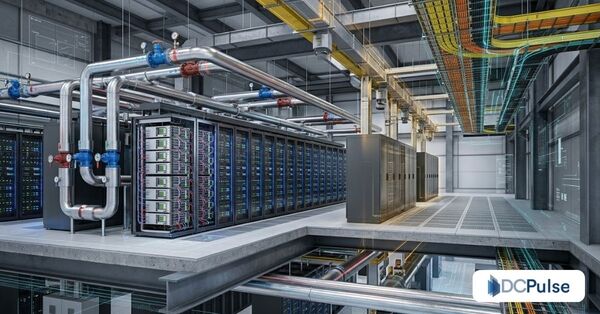
AI accelerators and associated server configurations can create substantial rack-level power and cooling demands. The exact requirements depend on the hardware platform, workload characteristics, and deployment architecture. Consequently, developers must evaluate computing density early in the design process rather than treating it as an operational consideration after construction.
These demands influence rack layouts, floor loading, electrical distribution, cooling capacity, and network architecture. Infrastructure teams must also consider how equipment configurations could change as AI hardware evolves.
DPI can help coordinate these requirements throughout the project lifecycle. Electrical engineers, mechanical specialists, network architects, construction teams, and IT planners need a shared understanding of the intended computing environment. Early coordination can reduce design conflicts and help ensure that individual systems support the facility's overall operational requirements.
Power Infrastructure Becomes a Central Engineering Priority
Power availability remains one of the most important considerations in AI data center development. High-performance computing clusters require dependable electricity supplies, while concentrated computing loads can place significant demands on electrical distribution equipment and facility-level power systems.
Engineering considerations extend beyond securing sufficient utility capacity. Developers must determine how electricity will be distributed throughout a facility, how protection systems will operate, and how redundancy requirements will be addressed. Transformers, switchgear, uninterruptible power supply systems, backup generation, and power distribution units must function as components of an integrated electrical architecture.
A facility may have sufficient overall electrical capacity but still encounter constraints if individual rooms, distribution circuits, or rack connections cannot support the intended equipment configuration. Power planning must therefore remain closely connected to IT deployment schedules.
DPI can align electrical infrastructure design with server specifications, construction phases, and anticipated expansion. This coordination is particularly important for multi-building campuses, where utility connections, electrical equipment installation, and computing capacity additions must progress together.
Energy efficiency also remains a priority. Efficient electrical equipment, improved power management, and coordination between computing loads and facility systems can support better energy performance. Actual results depend on equipment selection, operating conditions, and the wider facility design.
Cooling Systems Adapt to High-Density AI Computing
Cooling requirements are evolving alongside AI hardware. Dense computing configurations can concentrate heat within individual racks, making conventional air-cooling arrangements less suitable for certain deployments.
Liquid cooling is gaining importance in high-density environments because it can transfer heat directly from selected components or computing systems. Technologies include direct-to-chip liquid cooling and rear-door heat exchangers, while air cooling remains relevant for other equipment and lower-density areas. Some facilities may combine multiple approaches to accommodate different thermal requirements.
The engineering challenge involves more than selecting a cooling technology. Designers must evaluate heat loads, coolant distribution, hydraulic requirements, heat rejection, equipment compatibility, leak detection, and maintenance procedures. Cooling infrastructure must also be coordinated with electrical capacity because cooling systems consume power and influence overall facility efficiency.
DPI supports this integration by connecting cooling design with rack layouts, server specifications, and operating requirements. Manufacturers' recommendations concerning coolant conditions and equipment temperatures must inform the design process.
Flexibility is equally important. Future AI hardware generations may introduce different thermal characteristics, potentially requiring expensive modifications in facilities designed around a single configuration. Adaptable cooling infrastructure can help operators accommodate changing requirements when supported by appropriate engineering and investment.
High-Performance Networking Supports AI Infrastructure
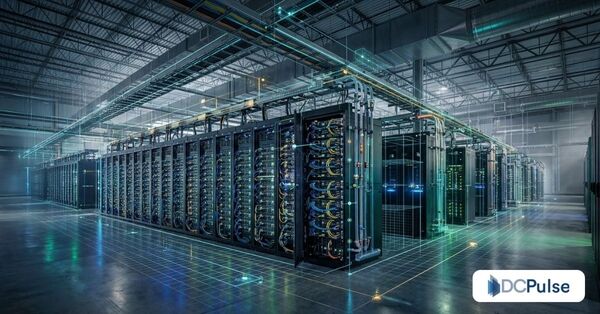
AI infrastructure depends on more than processing power. Distributed training and large-scale inference require networks that move data efficiently between accelerators, storage platforms, and computing resources.
Network performance can influence how effectively an AI cluster uses its available computing capacity. Bandwidth, latency, congestion, and communication patterns are important considerations, particularly when large numbers of accelerators exchange information during distributed processing.
These requirements make network architecture an integral part of data center engineering. Fiber routes, cable pathways, switch locations, equipment space, and power requirements must be considered alongside the computing architecture.
Networking equipment also contributes to facility power consumption and thermal loads. In large AI deployments, these requirements must be integrated into rack planning and cooling design rather than addressed as separate engineering concerns.
DPI can connect network topology decisions with construction documentation, equipment placement, and deployment sequencing. Accurate infrastructure records can also help operators manage upgrades, expand computing clusters, and identify physical dependencies when replacing network equipment.
Digital Engineering Improves Infrastructure Coordination
The complexity of AI data centers is increasing the importance of digital engineering tools. Building information modelling, computer-aided design, digital asset registers, and monitoring systems can help teams coordinate infrastructure and maintain accurate information throughout a facility's lifecycle.
Coordinated digital models can help engineers identify spatial conflicts, review equipment interfaces, and evaluate maintenance access before installation. These capabilities are particularly valuable where dense rack configurations leave limited room for cable pathways, piping, electrical distribution equipment, and service clearances.
During operations, accurate asset information can support maintenance planning, capacity management, and infrastructure changes. Monitoring systems provide information about electrical loads, thermal conditions, cooling performance, and equipment status, helping operators identify deviations from expected operating conditions.
The effectiveness of these tools depends on data quality, interoperability, and consistent updates. Digital models that no longer reflect actual site conditions may offer limited operational value.
DPI therefore requires more than adopting new software. Engineering teams need consistent data standards and clear responsibility for infrastructure information and processes for updating records when facility configurations change.
Sustainability and Reliability Remain Essential
AI expansion is increasing attention on the relationship between computing capacity, energy consumption, and environmental performance. Electricity demand, cooling requirements, and equipment utilization all influence the operational footprint of data centers.
Engineering teams can address these considerations through efficient electrical systems, appropriate cooling designs, improved thermal management, and effective monitoring. Renewable electricity procurement and low-carbon energy strategies can also contribute to sustainability objectives where suitable resources and arrangements are available.
Water use requires careful evaluation when selecting cooling technologies. Environmental impacts depend on system design, local climate, operating conditions, and water-management requirements. No single cooling approach provides the best outcome for every facility.
Reliability must remain equally important. AI facilities supporting critical applications require appropriate redundancy, fault isolation, maintenance access, and recovery procedures. Infrastructure failures can affect interconnected computing resources and the applications that depend on them.
An integrated engineering approach helps developers evaluate these considerations together rather than optimizing computing density, cooling performance, or energy efficiency independently.
The Future of DPI in AI Data Centre Deployments
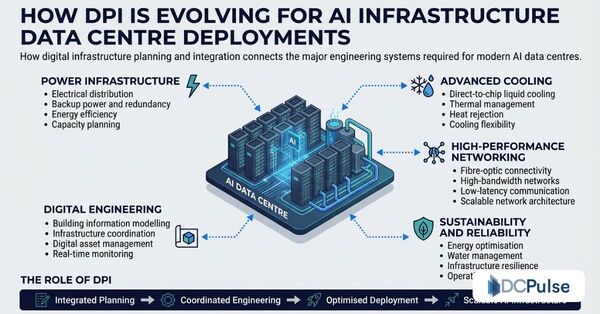
The evolution of DPI reflects the changing role of data centres in the digital economy. As AI workloads become more demanding, successful deployments increasingly depend on coordination between power systems, cooling infrastructure, networking, physical construction and digital operations.
Developers must establish realistic infrastructure requirements early, validate equipment assumptions and maintain flexibility throughout the project lifecycle. Operators, meanwhile, need accurate capacity planning, effective monitoring, maintainable systems and the ability to accommodate changing hardware configurations.
DPI is not a single technology or a universally standardised engineering method. It represents an integrated approach to planning and coordinating the systems that make advanced computing infrastructure possible. Its value lies in connecting design decisions with practical deployment and operational requirements.
As AI infrastructure continues to evolve, data centre engineering will need to balance computing density with electrical capacity, thermal performance, network efficiency, reliability and sustainability. Facilities designed around these interconnected requirements will be better positioned to accommodate changing AI workloads while managing the technical and operational challenges of large-scale digital infrastructure.