DCPulse

Artificial intelligence is moving beyond model development and training into everyday applications that generate answers, analyze documents, write code, process images, and support business decisions. Behind these capabilities lies AI inference, the process through which a trained model produces outputs from new inputs. As organizations deploy generative AI across customer services, enterprise software, healthcare, finance, and industrial operations, inference systems are becoming an important part of digital infrastructure.
For data center operators, understanding inference requires more than knowing which processors run an AI model. Performance depends on how computing resources, memory, networking, software, and incoming requests work together. Concepts such as latency, throughput, batching, and memory bandwidth help explain why two deployments running the same model can deliver different user experiences and operating costs.
Understanding AI Inference and How It Works
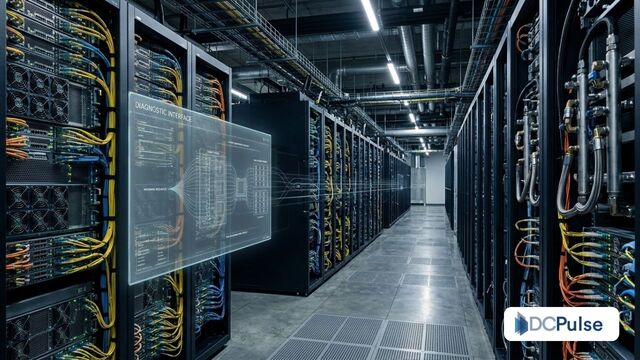
AI inference occurs when a trained machine learning model processes new information and generates a prediction, classification, recommendation, or response. Training establishes a model’s parameters using data and computational resources, while inference applies the resulting model to real-world requests.
Generative AI introduces additional complexity because models often produce outputs incrementally. When a user submits a question to a large language model, the system processes the input and generates a response as a sequence of tokens. A token may represent a word, part of a word, punctuation, or another unit of text.
The inference process commonly involves two phases: prefill and decode. During prefill, the model processes the input prompt and prepares the information needed to generate a response. During decode, it generates output tokens sequentially. These phases place different demands on processors and memory, making inference performance dependent on both the workload and the underlying hardware.
The distinction matters for infrastructure planning. A system that performs well when processing short prompts may behave differently when users submit lengthy documents or maintain extended conversations. Similarly, a deployment designed for offline document processing may prioritize overall processing capacity rather than the immediate response times expected from an interactive chatbot.
The Language of Inference Systems
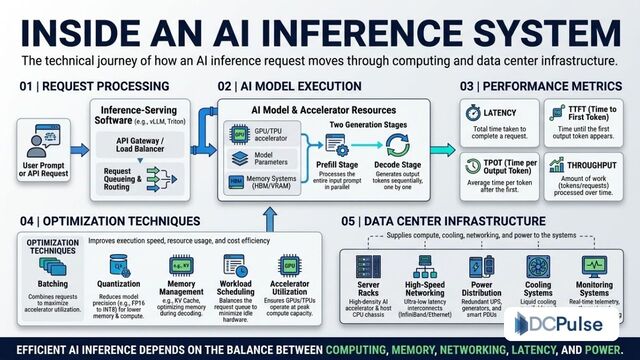
Inference performance is measured through several interconnected metrics. Understanding their meaning helps infrastructure teams assess whether a deployment can meet application requirements.
Latency measures the time required to complete a particular operation or request. For interactive AI applications, lower latency generally improves responsiveness, although acceptable response times depend on the use case.
Time to First Token (TTFT) measures how long a user waits before receiving the first generated token. This metric is especially relevant to conversational AI, where users may perceive a system as slow if the response takes too long to begin.
Time per Output Token (TPOT) measures the time required to generate subsequent tokens after the first token. Together with TTFT and output length, it helps explain the time needed to complete a generated response.
Throughput describes how much work a system processes over a given period. For language models, operators may measure output tokens per second, requests per second, or aggregate tokens processed across multiple concurrent requests.
Batching combines multiple requests or sequences into shared processing operations. Effective batching can improve hardware utilization and throughput, but excessive batching or waiting to accumulate requests can increase response latency.
Quantization reduces the numerical precision used to represent model parameters or other model data. Depending on the model, hardware, and technique, quantization can reduce memory requirements and improve execution efficiency, although accuracy and performance must be evaluated.
These metrics cannot be interpreted independently. High aggregate throughput does not automatically mean that every user receives a fast response. Infrastructure teams must assess performance under realistic workloads, including concurrent users, varying prompt lengths, response sizes, and periods of peak demand.
Why Inference Is Changing Data Center Infrastructure
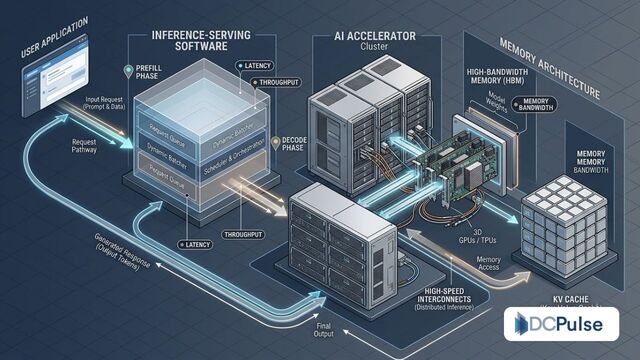
Inference workloads influence how data centers allocate computing capacity and organize supporting infrastructure. AI accelerators, including graphics processing units and other specialized processors, can execute the parallel mathematical operations used by many AI models. However, processing capability alone does not determine system performance.
Memory capacity and bandwidth are equally important considerations. Model parameters and intermediate information must be stored and accessed during inference. Large language models may also maintain a key-value cache, commonly called a KV cache, to retain information needed during token generation. The cache can consume substantial memory as context lengths and concurrent requests increase.
Networking also becomes important when inference is distributed across multiple accelerators or servers. Communication delays and data-transfer requirements can influence the performance of large deployments. Storage and model-loading arrangements matter when systems need to load large models or scale capacity quickly.
Consequently, inference infrastructure cannot be designed around processor specifications alone. Data center operators must consider the combined performance of accelerators, memory, interconnects, storage, software, and workload management.
Latency, Throughput, and the Economics of AI Inference
The economics of AI inference depend on delivering sufficient performance without allocating unnecessary infrastructure. Organizations must balance responsiveness, processing capacity, service reliability, and operating costs.
Low-latency applications may require additional available capacity to handle sudden increases in requests. Keeping more resources ready can improve responsiveness but may leave expensive accelerators underused during quieter periods. Conversely, running infrastructure at very high utilization can increase queueing delays when demand rises unexpectedly.
The most appropriate configuration depends on the application. A real-time voice assistant may prioritize fast initial responses and consistent token generation. An offline document-processing service may accept longer completion times if it can process large volumes of work efficiently.
Benchmarking should therefore reflect actual operating conditions. Relevant measurements include latency percentiles, TTFT, TPOT, output tokens per second, request concurrency, and resource utilization. Percentiles help reveal whether a system occasionally produces very slow responses even when its average performance appears acceptable.
Cost evaluations should also consider the complete deployment, including accelerator capacity, server power consumption, cooling, networking, software, and operational overhead. A configuration that generates more tokens per second may offer better efficiency, but only if it satisfies the required service levels and model-quality expectations.
Cloud, Edge, and Hybrid Inference Architectures
Inference can operate in centralized cloud environments, on edge infrastructure near users or devices, or across a combination of locations.
Cloud-based inference allows organizations to access scalable computing resources without operating every server themselves. Centralized deployments can support shared infrastructure and large models, although application performance may depend on network connectivity, service location, and demand.
Edge inference places computing closer to where data is generated or consumed. This approach can reduce dependence on remote connectivity and support applications with strict response-time or data-locality requirements. However, edge deployments may face limitations in available power, cooling, physical space, and computing capacity.
Hybrid architectures combine these approaches. An organization might process time-sensitive requests locally while routing more demanding tasks to centralized infrastructure. Such arrangements can provide flexibility, but they also introduce challenges involving workload placement, security, orchestration, and consistent performance across locations.
For data center operators, these models create different infrastructure requirements. Centralized facilities may support large-scale inference clusters, while regional and edge facilities can help deliver services closer to application users.
Power, Cooling, and Operational Challenges
Inference places additional demands on data center power and thermal management, particularly when deployments use dense accelerator configurations. Actual requirements vary according to the hardware, model, utilization, workload, and system architecture.
High-density server deployments can increase rack-level power requirements and concentrate heat in smaller areas. Facilities may need to evaluate electrical distribution, cooling capacity, airflow management, and monitoring systems before introducing new AI workloads. Liquid cooling may be appropriate for some high-density configurations, while other deployments can operate with carefully designed air-cooling systems.
Workload variability adds another operational consideration. Inference demand may change throughout the day as users interact with AI applications. Infrastructure must accommodate these changes without compromising reliability or service performance.
Power availability is also important when planning new capacity. Operators need to evaluate whether existing electrical infrastructure can support additional equipment and whether expansion requires new utility connections or facility upgrades.
Energy efficiency should be assessed alongside performance. Measuring power consumption against useful inference output can help operators understand how effectively infrastructure converts electricity into completed work. However, comparisons should use consistent workloads and account for differences in model quality, latency requirements, and hardware configurations.
What Inference Optimization Means for Data Center Operators
Inference optimization combines software, model, and infrastructure decisions to improve performance and resource utilization. The most effective approach begins with understanding the workload rather than selecting hardware based on headline specifications.
Techniques such as continuous batching can help serving systems process incoming requests more efficiently. Quantization can reduce model memory requirements when the resulting quality remains acceptable. Memory-management strategies can improve how systems handle intermediate data, while workload scheduling can distribute requests across available resources.
Model selection is another important factor. A smaller model may be sufficient for a particular task, reducing infrastructure requirements without compromising the application’s objectives. More complex tasks may justify larger models or additional computing resources.
Operators should also monitor performance after deployment. Metrics covering latency, throughput, queue depth, accelerator utilization, memory consumption, and power use can reveal bottlenecks and indicate when capacity adjustments are necessary. Representative testing is essential because results from one model or workload may not transfer directly to another.
Ultimately, optimization requires a balance between application quality, user experience, reliability, and cost. No single metric or technique can determine the best configuration for every inference system.
Conclusion
AI inference is becoming a defining workload for modern digital infrastructure as organizations integrate trained models into products, services, and enterprise operations. Its requirements extend beyond computational power to include memory, networking, workload scheduling, latency management, electricity, and cooling.
Learning the language of inference systems helps data center operators understand these interconnected demands. Metrics such as TTFT, TPOT, throughput, and utilization provide a practical basis for evaluating deployments and identifying bottlenecks.
As AI applications expand, infrastructure decisions will increasingly depend on how efficiently systems serve real-world requests rather than simply how quickly models can be trained. Data centers that align computing architecture, software optimization, and facility capabilities with actual inference workloads will be better positioned to support reliable and efficient AI services.