Pranav Hotkar
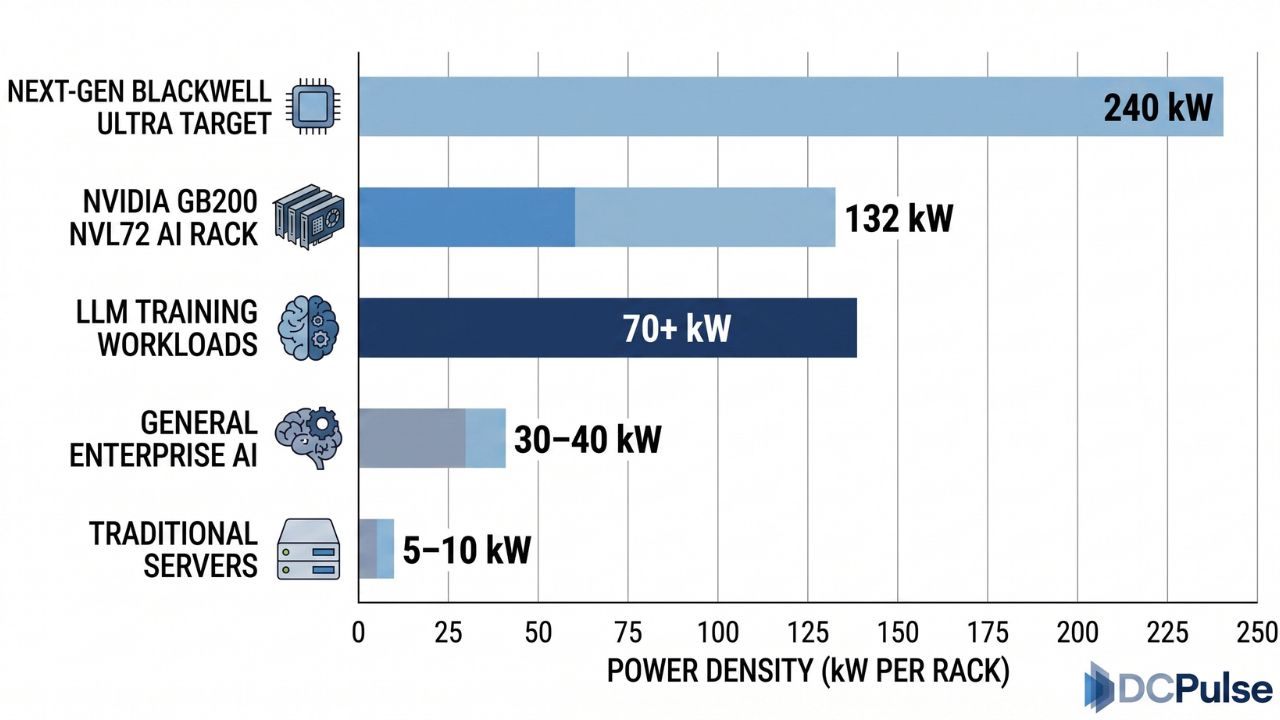
Something fundamental has changed inside the world's data centers, and most people outside the industry haven't noticed yet. The racks that once hummed quietly in the background, drawing a modest 5 to 10 kilowatts each, are being replaced by machines that consume more power than a small office building. A single AI rack running today's most advanced GPUs pulls 132 kilowatts. The next generation targets 250. The one after that, 900. NVIDIA's keynote at OCP 2025 unveiled designs approaching 1 megawatt per rack.
That number changes everything. Not just the cooling. Not just the power infrastructure. The entire logic of how a high-density data center is designed, built, and operated is being rewritten from the ground up, and the industry has never moved faster to keep up.
What Is Actually Happening Inside Data Centers as Rack Densities Climb?
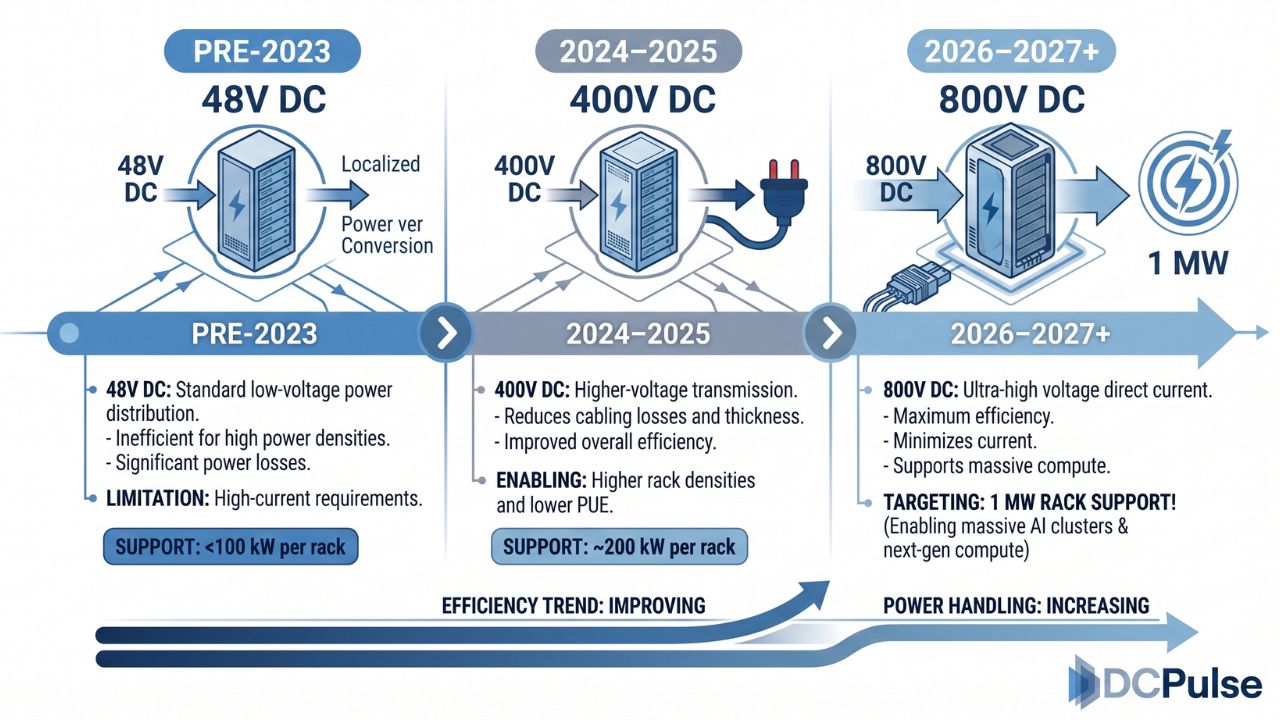
The power distribution architecture has changed; traditional AC systems are being replaced with high-voltage DC at 400V and 800V to reduce conversion losses at extreme densities. And the cooling systems have changed entirely, because air, reliable and inexpensive for decades, has run out of headroom.
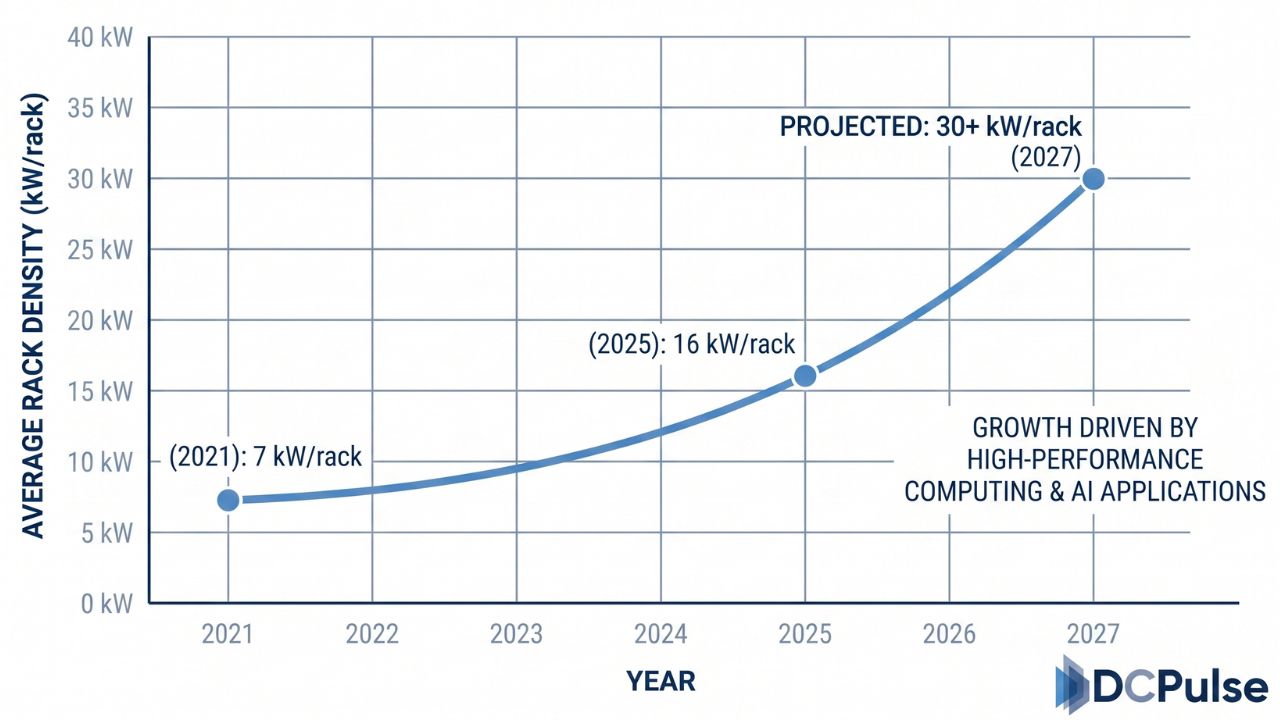
Traditional air-cooling maxes out at around 25 kW per rack, even with hot and cold aisle containment. That ceiling was fine when the average rack density in a data center sat at 7 kW per rack in 2021. By 2025, that average had climbed to 16 kW, and 79% of industry respondents expected it to keep rising, driven by AI and high-performance workloads. But averages tell only part of the story. The AI clusters being deployed right now aren't running at 16 kW. They are running at 132 kW per rack, and the next generation targets 240 kW.
Average Data Center Rack Density Progression (2021-2027)
Design loads above 100-200 kW per rack are now a common request, forcing a rethink of the mechanical and electrical architecture of entire sites. Cooling systems, power distribution, and structural layouts are all being redesigned simultaneously. A cooling failure in a 100-kW rack can lead to hardware damage in seconds, not minutes; the margin for error has effectively disappeared. The high-density data center of 2026 is not a scaled-up version of what came before. It is a fundamentally different facility, being built to an entirely different set of rules.
Rack Power Density Benchmarks by Workload Type
What Technologies Are Being Built to Keep 100 kW Racks, and Beyond, Running?
The engineering response to extreme data center rack density is happening on three fronts simultaneously: cooling, power distribution, and rack architecture. Each one is being redesigned from first principles, not incrementally improved, but fundamentally rebuilt. The innovations emerging from that process are redefining what data center rack-scale infrastructure looks like.
The most significant innovations reshaping high-density deployments right now include:
- Direct-to-chip liquid cooling as the new baseline- by 2026, 38.3% of enterprise data centers expect to employ liquid cooling, up from 20.1% in 2024; for new builds handling high-density workloads, liquid-ready infrastructure has become the default from day one.
- AI server rack cold plates and CDUs- the AI server rack cold plate removes heat directly at the chip die, with Google's Project Deschutes CDU, contributed to the Open Compute Project, designed to support racks scaling from 100 kW up to 1 MW.
- 800V DC power architecture- Schneider Electric abandoned its planned 600V DC system after realizing it could not support the 400 kW requirements of NVIDIA's Vera Rubin Ultra GPUs; the industry is now moving directly to 800V DC, requiring a full redesign of power distribution from utility connection through to individual servers.
- OCP-standard rack systems- Legrand, Schneider Electric, and Vertiv have all launched OCP-compliant rack systems in 2025, centralizing AC-to-DC conversion at the rack level and pushing cabinet capacities toward 300 kW. Source: IoT Analytics, Data Centre World London 2026
- Hybrid cooling architectures- the dominant 2025 design combines 70% liquid cooling and 30% air cooling within a single rack, with the rack itself serving as the integration point between both modalities. Source: Introl, December 2025
Data Center Power Architecture Evolution
The hybrid design is a bridge, not a destination. As AI data center rack power density climbs toward 250 kW and beyond in 2026, liquid cooling is expected to dominate entirely, with air retained only for lower-density zones within the same facility.
Enterprise Data Center Liquid Cooling Adoption (2024-2026)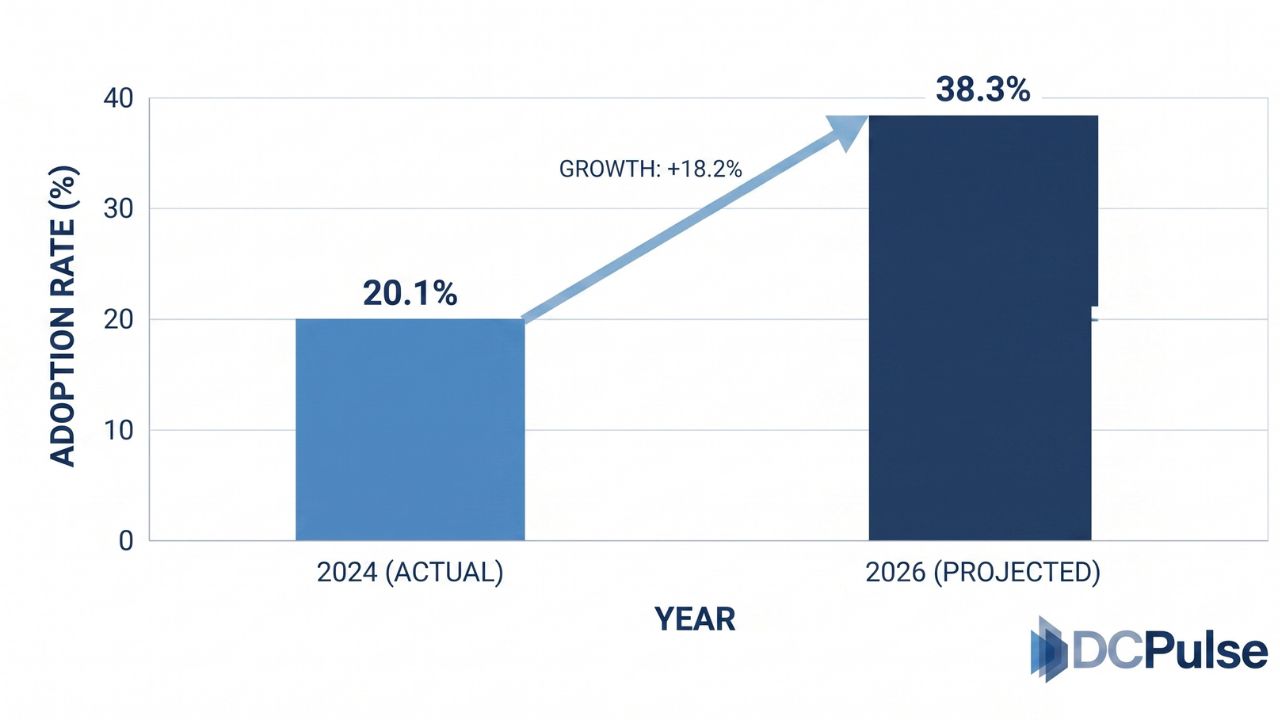
Which Companies Are Setting the Pace for High-Density Data Center Infrastructure?
The moves being made by hyperscalers and infrastructure vendors in 2025 and 2026 are not incremental upgrades. They are architectural declarations, signals that the era of the 1 MW data center rack is no longer theoretical and that the companies shaping it are building well ahead of current demand.
Google has been the most open about its roadmap. At the OCP EMEA Summit in April 2025, Google announced the transition from 48V DC to ±400V DC power delivery, the architecture enabling high-density colocation racks to scale from 100 kW to 1 MW, and contributed its fifth-generation Project Deschutes CDU to the Open Compute Project for industry-wide adoption.
The infrastructure vendor landscape is moving in lockstep. Johnson Controls launched its Silent-Aire CDU platform in September 2025, spanning 500 kW to over 10 MW capacity, with the explicit goal of helping high-density data center operators transition to liquid cooling as rack power climbs. Source: IoT Analytics, Data Center Infrastructure Market Report, November 2025.
The cost reality is equally striking. The average AI data center power density kW per rack has driven AI rack costs to USD 3.9 million per unit in 2025, a sevenfold increase from the USD 500,000 cost of a traditional server rack in a data center just three years ago. At Data Centre World London 2026, data center consultants confirmed they are actively designing 2.2 MW racks for U.S. clients with global deployment ambitions, validating a density roadmap that looked implausible as recently as 2023.
Data Center Infrastructure Inflection: Cost vs. Power Density
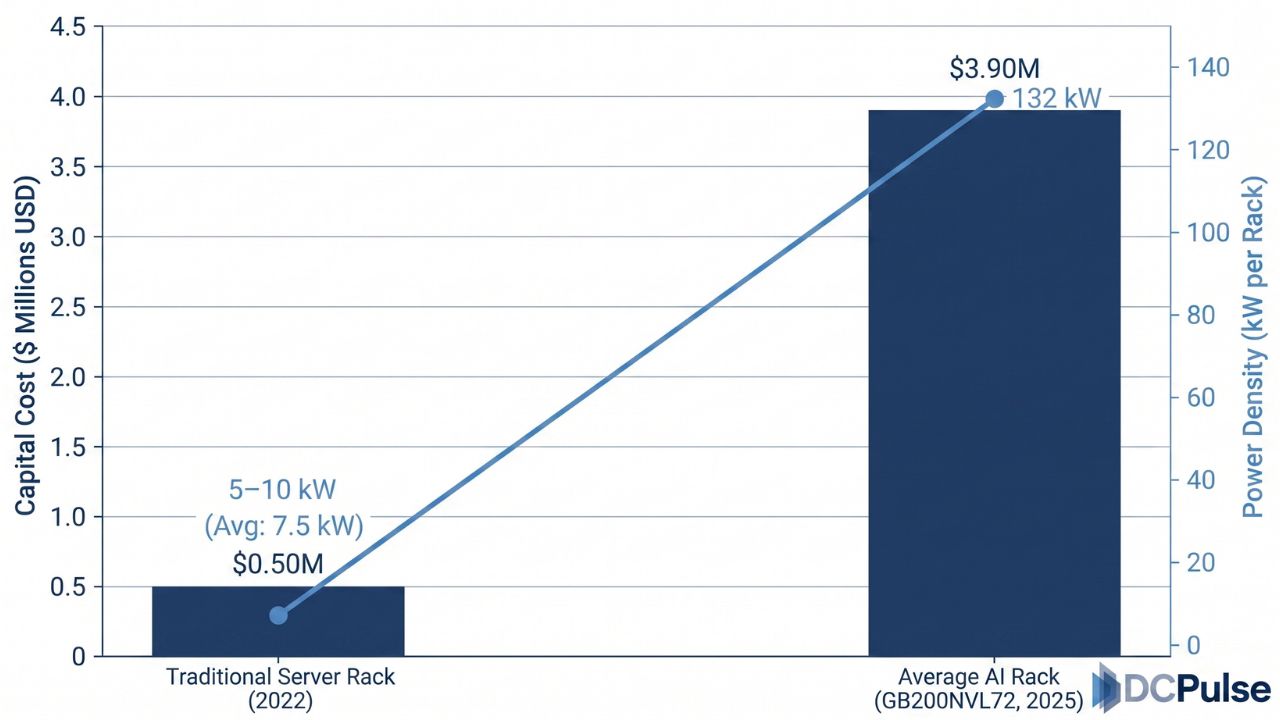
The infrastructure is expensive, the roadmap is aggressive, and the industry is committing to both without hesitation.
What Does the 1 MW Rack Era Mean for the Decade Ahead?
The global data center rack market is projected to grow from USD 5.17 billion in 2025 to USD 9.42 billion by 2030, at a CAGR of 12.7%. However, this number understates the real transformation underway. The market isn't just getting bigger. It is getting denser, hotter, and more expensive to build with every passing year. Data center consultants are already designing 2.2 MW racks for U.S. clients. NVIDIA has racks beyond that on its roadmap. The ceiling keeps moving.
For operators, the strategic decision is no longer whether to upgrade; it is how far ahead to build. Facilities designed for 30 kW per rack today will struggle to host 132 kW AI systems tomorrow. The gap between building for current demand and building for the demand two years out is the difference between leading the market and scrambling to retrofit.
The rack was once the most unremarkable piece of hardware in a data center. Today, it is the thing every infrastructure decision is being built around. That shift, quiet as it was, changes everything.