Pranav Hotkar
Data centres spent decades trying to keep servers as cold as possible. Warm-water cooling is beginning to reverse that logic.
As AI infrastructure pushes rack densities far beyond the limits traditional facilities were designed to handle, hyperscale operators are confronting a growing mechanical reality: aggressively chilled environments consume enormous amounts of energy, add system complexity, and become increasingly inefficient at scale. In many next-generation AI deployments, the challenge is no longer simply removing heat; it is doing so without allowing cooling systems themselves to become a major power burden.
Warm-water cooling is emerging as a response to that pressure. By operating at higher water temperatures than conventional chilled systems, these architectures can reduce or even eliminate dependence on energy-intensive chillers, simplify thermal loops, and improve overall facility efficiency. More importantly, they begin to change how heat itself is viewed inside hyperscale infrastructure.
Instead of treating thermal output purely as waste, operators are increasingly exploring how warm-water systems can support heat recovery, district energy integration, and more sustainable infrastructure economics. The result is a broader shift in data centre design, one where thermodynamics, not just compute density, is starting to define the future of hyperscale efficiency.
Why are traditional cooling systems struggling in the AI era?
The cooling systems that powered the cloud computing era were designed around a fundamentally different thermal environment than the one hyperscalers are now entering. For years, data center efficiency depended on colder air, aggressive chiller usage, and large-scale airflow management built around relatively stable rack densities. AI is beginning to break that model.
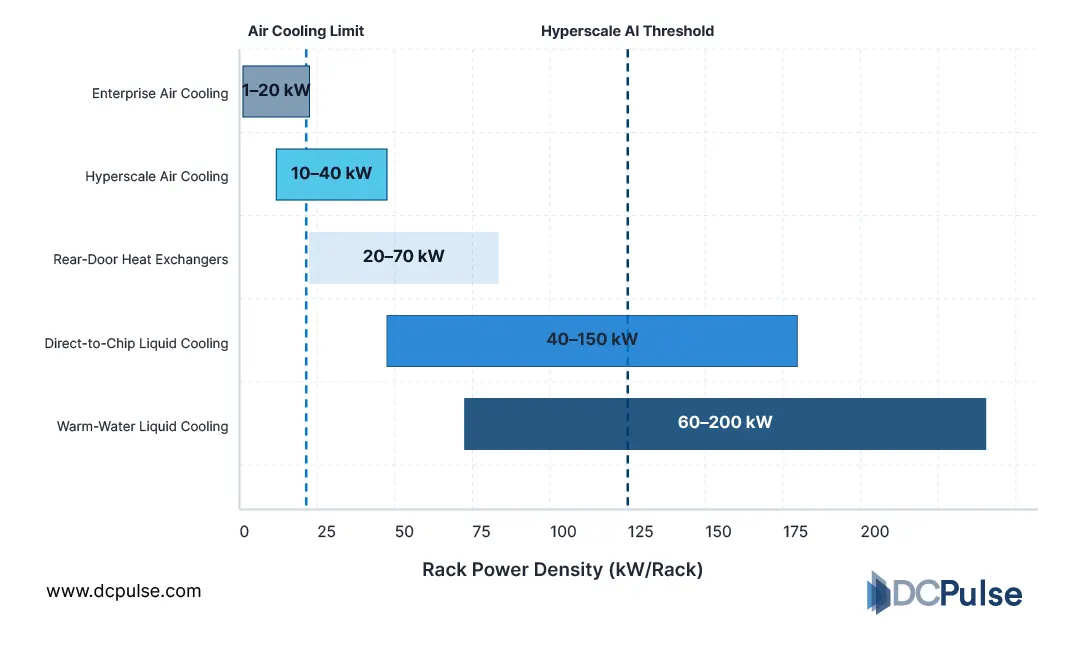
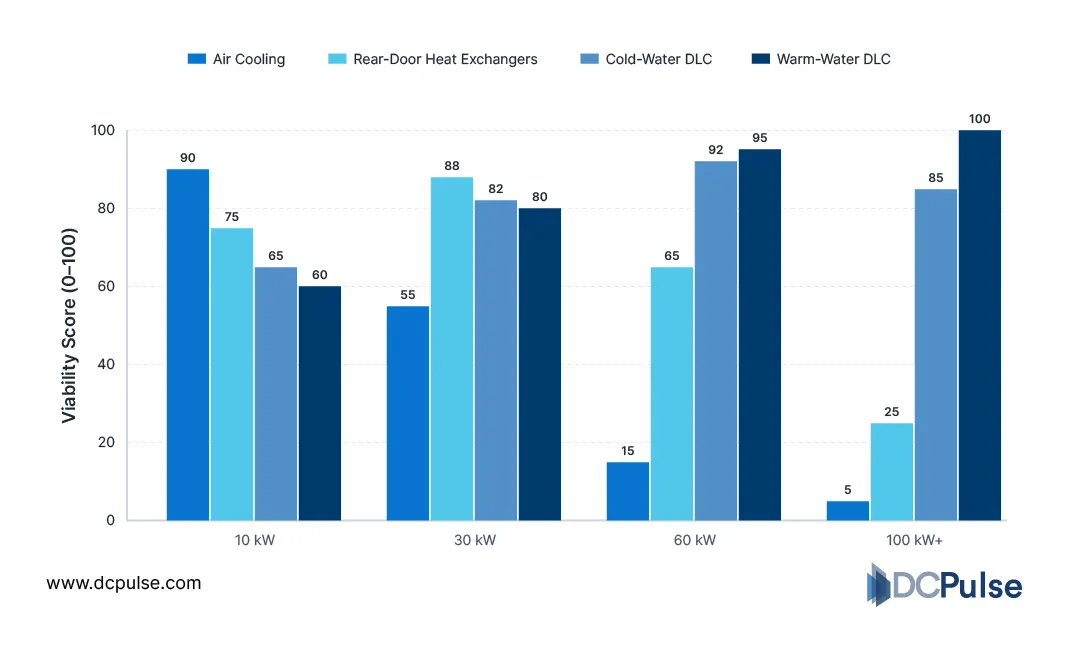
Modern GPU clusters are concentrating unprecedented thermal loads into compact footprints, rapidly pushing rack densities beyond the practical limits of conventional air cooling. NVIDIA notes that while traditional data centers commonly operated around 20 kW per rack, next-generation AI infrastructure is moving toward densities exceeding 100 kW per rack, dramatically increasing the complexity of heat removal.
Cooling Energy Consumption vs Inlet Water Temperature
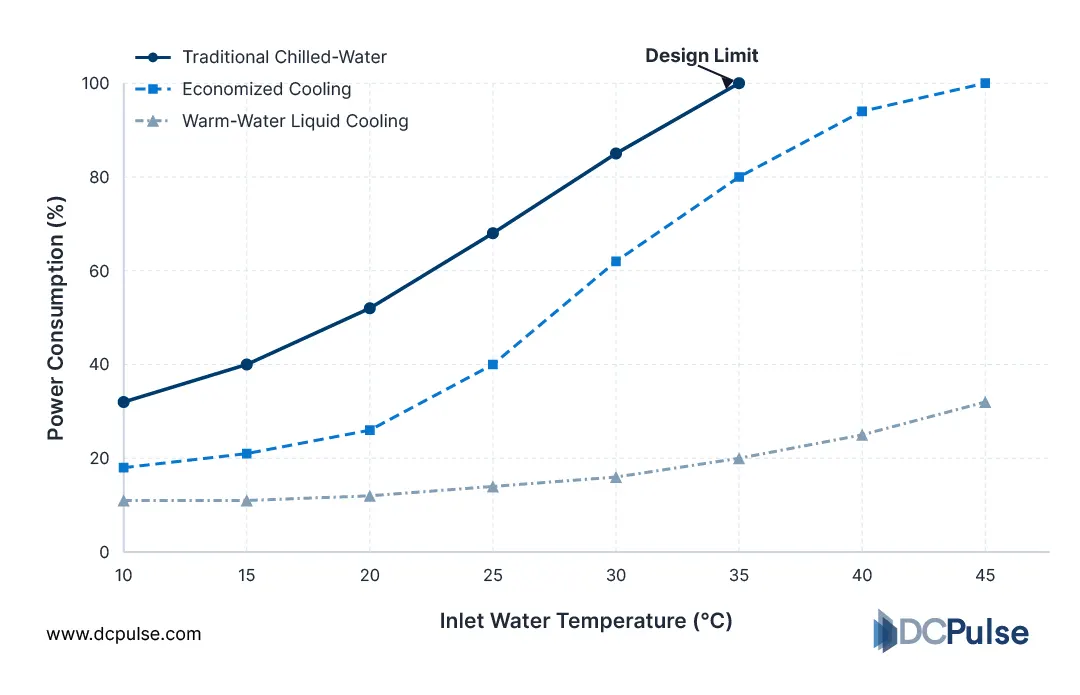
The challenge is no longer only about removing heat; it is about the growing energy penalty required to maintain extremely low operating temperatures at hyperscale. ASHRAE’s Datacom guidelines emphasise that increasing equipment power density is creating major thermal design challenges for modern facilities while encouraging broader operating temperature envelopes to improve energy efficiency.
Warm-water cooling changes the equation by allowing facilities to operate at higher inlet temperatures while maintaining hardware reliability. In some architectures, this can reduce or partially eliminate compressor-driven chilling infrastructure, lowering both cooling energy consumption and mechanical complexity. The result is not simply a more efficient cooling loop but a fundamental shift in how hyperscale facilities manage thermodynamics at AI scale.
Viability Thresholds by Cooling Architecture (2026 Benchmarks)
How is warm-water cooling reshaping hyperscale infrastructure design?
Warm-water cooling is beginning to change more than thermal management. In next-generation hyperscale environments, it is increasingly influencing how facilities are physically designed, how energy moves through infrastructure, and how waste heat is economically valued.
One of the biggest shifts is the rise of direct-to-chip liquid cooling systems operating at higher inlet water temperatures. Instead of relying on large volumes of chilled air to remove heat indirectly, these architectures capture heat closer to the processor itself, improving thermal transfer efficiency while reducing dependence on high-power airflow systems. Lenovo’s Neptune liquid cooling architecture demonstrates how higher-temperature water loops can support dense AI workloads while reducing overall facility energy consumption. (Source: Lenovo Neptune Liquid Cooling Architecture)
Where Data Center Power Goes as Cooling Temperatures Rise
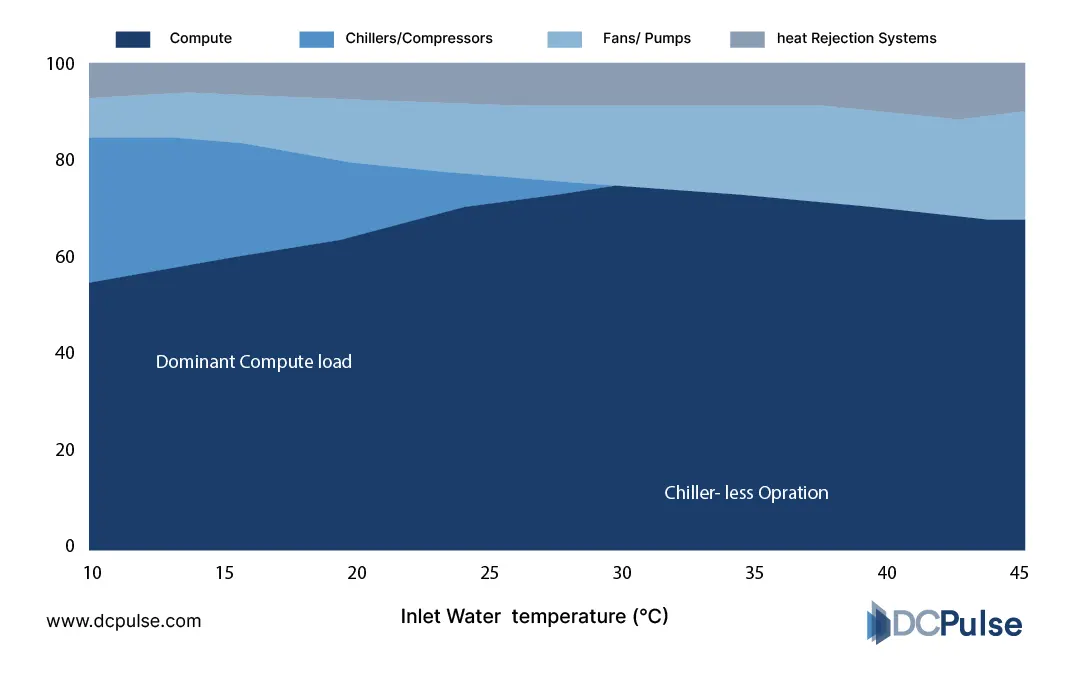
Warm-water architectures are also enabling broader use of economisation and partial chiller-less operation. ASHRAE’s thermal guidelines increasingly support wider operating temperature envelopes, allowing facilities to reduce compressor-driven cooling while improving overall energy efficiency.
Beyond efficiency, heat itself is starting to gain infrastructure value. Some hyperscale and HPC environments are exploring ways to redirect recovered thermal energy into district heating systems, campus thermal loops, and nearby industrial processes rather than rejecting it entirely into the atmosphere.
Cooling Viability Score (0-100) by Density Tier
Which companies are pushing warm-water cooling into the hyperscale mainstream?
Warm-water cooling is increasingly shifting from an experimental HPC technology into a core part of hyperscale AI infrastructure planning. The transition is being driven by a simple industry reality: AI systems are generating thermal loads that conventional cooling architectures are struggling to manage efficiently at scale.
Intel has expanded its focus on liquid-based thermal management through immersion and advanced liquid cooling initiatives aimed at dense AI and HPC deployments. In 2025, Intel collaborated with Shell and immersion cooling specialist Submer on certified immersion cooling solutions for Xeon-based data centres, highlighting how large-scale compute infrastructure is moving toward more thermally efficient architectures.
Vertiv is also rapidly expanding an AI-focused liquid cooling infrastructure. The company’s recent modular cooling platforms are designed to support rack densities exceeding 100 kW, reflecting how hyperscale AI clusters are forcing a shift toward liquid-first thermal strategies.
The broader ecosystem is simultaneously standardising around liquid-capable infrastructure. The Open Compute Project continues to advance open cooling specifications and interoperability initiatives designed to simplify deployment consistency across hyperscale environments. Meanwhile, infrastructure providers are increasingly treating thermal management as a strategic layer of AI scalability rather than a background facility function.
Will warm-water cooling redefine the economics of hyperscale infrastructure?
As AI infrastructure scales upward, cooling is becoming one of the biggest constraints on the efficiency of hyperscale data centres. The challenge is no longer simply removing heat from servers, but doing so without allowing thermal management systems to consume excessive power, water, and mechanical capacity.
Warm-water cooling is gaining momentum because it changes the economics of that equation. By operating at higher temperature ranges, these systems can reduce dependence on chillers, simplify cooling architectures, and improve facility-level efficiency at high AI rack densities.
More importantly, warm-water systems are beginning to shift how hyperscale facilities view heat itself. Instead of treating thermal output purely as waste, operators are increasingly exploring ways to reuse it through district heating networks, industrial applications, and campus-scale energy systems.
The broader implication is strategic: future AI infrastructure may not be defined by who can build the coolest facilities but by who can manage heat most efficiently at scale. Warm-water cooling represents an early step toward that transition.