Pranav Hotkar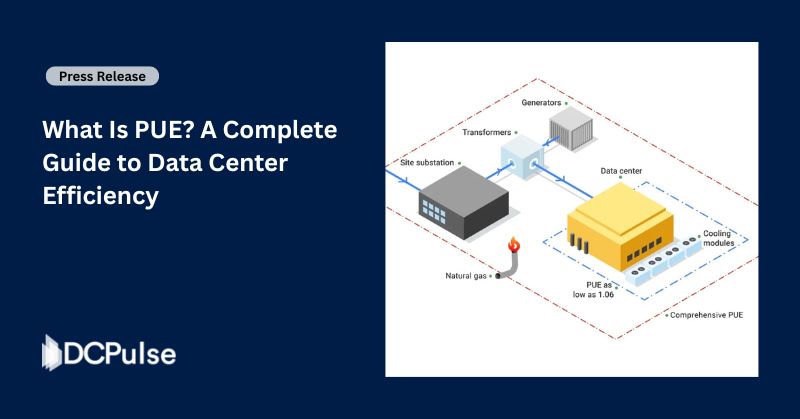
Every data center in the world draws more power than its servers actually need. Some of that extra energy runs the cooling systems, keeping hardware from overheating. Some goes to lighting, power distribution, and backup systems. A small amount is simply lost in the journey from the grid to the chip. The gap between what a facility consumes and what its IT equipment actually uses has a name, and it has become one of the most closely watched numbers in the industry.
That number is PUE, short for Power Usage Effectiveness. It is the data center industry's primary measure of energy efficiency, and understanding it is the first step to improving it.
What Does PUE Actually Mean, and Where Does the Industry Stand Today?
Power Usage Effectiveness is calculated by dividing a facility's total power consumption by the energy used solely by its IT equipment. A PUE of 2.0, for example, means that for every watt used to power IT equipment, an additional watt is consumed by cooling, power distribution, and other overhead systems.
A perfect score of 1.0, where every watt drawn goes directly to IT, is physically unachievable. The closer a facility gets to 1.0, the more efficiently it is running. That is the PUE definition in practice: a simple ratio with significant operational and financial consequences.
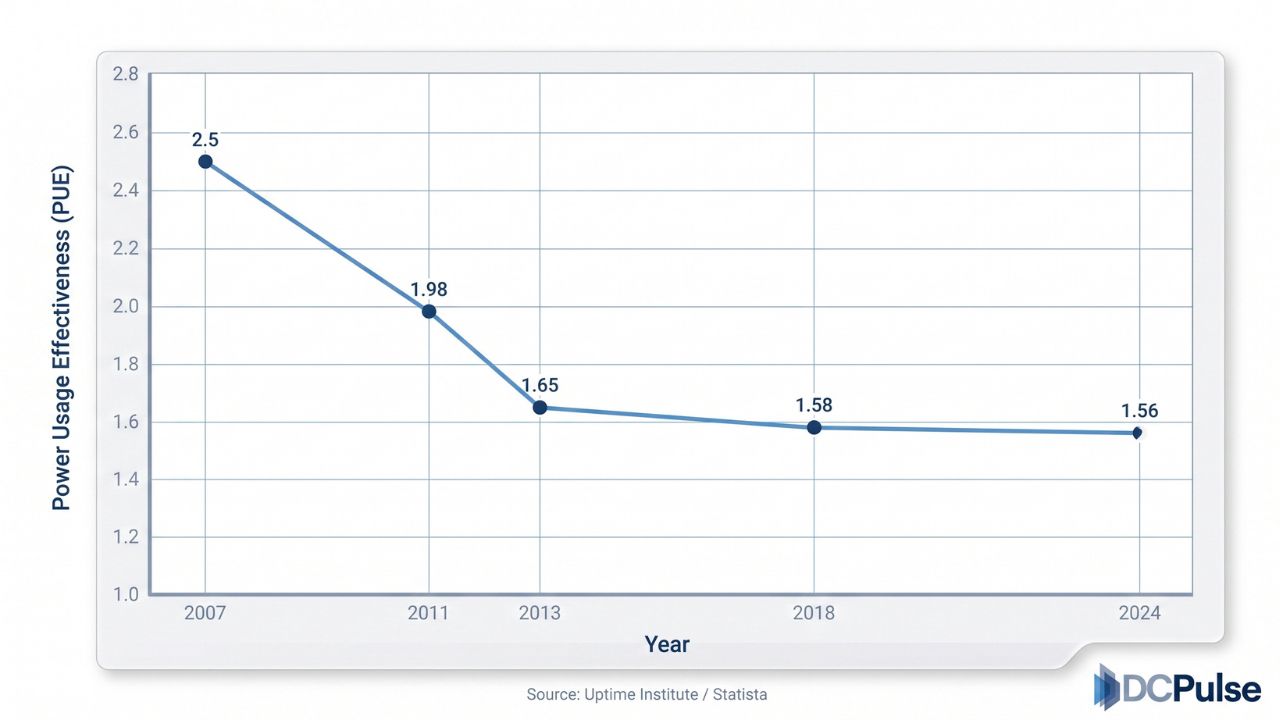
To define PUE in context, consider what the numbers reveal about the industry today. According to the Uptime Institute Global Data Center Survey 2023, the industry average PUE stood at 1.58, a number that has remained essentially flat since 2018.
The Uptime Institute Global Data Center Survey 2024 recorded an industry average PUE of 1.56, the fifth consecutive year of near-stagnation. Newer, larger facilities are pulling the average down. But the weight of older, less efficient infrastructure continues to hold it in place.
Global Data Center Industry Average PUE (2007-2024)
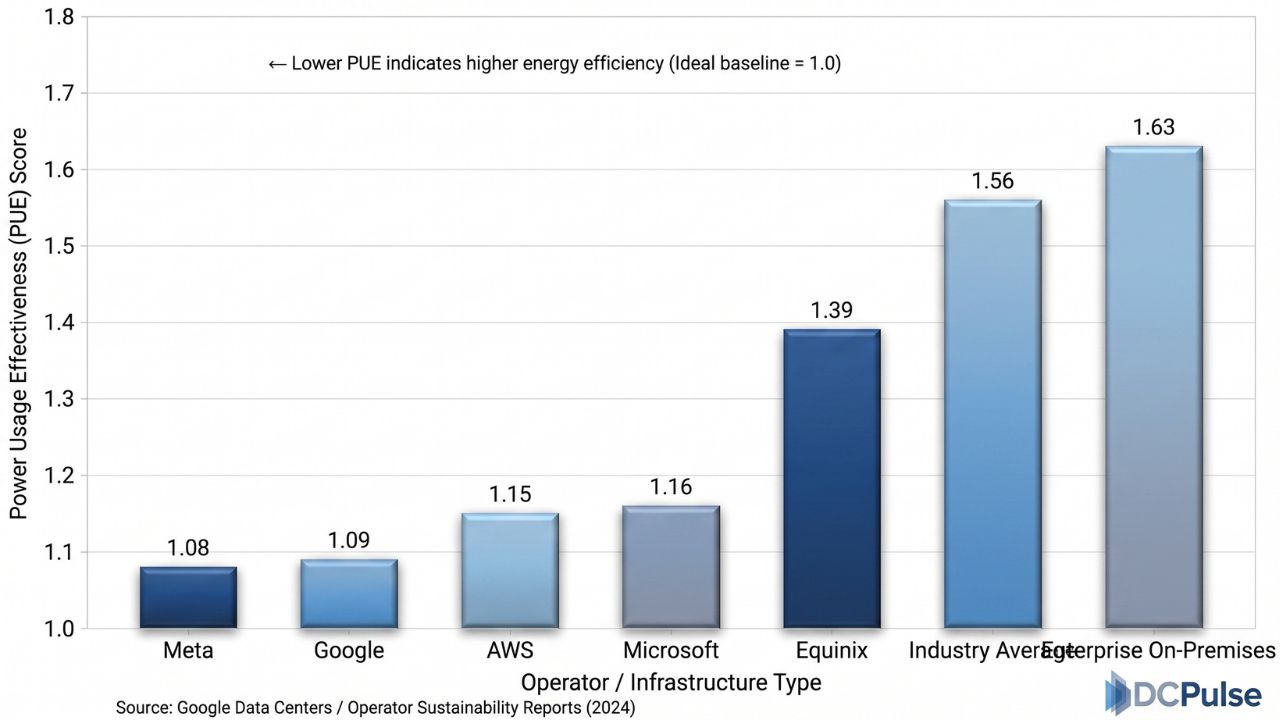
The gap between the industry average and what leading operators have achieved tells a sharper story. Google's global fleet averaged a PUE of 1.09 in 2024, with its best-performing site in Ohio reaching 1.04. Meta reported a fleet average of 1.08, AWS averaged 1.15, and Microsoft reported 1.16 for FY2024. The data center industry's average PUE of 1.56 is not a ceiling; it is a baseline that the best operators have already surpassed. The question is why the rest of the industry hasn't followed.
2024 Data Center Efficiency Matrix (PUE by Operator)
What Innovations Are Actually Moving the Needle on PUE?
The industry average PUE for data center infrastructure has remained largely unchanged in six years, but this stagnation masks significant progress at the technology level. A new generation of cooling architectures, intelligent controls, and efficiency metrics is giving operators the tools to push well below the 1.56 average. The most significant innovations doing that work right now include the following:
- Direct-to-chip liquid cooling- liquid cooling adoption now covers 22% of facilities with a USD 5.52 billion market, enabling PUE approaching 1.05, compared to air-cooled averages of 1.5 and above.
- Two-phase immersion cooling- fluorocarbon liquids boil at chip temperatures, providing isothermal cooling with no pumps; early deployments are achieving a PUE of 1.03, the closest the industry has come to the theoretical floor
- AI-driven cooling management- Google uses AI to manage cooling in real time across its fleet, a key factor in sustaining its fleet-wide PUE of 1.09
- Waste heat recovery and Energy Reuse Effectiveness (ERE)- capturing and redirecting thermal output into district heating networks; ERE measures total facility energy minus reuse energy divided by IT equipment energy, where an ERE of 0 means 100% of energy brought into the facility is reused externally
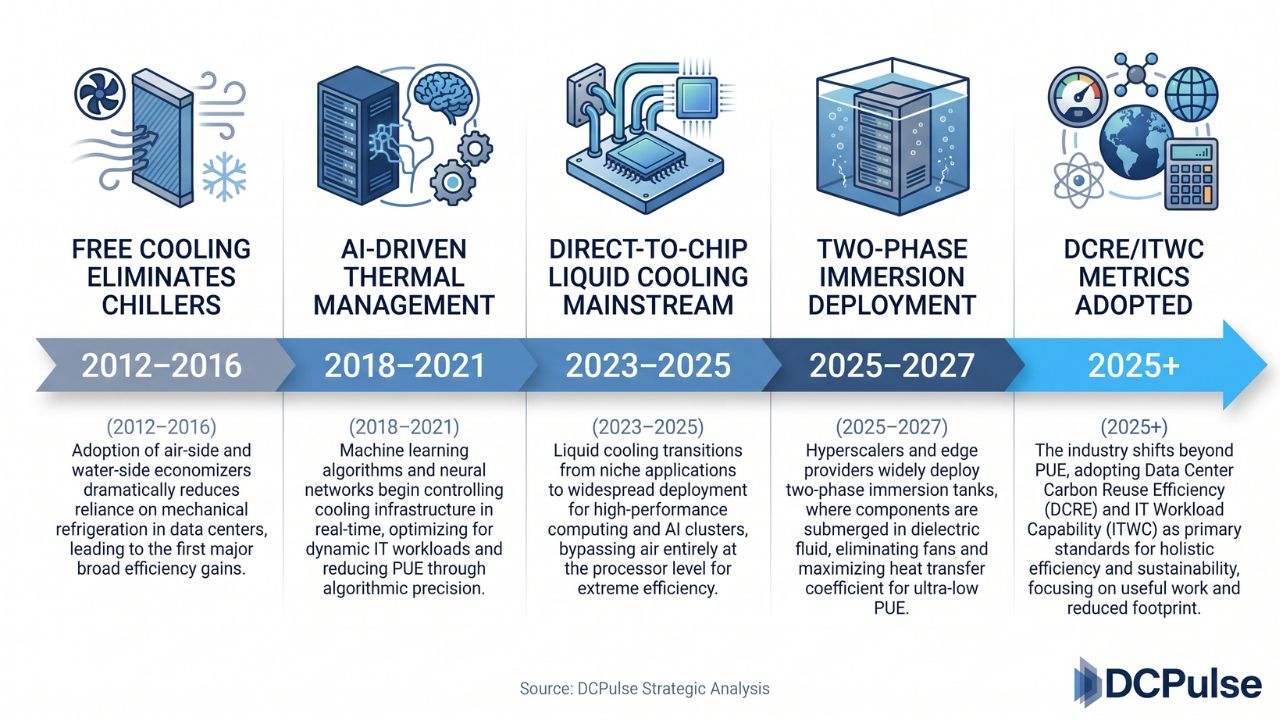
- ePUE and beyond-PUE metrics- The Green Grid released two new metrics in 2025, Data Center Resource Effectiveness (DCRE) and IT Work Capacity (ITWC), designed to measure efficiency beyond infrastructure overhead and into IT performance itself
Data Center PUE by Cooling Technology Type
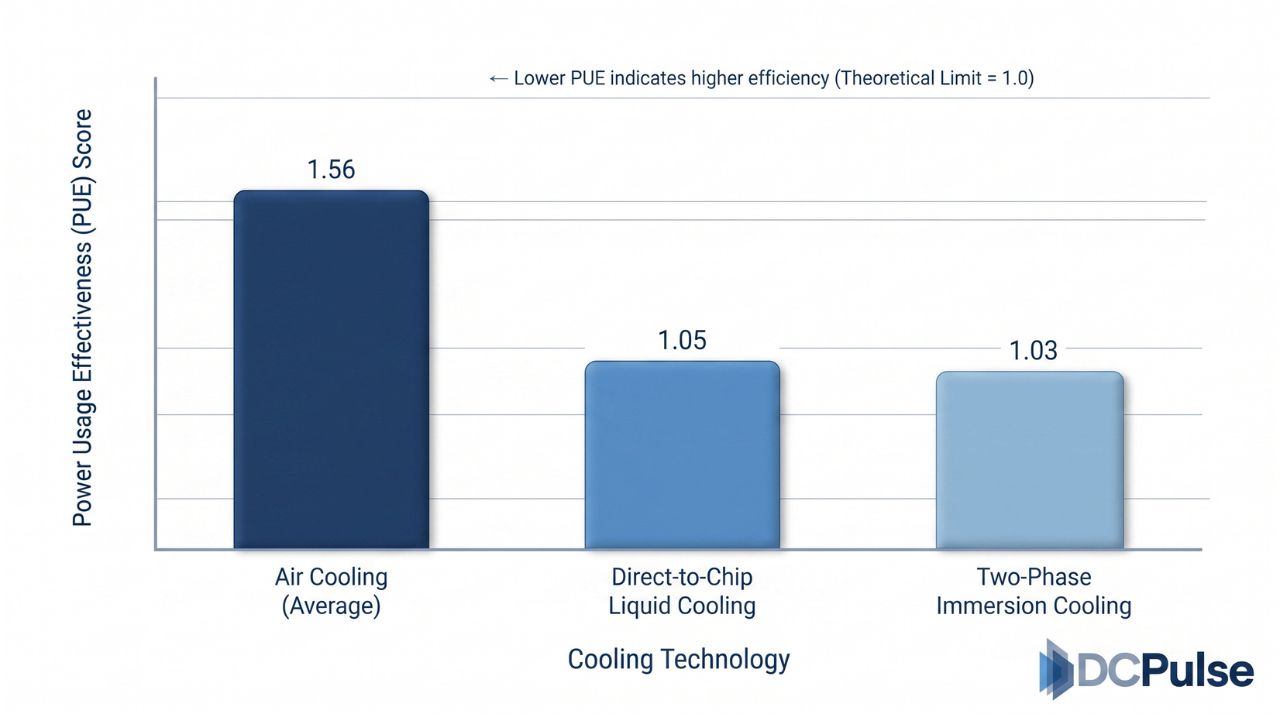
According to the Uptime Institute's 2025 Global Data Center Survey, average PUE improvements are plateauing, particularly in mature facilities constrained by legacy designs, meaning the gains are increasingly concentrated in new builds and retrofits that adopt these technologies from the ground up.
PUE improvement milestones by technology
How Are Hyperscalers Turning PUE Into a Competitive Advantage?
For the world's largest data center operators, PUE is not an abstract question; it is a measurable competitive lever. The gap between the industry average and what leading hyperscalers have achieved is not accidental. It is the result of deliberate, sustained engineering investment, and it is now reshaping how new facilities are designed from the ground up.
The hyperscale data center PUE target has effectively reset industry expectations. Google's global fleet sustained a trailing twelve-month PUE of 1.09 across all large-scale data centers in 2024 and Q1 2025, compared to the industry average of 1.56, meaning Google uses approximately 84% less overhead energy per unit of IT equipment energy. That gap translates directly into operating cost. At hyperscale, even a 0.1 improvement in power PUE can represent hundreds of millions of dollars in annual energy savings.
The moves being made in 2025 and 2026 reflect that understanding. Microsoft's Fairwater AI campuses use closed-loop liquid cooling systems that eliminate operational water consumption, a design choice that simultaneously pushes PUE lower and addresses water usage concerns. Google committed USD 624 million to a hyperscale facility in Norway powered by 100% renewable hydropower, featuring heat reuse systems scheduled for 2026. Meta's new Louisiana and Indiana campuses are powered by renewable energy and feature cutting-edge cooling systems targeting sub-1.1 PUE performance.
Hyperscaler vs. Industry Average PUE
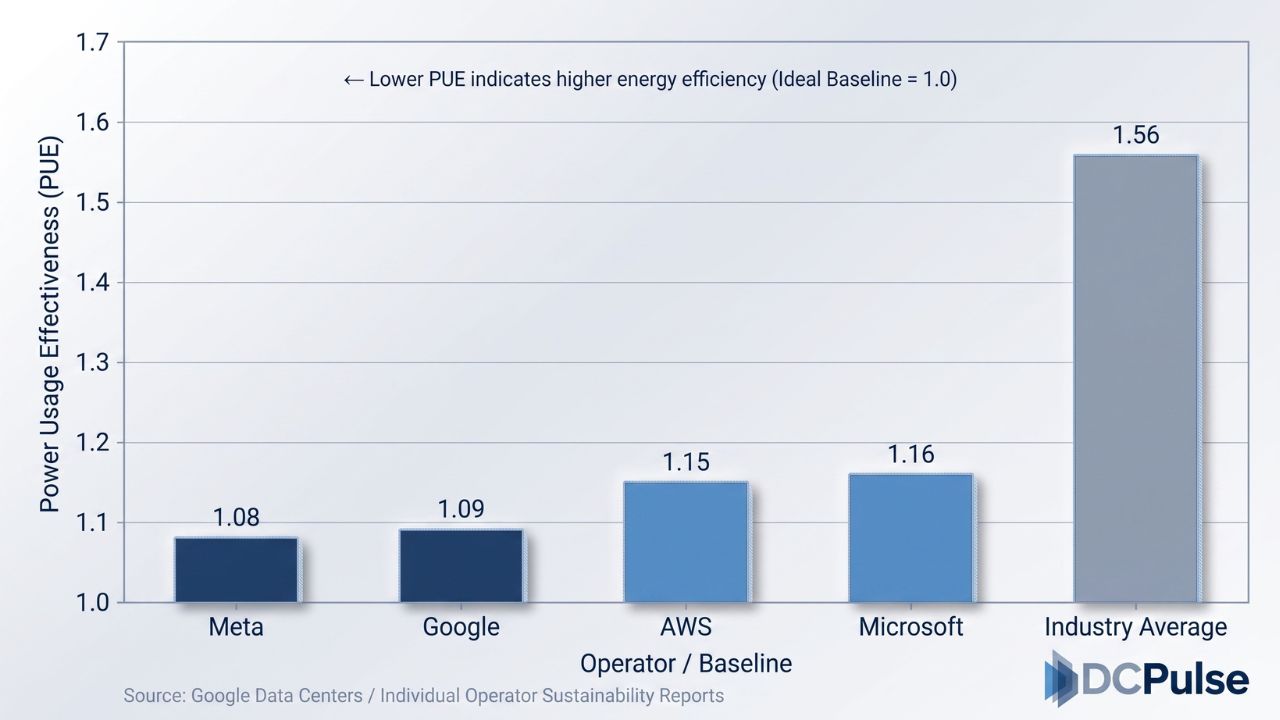
The broader market tells a different story; the average enterprise on-premises facility runs at approximately 1.63, and major colocation operators range from 1.39 to 1.58. The PUE data center performance gap between hyperscalers and the rest of the market is widening, not because the rest of the market is standing still, but because the hyperscalers are moving faster.
What Does the Future of PUE Look Like, and Why Does It Matter More Than Ever?
PUE is no longer just an engineering benchmark. It is becoming a regulatory requirement. Germany's Energy Efficiency Act requires that new data centers commissioned after July 2026 must achieve a PUE of 1.2 or lower within two years of commissioning. Existing facilities are required to reach a PUE of 1.5 by July 2027 and 1.3 by July 2030. Penalties for non-compliance reach €100,000. Germany is the leading indicator, not the exception; the European Commission is preparing an EU-wide data center energy efficiency package targeting broader minimum performance standards.
For operators, the implication is clear: PUE is transitioning from a voluntary efficiency metric into a compliance obligation. Facilities that have not invested in liquid cooling, AI-driven thermal management, or modern power architecture are now carrying regulatory exposure alongside operational inefficiency.
PUE remains a core operational KPI in 2026, but the best practice is to complement it with carbon, water, and heat reuse indicators for a complete efficiency picture. The number still matters. What surrounds it now matters just as much.