Pranav Hotkar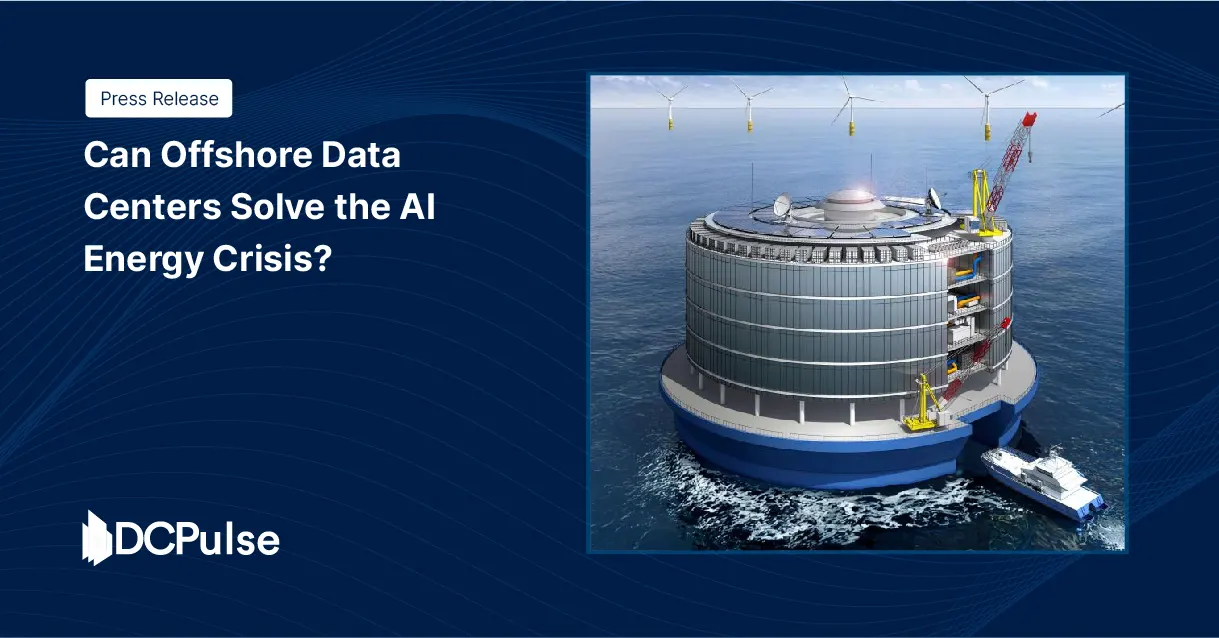
For decades, data centers moved closer to cities, terrestrial fiber routes, and major population hubs. AI infrastructure may begin to reverse some of that logic.
As next-generation AI clusters push power consumption and cooling demands to unprecedented levels, hyperscale operators are facing growing pressure from grid congestion, land scarcity, permitting delays, and rising cooling overhead. In some regions, scaling traditional data center infrastructure is becoming increasingly difficult as AI facilities grow larger and denser.
That pressure is reviving interest in offshore data centers, not simply as engineering experiments, but as potential extensions of future energy infrastructure. Oceans provide two resources AI systems increasingly need at the same time: large-scale cooling capacity and proximity to emerging offshore energy ecosystems, including offshore wind generation and subsea power networks.
The broader question extends beyond underwater servers themselves. If AI infrastructure continues scaling aggressively, the industry may eventually need to decide whether future compute should remain concentrated around terrestrial constraints or move closer to where energy and cooling are more abundant.
Why is AI infrastructure pushing data centers toward new geographies?
The modern data center industry was built around a relatively stable assumption: compute infrastructure would expand near population centers, terrestrial fiber routes, and established power grids. AI is beginning to challenge that model.
Large-scale AI clusters are dramatically increasing the physical demands placed on infrastructure. Compared with traditional cloud workloads, advanced AI systems require far higher rack densities, greater cooling intensity, and significantly larger power allocations. The International Energy Agency estimates that electricity demand from data centers, AI, and cryptocurrency could more than double globally by 2026 as accelerated computing adoption expands.
At the same time, terrestrial expansion is becoming harder in major hyperscale regions. Lawrence Berkeley National Laboratory has reported growing interconnection queue backlogs across US power markets, with new generation and transmission projects facing multi-year delays before grid connection approval. That creates mounting pressure for power-hungry AI infrastructure that requires rapid deployment timelines.
Cooling is also emerging as a major scaling constraint. Uptime Institute notes that high-density AI deployments are forcing operators to rethink traditional cooling architectures as rack power levels rise sharply beyond conventional enterprise and cloud environments.
How AI Workloads Are Reshaping Data Center Resource Demand
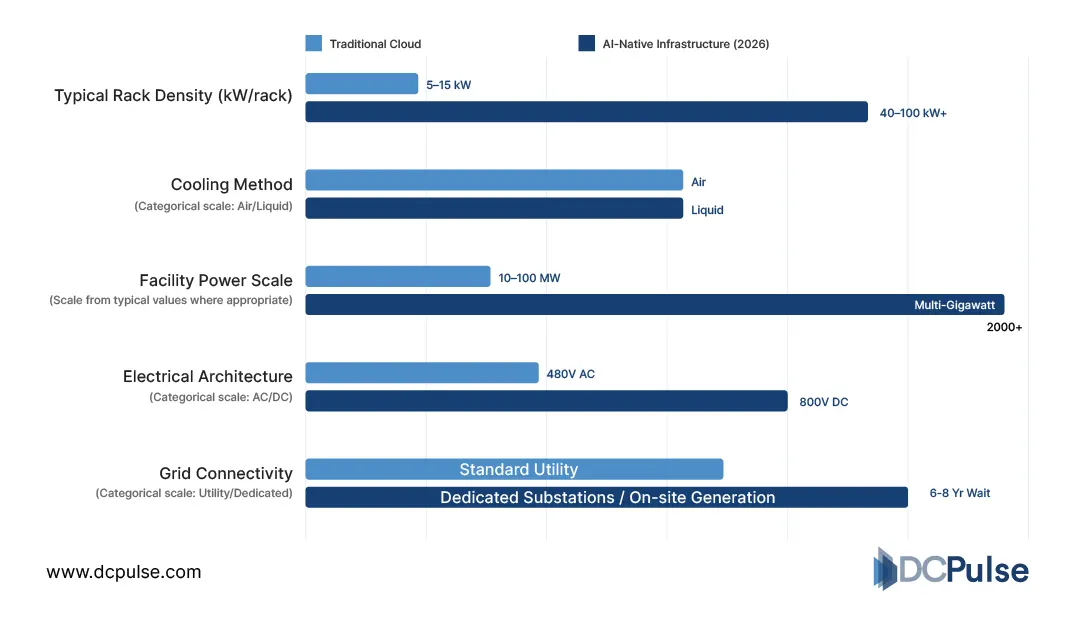
As these pressures intensify, geography itself is becoming part of the infrastructure challenge. Increasingly, the question is no longer only where compute demand exists but also where sufficient power, cooling capacity, and long-term scalability can realistically be sustained.
Can offshore infrastructure improve AI energy and cooling efficiency?
As AI systems become more power-dense, the infrastructure required to cool them is scaling almost as aggressively as the compute itself. High-density AI clusters are increasing rack power, thermal output, and cooling intensity far beyond the levels traditional cloud facilities were originally designed to support. According to the International Energy Agency, global electricity demand from data centers is expected to rise sharply as AI adoption accelerates, placing additional pressure on both power grids and cooling infrastructure.
How AI Density Is Increasing Cooling and Power Demand
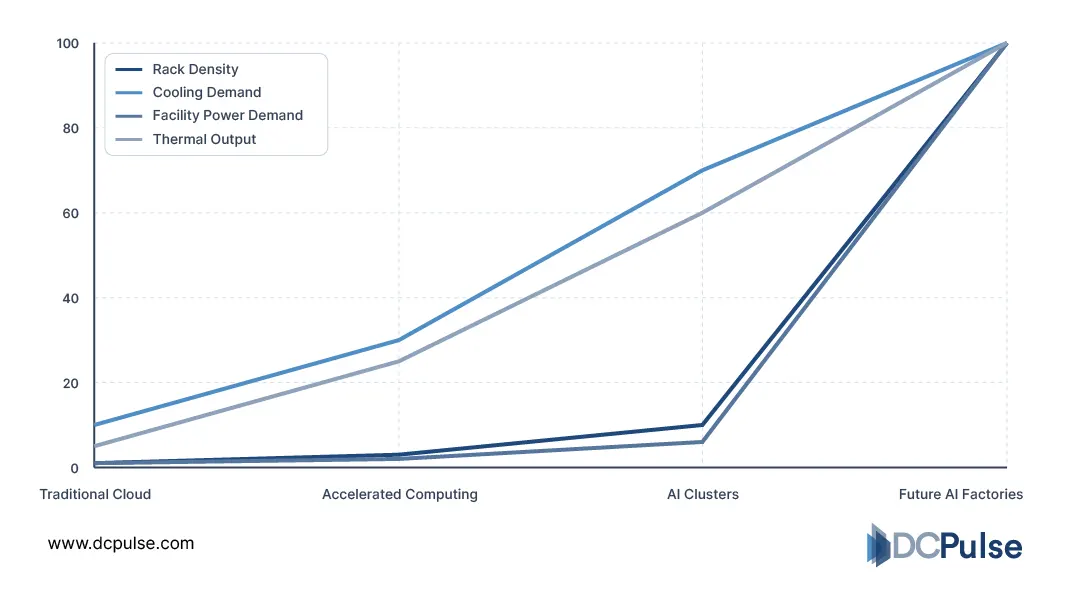
That growing thermal burden is one reason offshore infrastructure is attracting renewed interest. Instead of depending entirely on large-scale mechanical chilling systems, offshore environments could potentially use seawater-assisted cooling loops to reduce cooling energy demand and lower dependence on freshwater-intensive thermal management systems.
Cooling Resource Requirements: Terrestrial vs Offshore Data Centers
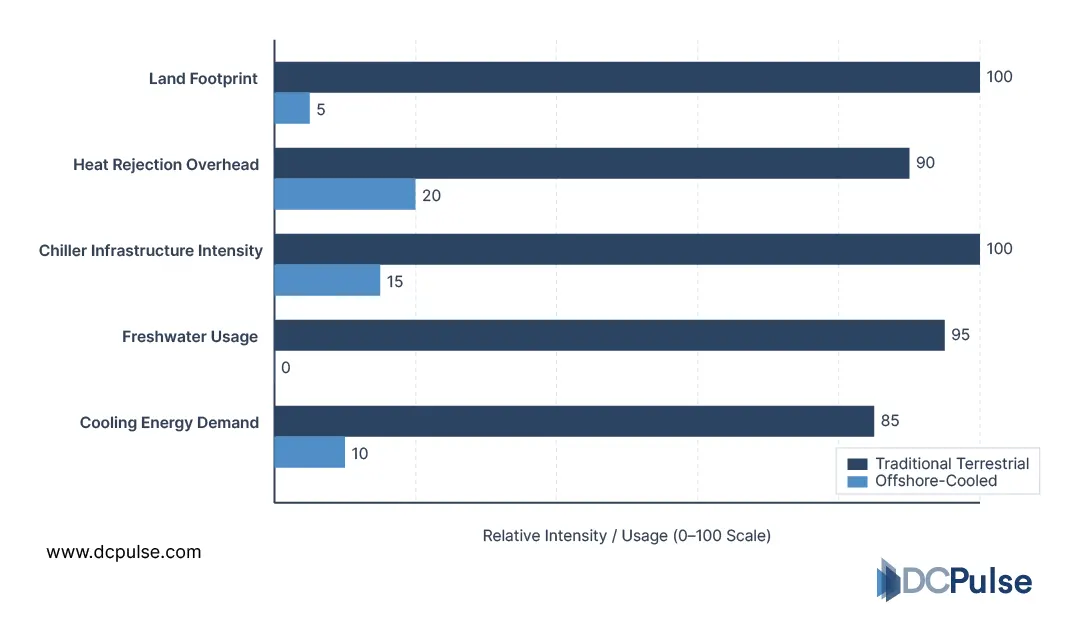
Microsoft explored part of this concept through Project Natick, an underwater data center experiment deployed off the coast of Scotland. Microsoft reported that the subsea system demonstrated lower hardware failure rates than comparable land-based deployments during the trial period, partly due to its stable operating environment.
At the same time, offshore infrastructure introduces its own operational tradeoffs, including marine maintenance complexity, environmental exposure, and dependence on subsea connectivity systems. As a result, offshore deployments are more likely to emerge as specialized infrastructure models for certain high-density AI applications rather than direct replacements for terrestrial hyperscale campuses.
Which companies and industries are testing offshore compute infrastructure?
Interest in offshore data centers is still limited compared with traditional hyperscale development, but several companies and infrastructure sectors are beginning to explore whether compute can eventually integrate more closely with offshore energy and cooling ecosystems.
Microsoft remains one of the most visible examples through Project Natick, which tested a subsea data center off the coast of Scotland. The company reported that the underwater deployment achieved lower hardware failure rates than comparable land-based systems during its operational trial, reinforcing the potential reliability advantages of sealed offshore environments.
How AI Expansion Is Driving Interest in Alternative Infrastructure Models
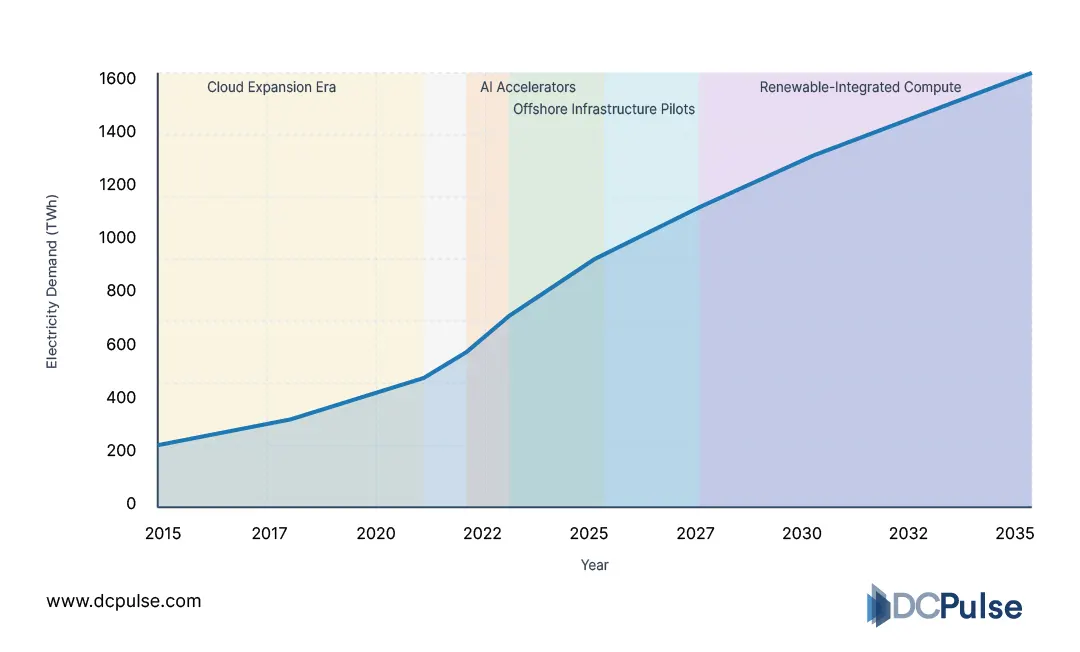
At the same time, the offshore wind industry is expanding rapidly across parts of Europe, Asia, and North America, creating new coastal energy corridors with growing power-generation capacity. According to the International Energy Agency, offshore wind deployment is expected to scale significantly this decade as countries expand renewable energy infrastructure. That trend is helping fuel broader discussions around locating future compute infrastructure closer to large-scale renewable generation.
Potential Infrastructure Advantages of Coastal and Offshore Compute
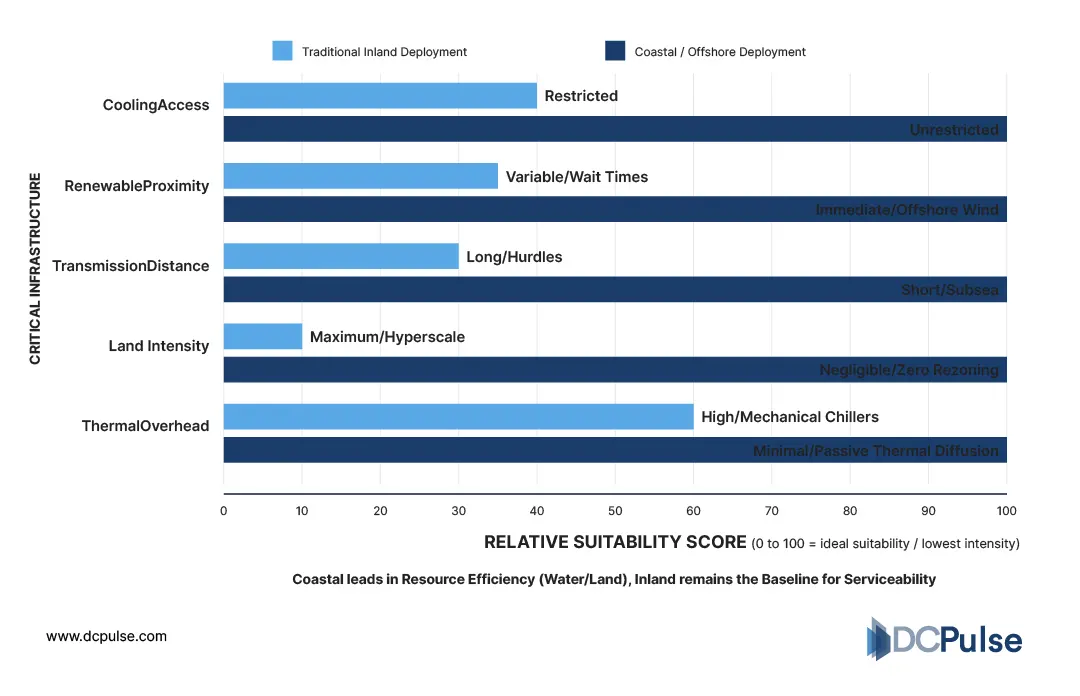
Some companies are also exploring floating and modular infrastructure concepts designed to improve deployment flexibility near coastal regions. However, offshore infrastructure still faces major operational challenges, including marine maintenance complexity, environmental exposure, and subsea connectivity dependence.
Could AI infrastructure eventually follow energy instead of cities?
Offshore data centers remain highly experimental, and major operational challenges, including marine maintenance, deployment complexity, and environmental exposure, still limit their large-scale practicality today. They are unlikely to replace terrestrial hyperscale campuses anytime soon.
But the underlying pressure driving these experiments is becoming increasingly difficult to ignore. AI infrastructure is rapidly changing the economics of power, cooling, and facility scalability, forcing operators to reconsider some of the geographic assumptions that shaped the modern data center industry.
For decades, compute moved closer to cities, users, and terrestrial connectivity corridors. Future AI infrastructure may increasingly need to move closer to abundant power, large-scale cooling capacity, and renewable energy ecosystems instead. Offshore data centers represent one possible response to that shift.
The larger question is no longer whether underwater servers are feasible. It is whether AI infrastructure can continue scaling efficiently within the energy and geographic limits that defined the first generation of hyperscale computing.