Pranav Hotkar
In the world of telecommunications, milliseconds matter. As applications like autonomous vehicles, immersive gaming, and real-time industrial monitoring proliferate, the need for ultra-low latency is pushing networks to their limits. Traditional centralized data centers can no longer deliver the responsiveness modern users and devices demand.
Enter the telecom edge: a distributed network of mini data centers and compute nodes positioned close to end-users. By processing data at the edge rather than routing it across long-haul networks, carriers can reduce latency dramatically, sometimes by an order of magnitude. This shift is not merely about speed; it enables new classes of applications that were previously impossible, from real-time AR/VR experiences to predictive machine controls in smart factories.
Telecom operators are now racing to build infrastructure that can scale elastically, integrate seamlessly with cloud providers, and maintain reliability under surging traffic. The race to zero latency is reshaping the industry, redefining what “real-time” truly means, and setting the stage for the next generation of connected experiences.
Telecom Edge Infrastructure Today
Telecom edge infrastructure has moved from concept to operational deployment as carriers accelerate efforts to deliver ultra-low latency connectivity required by emerging digital services. At its core, Multi‑Access Edge Computing (MEC), defined as computing and storage placed close to end users and devices, enables data to be processed near the source rather than backhauling it to centralized cloud centers, which significantly reduces latency and enhances responsiveness for real‑time applications.
5G networks have become the backbone of this shift because they provide the high bandwidth and low-latency communication links needed to support distributed edge workloads. Combining 5G with MEC enables service providers to host compute, storage, and network functions at or near cellular base stations, allowing latency‑sensitive applications, such as autonomous vehicle coordination, industrial IoT controls, and real‑time video analytics, to respond within milliseconds.
In the current landscape, major operators are integrating these technologies into their 5G infrastructures: carriers such as AT&T and Verizon are embedding edge nodes within metropolitan networks to bring compute closer to consumers and enterprise customers. Meanwhile, collaborative efforts like the European Edge Continuum, a federated edge cloud across Deutsche Telekom, Vodafone, Orange, Telefónica, and TIM, are laying the groundwork for seamless application deployment across borders.
Average Latency by Deployment Type (2025-2026)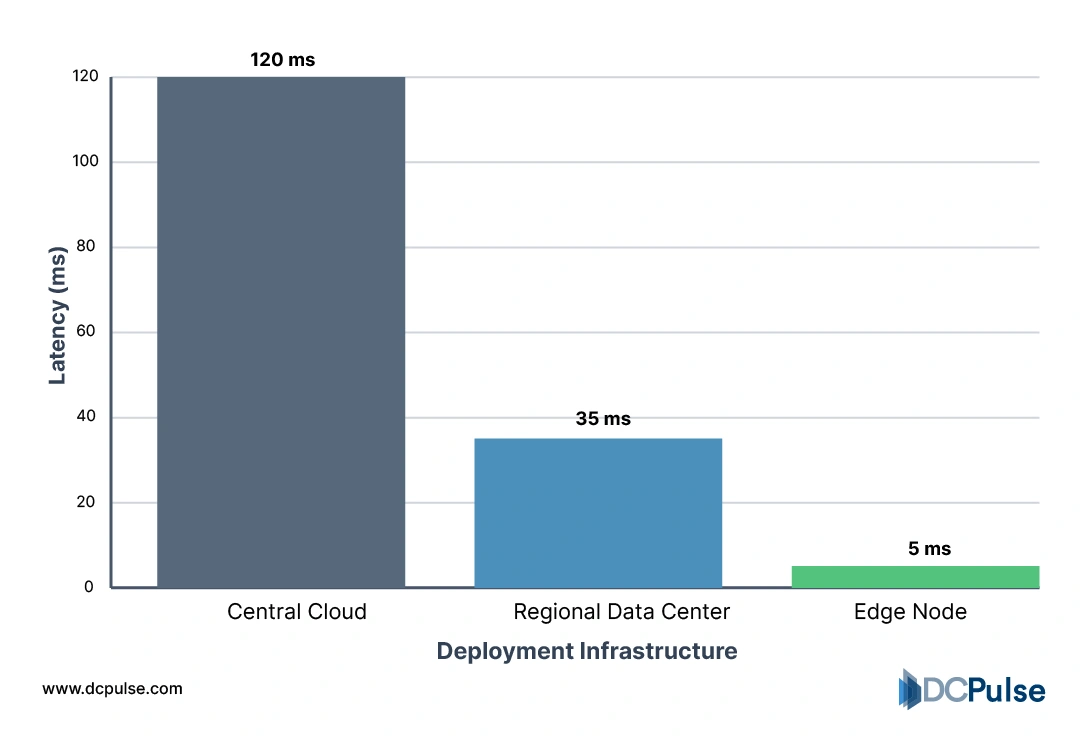
Operators are also experimenting with edge architectures that integrate with hybrid cloud and core networks, allowing workloads to move dynamically based on performance requirements and network conditions. While infrastructure gaps and orchestration complexity remain challenges, the current landscape shows that edge deployments are rapidly becoming a fundamental component of modern telecom infrastructure rather than a niche experiment.
What Emerging Innovations Are Advancing the Telecom Edge Race to Zero Latency?
Telecom edge infrastructure is not just expanding geographically; it is also evolving technologically through several emerging innovations designed specifically to reduce latency and empower next-generation applications. A key advancement is the tight convergence of 5G and edge computing, where distributed compute power sits close to users and devices, enabling faster processing and real‑time responsiveness that traditional cloud models can’t match. Together, these technologies support demanding use cases such as remote healthcare monitoring, industrial automation, autonomous systems, and immersive media.
Another innovation fueling this momentum is the adoption of AI and machine learning at the edge. Rather than simply routing data back to centralized infrastructure for analysis, smart edge nodes can perform local data filtering, pattern recognition, and decisioning, reducing the amount of data that must travel across the network and improving response times for latency‑sensitive workloads. This trend is increasingly emphasized in research examining how edge architectures can be optimized through intelligent processing and orchestration.
Edge networking itself is becoming more sophisticated, with advancements in lightweight virtualization, containerization, and collaborative processing frameworks that allow edge applications to scale efficiently and support diverse workloads without stressing centralized resources. This modular approach not only improves performance but also simplifies deployment and upgrades across distributed sites.
These innovations, 5G edge convergence, embedded AI processing, and flexible infrastructure design, collectively transform edge networks from static extensions of the core into dynamic, intelligent environments capable of delivering near real-time performance. As these technologies mature, the edge will increasingly be where critical decisioning, inference, and interactive experiences occur, driving the industry closer to the goal of true zero‑latency connectivity.
Strategic Moves Shaping the Telecom Edge Landscape
Telecom operators and cloud providers are moving aggressively to secure leadership in the low-latency edge market, forging strategic partnerships, deploying MEC sites, and integrating edge nodes into core networks.
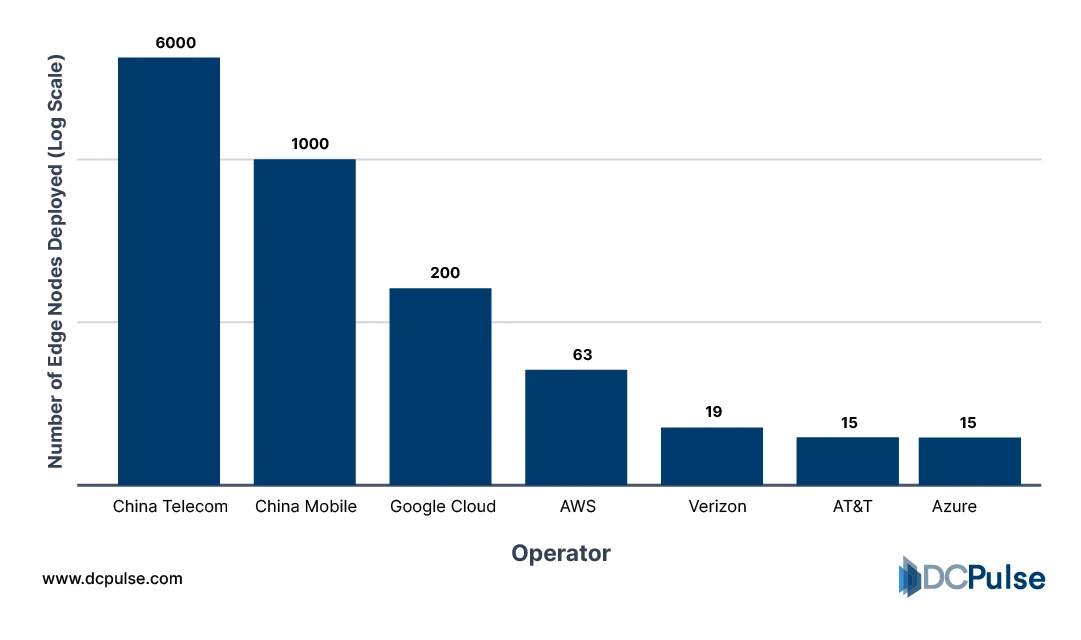
In North America, AT&T and Verizon have expanded edge deployments across major metropolitan areas, embedding compute at cell towers and central offices to bring processing closer to end users. Similarly, in Europe, Vodafone and Deutsche Telekom are collaborating on federated edge clouds that enable seamless service delivery across borders and networks.
Cloud providers are also heavily investing in integrating edge services with their platforms. AWS Wavelength and Azure Edge Zones are examples of cloud-edge convergence, providing developers with compute and storage resources directly at the edge to reduce latency for mobile and IoT applications. This integration allows telecom operators to offer enterprise customers advanced, low-latency services without building all infrastructure in-house.
Number of Edge Sites per Major Operator (March 2026)
Additionally, several global telecom players are engaging in joint research programs and consortia to standardize edge architecture, optimize interoperability, and accelerate innovation. Initiatives like 5G-ACIA (5G Alliance for Connected Industries and Automation) are enabling industrial adoption of low-latency edge networks for smart factories, logistics automation, and predictive maintenance.
Through these strategic moves, edge node rollouts, cloud integration, and industry collaborations, operators are shaping a global ecosystem capable of supporting ultra-low latency applications and preparing for the next wave of 6G-enabled services.
Will Telecom Edge Infrastructure Truly Achieve Near-Zero Latency?
Telecom edge infrastructure is steadily moving toward near-zero latency, but achieving it consistently across networks will depend on how effectively operators integrate distributed compute, intelligent orchestration, and next-generation connectivity. While current deployments have already reduced latency to sub-10 millisecond levels in many urban environments, further gains will require deeper coordination between edge nodes, core networks, and cloud platforms.
One critical factor will be the evolution of AI-driven network management, enabling real-time traffic optimization, predictive scaling, and autonomous decision-making at the edge. At the same time, continued investment in dense edge node deployment and fiber backhaul will be essential to eliminate bottlenecks, particularly in underserved and rural regions.
However, the path to zero latency is not purely technical. Operators must balance cost, energy consumption, and infrastructure complexity, especially as networks scale to support billions of connected devices. Interoperability across vendors and regions will also play a key role in ensuring seamless performance.
Ultimately, while absolute zero latency may remain theoretical, telecom edge infrastructure is set to deliver near-instant responsiveness, redefining real-time digital experiences and becoming a cornerstone of future 5G and 6G ecosystems.