Pranav Hotkar
As global demand for digital services continues to surge, data centers and large enterprises are becoming some of the largest consumers of electricity worldwide. From cloud computing to artificial intelligence workloads, the infrastructure powering the digital economy now requires a vast and continuous energy supply, placing increasing pressure on traditional power systems.
At the same time, organizations are facing growing expectations to reduce carbon emissions and transition toward cleaner energy sources. According to the International Energy Agency, renewable energy capacity additions are accelerating globally as countries and industries push toward decarbonization targets.
In response, companies are increasingly turning to Power Purchase Agreements (PPAs) as a strategic mechanism to secure long-term renewable energy supply. These agreements allow organizations to directly support renewable energy projects while stabilizing energy costs and advancing sustainability goals.
As renewable integration becomes more complex, PPAs are evolving from simple procurement tools into a critical component of energy strategy for the modern digital economy.
How PPAs Are Reshaping Renewable Energy Procurement
The global shift toward renewable energy procurement is being actively shaped by large enterprises adopting Power Purchase Agreements (PPAs) as a core energy strategy. Unlike traditional utility sourcing, PPAs allow organizations to directly contract renewable energy through long-term agreements, typically structured as physical PPAs (direct power delivery) or virtual PPAs (VPPAs), which operate as financial hedging instruments tied to wholesale electricity markets.
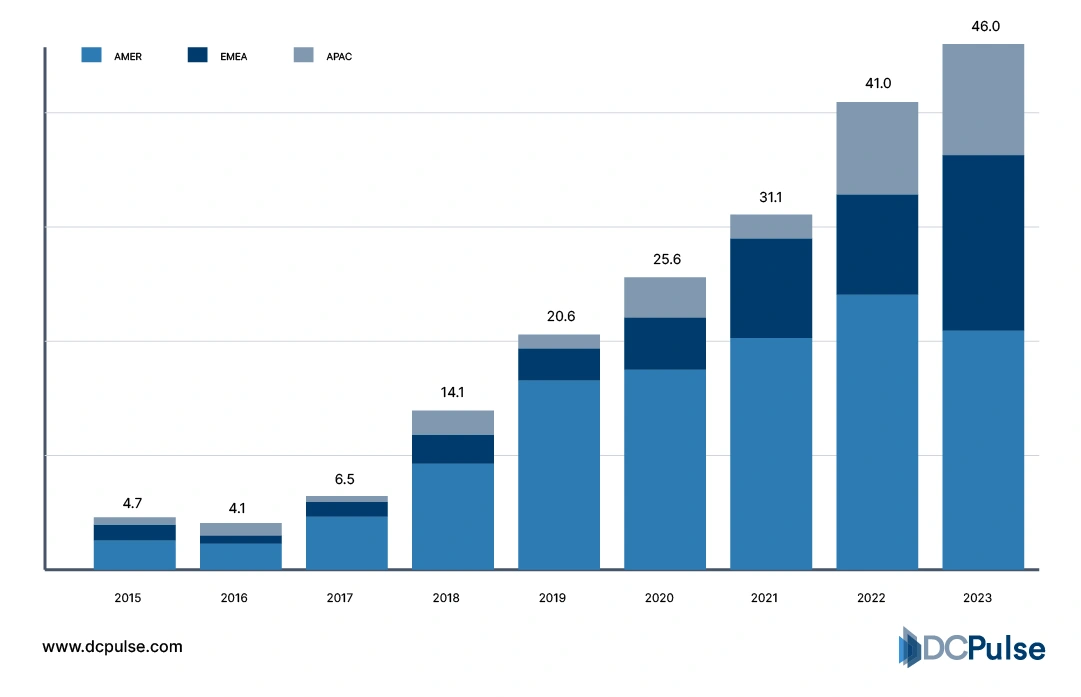
This transformation is being led by hyperscalers such as Amazon and Google, which have emerged as the largest corporate buyers of renewable energy globally. Corporations signed a record 46 gigawatts (GW) of clean energy PPAs in 2023, reflecting sustained growth in long-term renewable procurement.
Global Corporate Renewable PPA Capacity (2015–2023)
At the infrastructure level, integrating renewable energy into power grids introduces complexity due to the intermittent nature of solar and wind generation. This variability requires grid operators to maintain real-time balance between supply and demand, accelerating investments in forecasting systems and grid flexibility mechanisms.
PPAs play a critical role in stabilizing this ecosystem. By locking in long-term pricing and demand, they reduce financial risk for developers while enabling enterprises to hedge against market volatility. As renewable adoption scales, PPAs are no longer just sustainability tools—they are becoming foundational to how modern infrastructure secures, prices, and manages energy.
Can PPAs Evolve to Deliver 24/7 Clean Energy at Scale?
The limitations of traditional Power Purchase Agreements (PPAs) are becoming increasingly visible as energy demand from always-on digital infrastructure continues to rise. Most existing PPAs are structured around annual renewable matching, where companies offset total yearly consumption with renewable generation. However, this model does not reflect real-time usage, creating a mismatch between when clean energy is produced and when it is actually consumed.
To address this gap, companies such as Google and Microsoft are advancing 24/7 carbon-free energy (CFE) strategies. These initiatives aim to match electricity consumption with clean energy on an hourly basis, requiring a more sophisticated integration of renewable assets, grid coordination, and energy tracking systems.
This transition is being enabled by a combination of energy storage systems, AI-driven demand forecasting, and hybrid renewable models that combine solar, wind, and battery storage. These technologies allow excess renewable generation to be stored and deployed during periods of low production, improving alignment with real-time demand.
Storage-integrated PPAs are particularly critical in this evolution. By embedding battery storage into renewable contracts, they enhance reliability and reduce dependence on fossil-fuel-based backup power.
As these innovations mature, PPAs are shifting from static procurement tools to dynamic energy management systems designed to support continuous, low-carbon operations.
How Industry Leaders Are Locking in Renewable Supply
The acceleration of renewable energy adoption is being driven by a wave of large-scale Power Purchase Agreements (PPAs) signed by hyperscalers and data center operators. These agreements are no longer experimental; they are now central to how leading companies secure long-term energy supply while meeting aggressive sustainability targets.
Among the most active players, Amazon has consistently ranked as the world’s largest corporate buyer of renewable energy, signing gigawatts of solar and wind PPAs across multiple regions. Amazon alone contracted 8.8 GW of clean energy in 2023, reinforcing its position at the top of global corporate procurement.
Similarly, Meta and Google continue to expand their renewable portfolios through long-term PPAs tied directly to data center operations. These agreements are often structured to support new renewable projects, ensuring additional capacity is brought online rather than relying on existing grid supply.
Top Corporate Renewable Energy Buyers (2025)
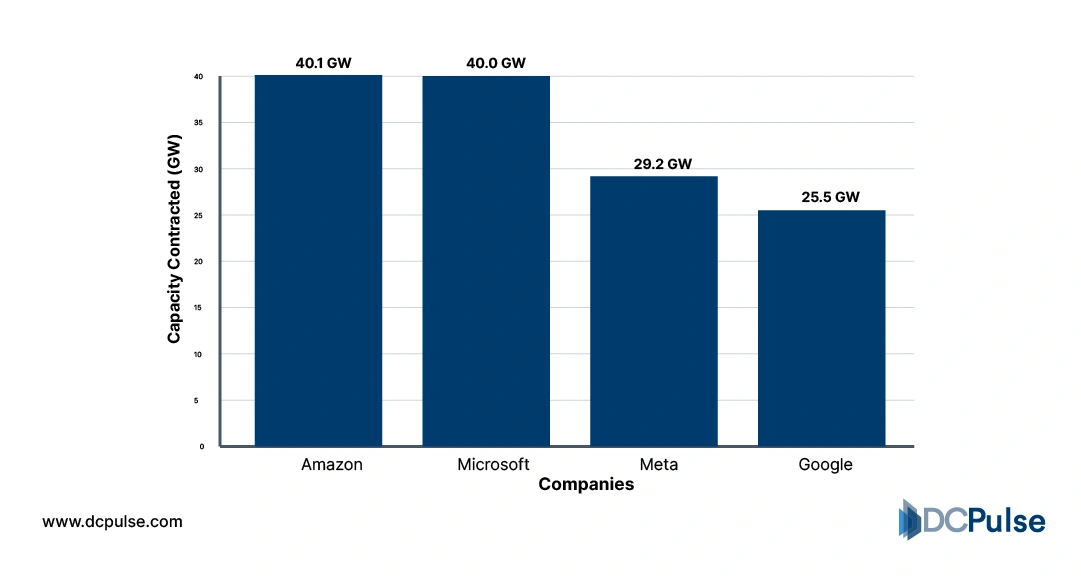
Beyond hyperscalers, colocation providers such as Equinix are also increasing their reliance on PPAs to meet sustainability commitments across distributed data center networks. These companies often operate in multiple energy markets, requiring a combination of regional PPAs and renewable energy certificates to achieve coverage.
Geographically, corporate PPA activity is expanding beyond North America into Europe and Asia-Pacific, reflecting broader global demand for clean energy procurement. This shift is driving the development of new renewable projects in emerging markets, where corporate demand is helping unlock financing for large-scale solar and wind installations.
Global Map - Corporate PPA Project Distribution
(Highlight: North America, Europe, Asia-Pacific growth regions)
As industry participation deepens, PPAs are becoming a primary mechanism through which enterprises influence energy markets, directly shaping the scale and location of renewable infrastructure deployment.
Are PPAs Enough to Sustain the Next Phase of Renewable Growth?
Power Purchase Agreements (PPAs) have become a foundational tool for scaling renewable energy, but their long-term effectiveness will depend on how well they adapt to emerging grid and infrastructure challenges. While PPAs provide price stability and enable new renewable capacity, they do not fully address the issue of intermittency, where energy generation does not align with real-time demand.
As renewable penetration increases, grid constraints, transmission bottlenecks, and regional supply imbalances are becoming more pronounced. This is pushing organizations to move beyond traditional procurement models toward more integrated strategies that combine PPAs with energy storage, grid flexibility, and advanced demand management systems.
Leading companies such as Google and Microsoft are already shifting toward 24/7 carbon-free energy models, signaling the next phase of energy procurement. In this environment, PPAs will remain essential, but not sufficient on their own.
The strategic takeaway is clear: enterprises must evolve from simply buying renewable energy to actively managing when and how that energy is generated, stored, and consumed