Pranav Hotkar
Every year, e-commerce platforms face moments where traffic doesn’t just grow; it surges unpredictably and at a massive scale. Events like flash sales, holiday seasons, and global shopping days push digital storefronts to their limits, often within minutes. A platform that handles steady daily traffic can suddenly experience 10-20× spikes, driven by time-sensitive promotions and consumer urgency.
For companies operating at scale, these spikes are not occasional anomalies; they are predictable patterns that demand highly elastic infrastructure. Platforms like Amazon and Shopify have had to redesign their backend systems to handle millions of concurrent users, real-time transactions, and dynamic inventory updates without latency or downtime.
This has fundamentally changed how data centers are designed and operated. Traditional, fixed-capacity infrastructure is no longer sufficient. Instead, e-commerce is driving a shift toward elastic data center strategies, where compute, storage, and networking resources can scale instantly in response to demand.
In this environment, the ability to scale is no longer a feature; it is the foundation of digital commerce reliability.
Scaling for the Surge: How E-Commerce Platforms Handle Seasonal Demand Today
E-commerce platforms today operate in an environment where seasonal demand spikes are both predictable and extreme, requiring infrastructure that can scale rapidly without compromising performance. Events such as holiday sales, flash deals, and global shopping festivals create sharp, short-lived traffic peaks that demand instant resource expansion.
To manage this, platforms increasingly rely on cloud-based elasticity and distributed delivery networks. Providers like Amazon Web Services enable “cloud bursting,” where baseline workloads run on dedicated infrastructure while excess demand is offloaded to the cloud during peak periods. This allows platforms to avoid overprovisioning while still maintaining high availability.
Hourly Traffic Volume During Seasonal Events
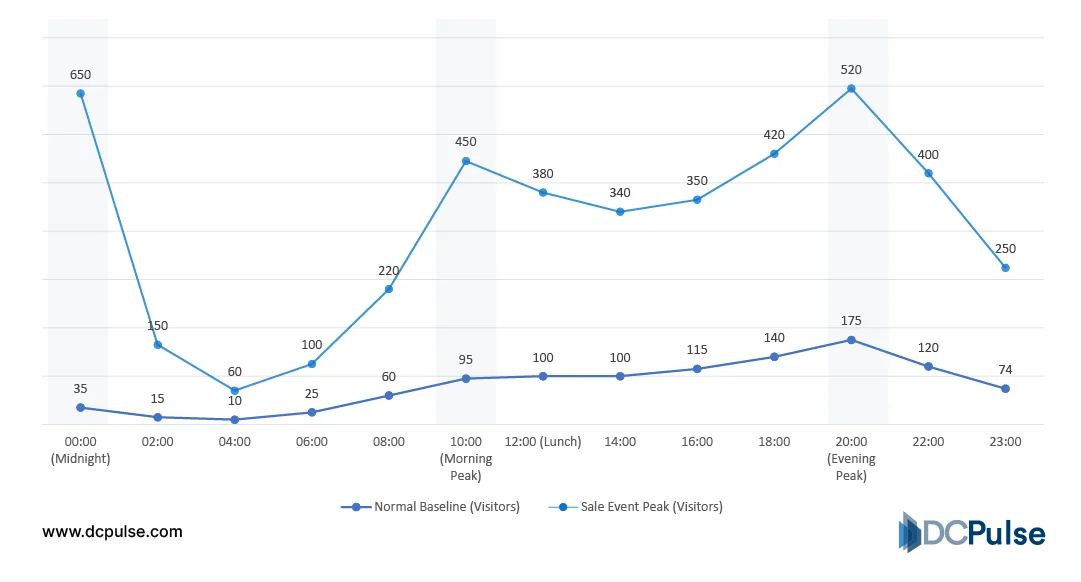
In parallel, companies like Shopify leverage a combination of cloud infrastructure and content delivery networks (CDNs) to handle massive traffic surges during events like Black Friday and Cyber Monday, ensuring fast page loads and transaction stability across global markets.
Despite these advances, challenges remain. Sudden demand spikes can still strain systems, particularly when scaling decisions are reactive rather than predictive. This highlights a key limitation of current strategies: while infrastructure can scale, anticipating demand with precision remains a critical gap in managing seasonal e-commerce workloads.
How Are Emerging Technologies Enabling Predictive and Elastic Scaling in E-Commerce?
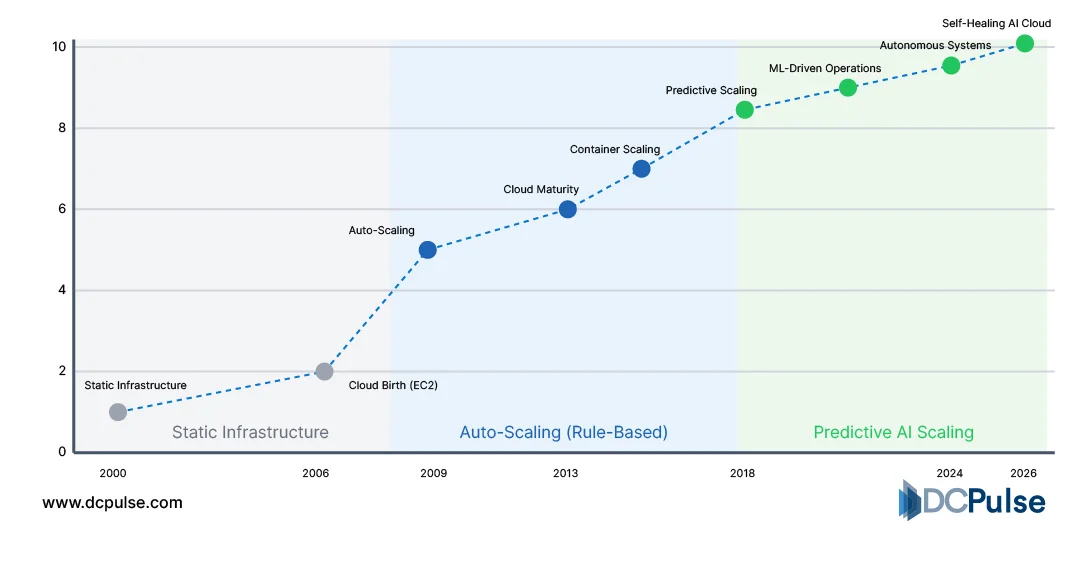
E-commerce infrastructure is rapidly evolving from reactive scaling to predictive and automated elasticity, driven by advances in AI, serverless computing, and edge networks. Instead of responding to traffic spikes after they occur, platforms are increasingly using machine learning models to forecast demand patterns based on historical data, user behavior, and seasonal trends.
Cloud providers like Google Cloud are enabling this shift through AI-driven analytics and auto-scaling services that dynamically allocate compute resources ahead of anticipated demand. These systems reduce latency and prevent service degradation during peak events by pre-provisioning capacity based on predictive insights.
Evolution of Infrastructure Scaling Strategies
At the same time, edge platforms like Cloudflare are enhancing performance during high-traffic periods by distributing workloads closer to users. By caching content and executing logic at the edge, these systems reduce the burden on centralized data centers and ensure consistent user experience even during extreme demand spikes.
Another key innovation is the rise of serverless architectures, where compute resources are allocated automatically in response to incoming requests. This model eliminates the need for manual provisioning and allows platforms to scale seamlessly with user demand, making it particularly effective for unpredictable traffic patterns.
Together, these innovations are enabling e-commerce platforms to transition from reactive infrastructure management to intelligent, self-adjusting systems, capable of handling seasonal demand with greater efficiency and reliability.
How E-Commerce Giants Execute at Peak Scale
Seasonal demand in e-commerce is no longer theoretical; it is tested in real time during global events where platforms must handle extreme, synchronized traffic spikes without failure. The most telling industry moves come from how leading platforms execute during these moments.
During major sales events like Prime Day, Amazon operates at a scale where millions of transactions occur within minutes, supported by a globally distributed infrastructure built on its own cloud ecosystem. These events demonstrate the effectiveness of deep vertical integration, where compute, storage, and networking are tightly controlled to ensure resilience under peak load.
Peak Shopping Event Scale (2025 Actuals)
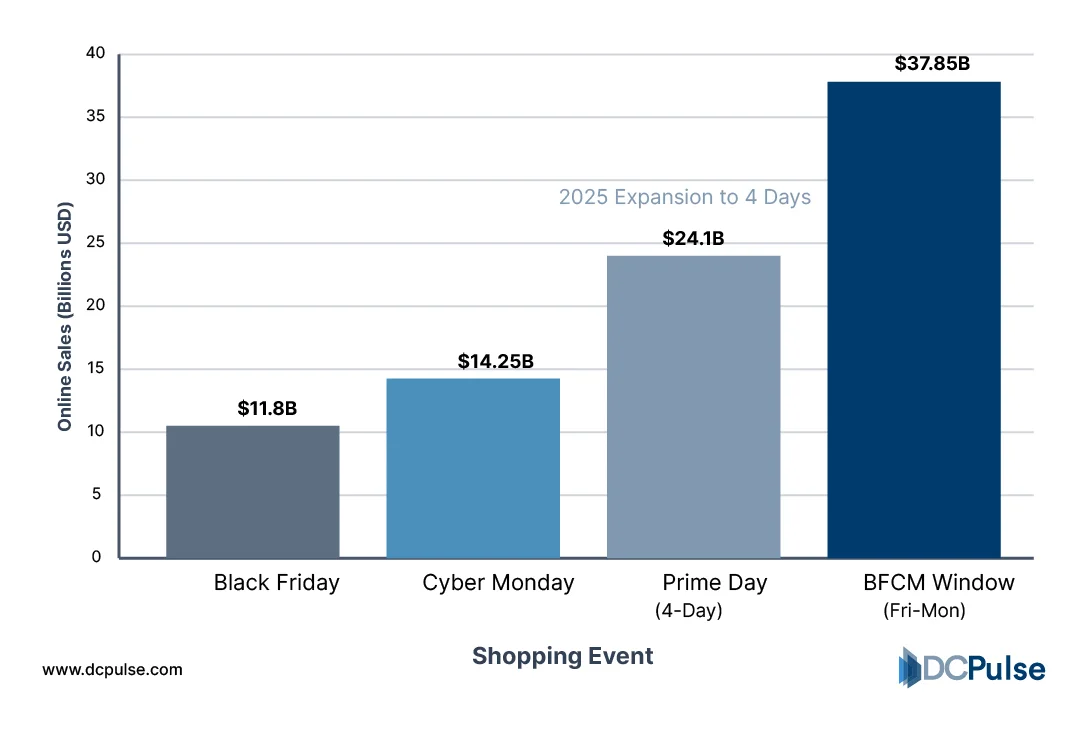
Similarly, Shopify has demonstrated its ability to handle massive seasonal demand during Black Friday-Cyber Monday events, where the platform processes millions of orders and sustains high transaction throughput globally. Its approach relies on pre-event load testing, elastic cloud scaling, and edge distribution, ensuring consistent performance across regions.
Beyond individual platforms, companies like Cloudflare play a critical role in absorbing traffic surges at the network edge, mitigating latency and protecting origin infrastructure during high-demand periods.
These industry moves highlight a clear pattern: successful execution during seasonal peaks depends on a multilayered strategy, combining proprietary infrastructure, elastic cloud scaling, and edge network optimization to maintain performance at global scale.
Will Elastic Data Center Strategies Become the Default for E-Commerce Infrastructure?
Elastic data center strategies are rapidly becoming the default model for e-commerce, driven by the need to handle highly variable, seasonal demand without overprovisioning infrastructure. As traffic patterns grow more unpredictable and globally distributed, fixed-capacity systems are proving inefficient both in cost and performance.
The shift toward elasticity is being reinforced by advances in cloud computing, edge networks, and predictive scaling. Platforms can now dynamically allocate resources in real time, ensuring consistent performance during peak events while minimizing idle capacity during off-peak periods. This not only improves operational efficiency but also enhances customer experience by reducing latency and downtime.
However, challenges remain. Over-reliance on elastic scaling can lead to cost volatility, particularly during extended high-demand periods. Additionally, integrating multiple layers, core data centers, cloud environments, and edge networks requires sophisticated orchestration and monitoring capabilities.
Despite these complexities, the long-term trajectory is clear. E-commerce infrastructure is moving toward fully autonomous, self-scaling systems, where elasticity is not an optimization layer but a foundational design principle. In this environment, the ability to scale seamlessly will define competitive advantage in digital commerce.