Pranav Hotkar
When a customer taps “Buy Now,” the real race begins, not on a website, but inside a data center that may be just a few miles away. For e-commerce giants, milliseconds now define competitive advantage. Same-day delivery promises, real-time inventory visibility, dynamic pricing, fraud detection, and personalized recommendations all hinge on how quickly data can be processed and acted upon. Centralized cloud regions alone can no longer keep up with this demand for immediacy.
This is where edge deployments are reshaping the digital commerce stack. By pushing compute, storage, and analytics closer to consumers, e-commerce leaders are re-architecting their infrastructure to reduce latency, cut bandwidth costs, and maintain uptime during traffic spikes such as flash sales and holiday events. What began as a performance optimization has become a strategic infrastructure shift, one that is redefining how retail platforms scale, secure, and monetize digital experiences.
Edge computing is no longer an experiment at the margins of e-commerce. It is becoming a core pillar of how the world’s largest online retailers design their data center footprint for the next phase of growth.
Edge Infrastructure as a Performance Layer for Digital Commerce
For large e-commerce platforms, edge infrastructure has moved from optimization to necessity. As customer expectations around page load times, checkout responsiveness, and real-time availability have tightened, centralized cloud regions alone struggle to deliver consistent performance at scale.
Physical distance still matters. Edge computing reduces that distance by processing data closer to users, cutting network latency and improving response times for transaction-heavy workloads such as search, product rendering, and checkout flows.
Global Distributed Banking Infrastructure - Edge Nodes Aligned with Demand Cluster:
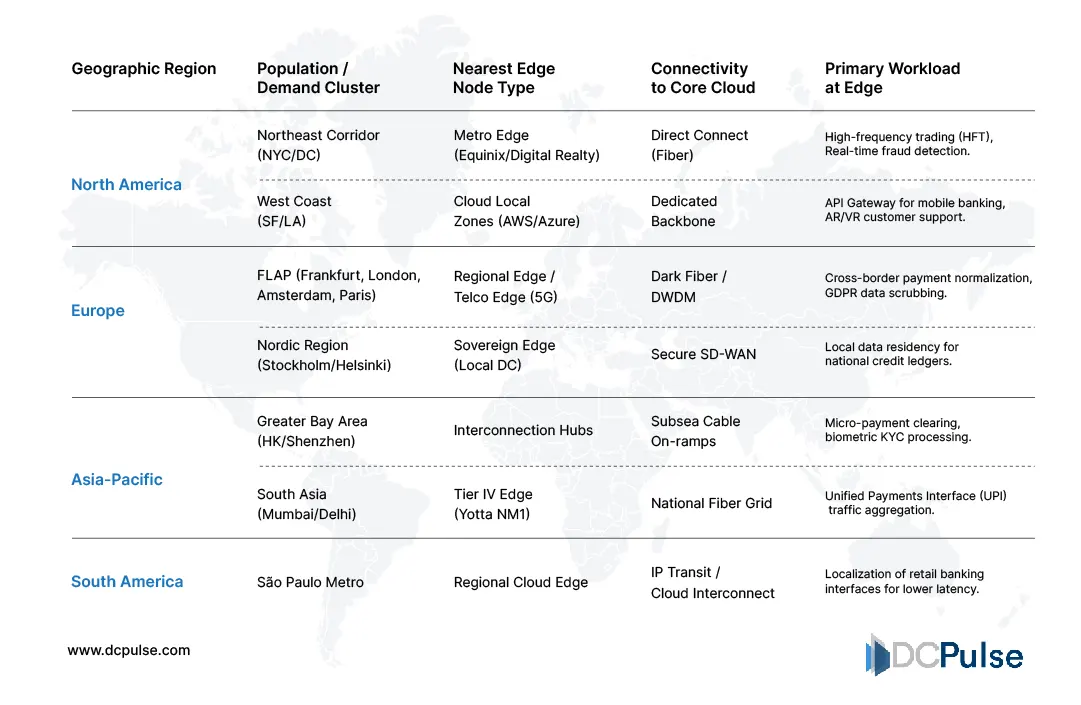
In practice, this means e-commerce companies are relying on a hybrid model: centralized cloud infrastructure for core data and orchestration, supported by regional and metro-level edge nodes for latency-sensitive tasks. During high-traffic events, flash sales, seasonal promotions, or major product launches, edge deployments help absorb load locally, preventing congestion in central systems and maintaining user experience.
Centralized Cloud vs. Cloud-plus-Edge Delivery Paths
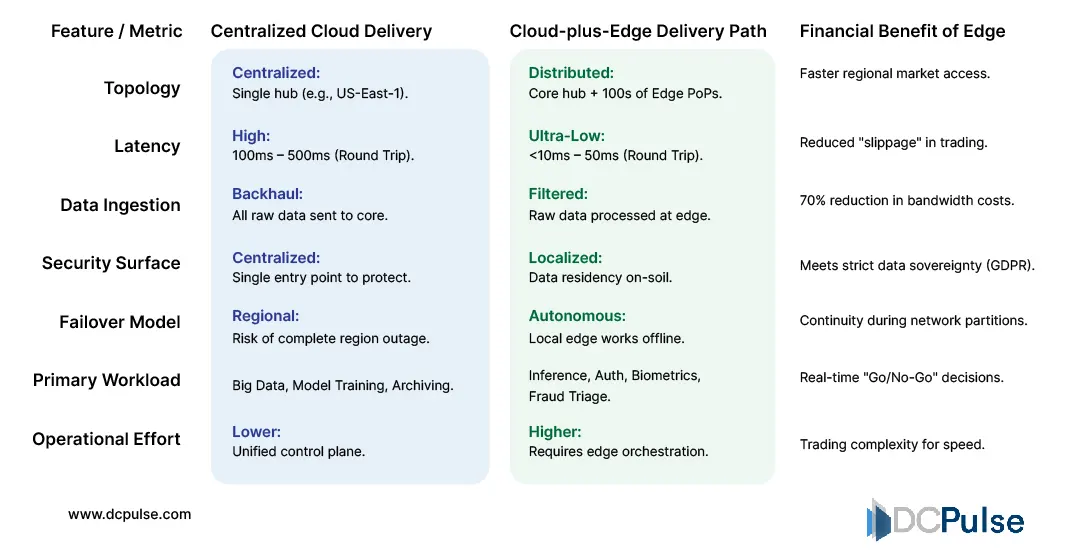
Edge infrastructure also improves bandwidth efficiency and resilience by handling repetitive or localized workloads near the source, reducing backhaul traffic and minimizing single points of failure. This shift is influencing how data center operators design facilities, with greater emphasis on distributed, smaller-footprint sites closer to demand centers.
Infrastructure Innovations Tailored to E-Commerce Workloads
E-commerce platforms are pushing edge deployments beyond basic caching into real-time, localized processing that directly improves customer experience and operational efficiency. One major innovation is the use of edge computing for instant personalization, processing browsing patterns, purchase histories, and behavioral signals locally to deliver tailored recommendations and dynamic promotions without a round trip to centralized cloud servers. This reduces latency and enhances conversion rates during peak shopping moments.
Another emerging use of edge infrastructure is in real-time fraud detection and prevention. By analyzing transaction patterns and anomaly signals at the edge rather than in distant data centers, platforms can flag suspicious behavior and block fraudulent actions before they complete, improving both security and trust.
Edge innovation also extends to smart logistics and inventory orchestration. Hybrid systems use edge analytics near warehouses and fulfillment centers to optimize stocking, routing, and demand forecasting, reducing latency in supply chain decisions and lowering delivery times.
Taken together, these innovations show that edge deployments are no longer just peripheral enhancements; they are integral infrastructure upgrades enabling real-time responsiveness, localized security, and smarter operational decisions for e-commerce giants.
From Strategy to Footprint: What Large E-Commerce Players Are Actually Building
E-commerce giants are turning edge experimentation into operational strategy, using distributed infrastructure to improve performance, reliability, and responsiveness.
Amazon continues to anchor edge and regional deployments through its AWS edge services. Its AWS Local Zones and CloudFront CDN help bring compute and caching closer to end users, reducing latency for personalized experiences and checkout workflows. These edge extensions are used not just for static content but also for accelerating dynamic e-commerce logic at scale.
Walmart has taken a different approach by integrating edge compute directly into fulfillment and store networks. By deploying compute nodes near logistics hubs and store clusters, Walmart leverages edge processing for inventory visibility, real-time pricing adjustments, and last-mile fulfillment orchestration, blurring the line between physical and digital infrastructure.
Alongside hyperscalers and retailers, colocation providers like Equinix and Digital Realty are expanding edge footprints to support latency-sensitive commerce workloads. Their data centers host interconnections between retailers, payment processors, and cloud services, enabling multi-party edge ecosystems that reduce transit times and improve resilience.
These moves show that e-commerce edge deployments are no longer isolated pilots. They are institutional infrastructure decisions influencing where and how digital commerce operates at scale across regions.
Edge Infrastructure as a Strategic Commerce Asset
Edge deployments are no longer experimental add-ons to e-commerce platforms. They have become strategic infrastructure layers that reduce latency, improve resilience, and enable real-time responsiveness at scale. As companies continue to push personalized services, dynamic pricing, and logistics automation, edge compute and caching nodes will play an increasingly visible role in shaping customer experiences and operational cost structures.
The competitive edge gained from localized compute is not just performance; it also supports regional compliance, data sovereignty, and security frameworks by placing sensitive processing closer to users while maintaining centralized governance. Choosing where and how to deploy edge nodes has become a deliberate decision tied to traffic patterns, fulfillment geography, and expected peak loads.
For operators, this means planning for distributed capacity, not just bigger core data centers. It means integrating edge into capacity forecasts, redundancy planning, and network design from the outset. And it means partnering with providers that can span from centralized cloud to metro and regional edge with consistency in security, monitoring, and system management.
Edge infrastructure has moved from optional optimization to a core enabler of next-generation digital commerce, a shift that will define how e-commerce platforms scale and compete in the years ahead.