Pranav Hotkar
Digital banking may feel weightless to customers, with instant payments, real-time balances, and always-on mobile access, but behind every transaction sits a physical infrastructure that cannot afford to fail. As banks move deeper into cloud-native platforms and real-time financial services, data centers have become the operational backbone of modern banking.
Unlike traditional enterprise workloads, digital banking systems operate under constant regulatory scrutiny, strict latency requirements, and zero tolerance for downtime. Every login, payment authorization, and fraud check depends on resilient compute, secure storage, and highly available network paths operating across multiple locations.
This shift has forced banks and financial institutions to rethink where and how their digital platforms run. From regional colocation facilities supporting core banking applications to hyperscale cloud data centers enabling analytics and AI-driven risk models, infrastructure decisions now directly shape customer experience and regulatory compliance.
In the digital banking era, innovation at the application layer is only as strong as the data centers that support it.
Where Banking Infrastructure Stands Today
The digital banking revolution has pushed data center infrastructure into the spotlight in ways few other industries have experienced. Traditional financial systems were often run in private enterprise facilities with strict control over hardware and environments.
Today’s digital banks rely on a mix of hyperscale cloud platforms, regional colocation data centers, and on-premises core systems to meet the demands of availability, scalability, and security.
A 2024 survey by the Banking Industry Architecture Network (BIAN) found that over 70% of banks now operate core or customer-facing functions in multi-site data center environments, combining cloud and colocation to balance performance with regulatory compliance. This hybrid model ensures that critical financial workloads are supported by resilient infrastructure while meeting data residency and audit requirements.
Hybrid Financial Infrastructure
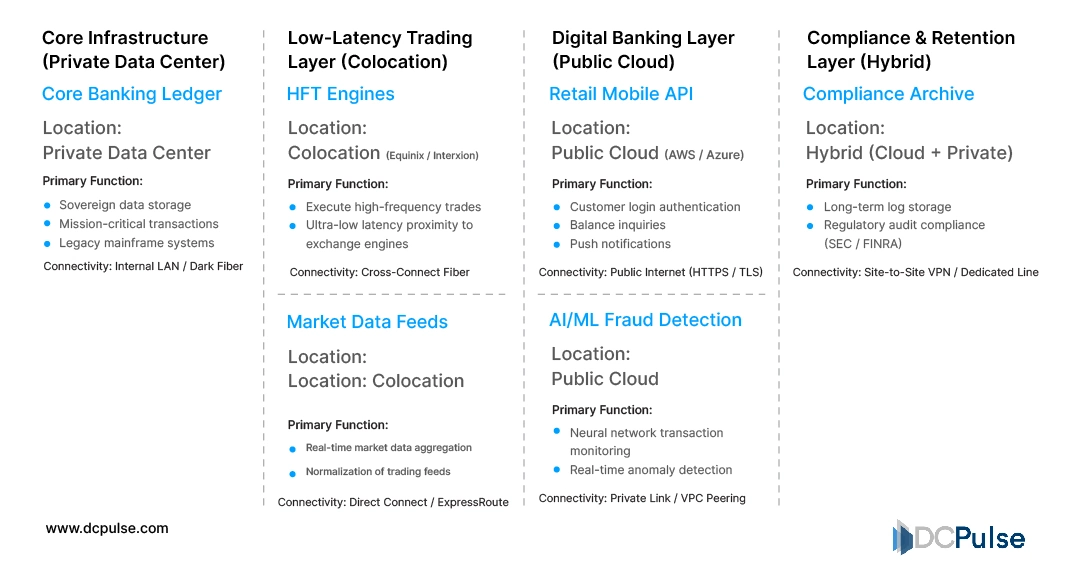
Security remains paramount. Financial regulators globally require robust physical and logical security controls for systems handling payments and customer data. Data centers hosting these workloads typically meet multiple certifications such as ISO 27001, SOC 2, and PCI DSS, assuring controlled access, monitoring, and audit readiness.
Latency and uptime are also distinct constraints. Retail banking services expect sub-second responsiveness, especially for real-time payments and fraud detection systems. As a result, many banks distribute services across multiple edge-proximate data centers and cloud availability zones to reduce latency and avoid single points of failure.
Key Low-Latency Financial Hubs
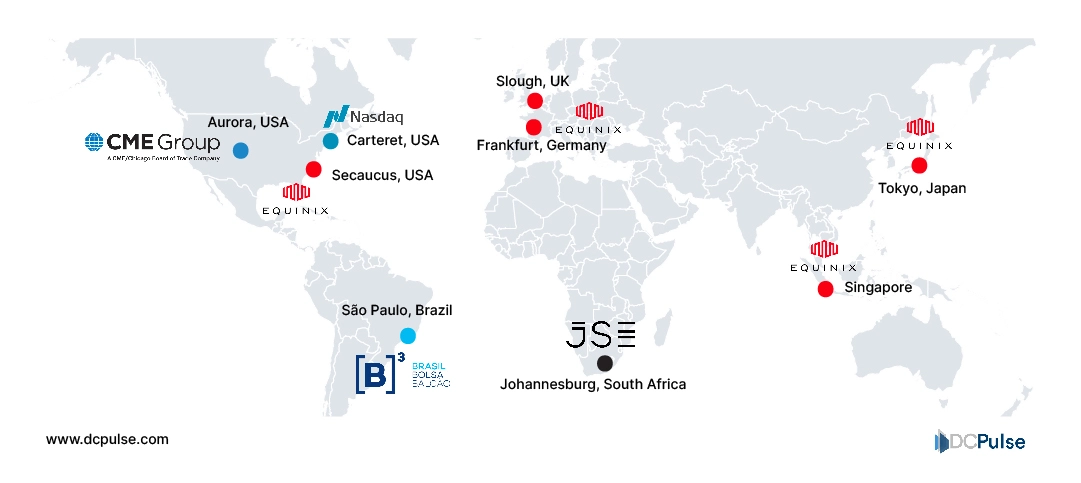
In this environment, data centers are no longer neutral pipes for computing; they are strategic assets shaping how digital banking services are delivered, scaled, and secured.
Infrastructure Innovations Enabling Always-On Digital Banking
Digital banking growth has prompted operators to rethink data center design, focusing on resilience, compliance, and latency-sensitive performance. One of the clearest innovations is banking-specific colocation environments, which provide secure, audit-ready infrastructure tailored to regulated workloads.
These facilities integrate hardened access control, monitored zones, and compliance frameworks such as PCI DSS and ISO 27001, allowing banks to scale without compromising regulatory requirements.
Another innovation is the rise of active-active multi-site architectures. Banks are synchronizing core systems and transaction processing across multiple data centers, reducing downtime risk and ensuring real-time availability for payments, fraud detection, and customer services. Tier III and above facilities provide N+1 redundancy, supporting continuous operations without maintenance interruptions.
Finally, hybrid cloud and edge integration are enabling real-time banking services with minimal latency. Distributed, edge-proximate nodes allow instant payments and fraud scoring while maintaining centralized control over sensitive financial data.
How Banks and Infrastructure Providers Are Responding
As digital banking matures, infrastructure decisions are increasingly being shaped by concrete moves from hyperscalers, colocation providers, and financial institutions themselves. Major cloud providers are formalizing banking-specific infrastructure offerings rather than treating financial services as generic enterprise workloads.
Microsoft’s Cloud for Financial Services framework, for example, emphasizes secure data handling, regulatory alignment, and hybrid deployment models that rely on tightly integrated data center infrastructure.
On the physical infrastructure side, colocation providers are doubling down on financial ecosystems. Equinix continues to expand its financial services hubs, where banks, payment networks, and cloud platforms interconnect inside the same data center campuses to reduce latency and enhance transaction resilience.
Banks are also making deliberate architectural shifts. JPMorgan Chase, for instance, has publicly outlined its transition to a hybrid cloud and data center model, keeping sensitive workloads under tight control while using cloud infrastructure for scalability and analytics.
Together, these moves signal that digital banking infrastructure is becoming more distributed, interconnected, and purpose-built.
Why Infrastructure Will Define the Next Phase of Digital Banking
The next phase of digital banking will be shaped less by new features and more by the infrastructure choices banks make today. As transaction volumes rise and real-time services become standard, data centers will continue to act as the foundation for reliability, security, and regulatory compliance.
Rather than consolidating into fewer locations, banking infrastructure is becoming more distributed and interconnected. Hybrid models that combine private data centers, regulated colocation, and cloud platforms allow banks to balance control with scalability while maintaining low-latency access for customers. This approach reduces systemic risk and improves resilience during outages or demand spikes.
Security and compliance will remain non-negotiable. With increasing regulatory scrutiny and growing cyber threats, banks will favor infrastructure partners that can demonstrate physical security, audit readiness, and operational transparency at scale. These requirements elevate data centers from backend assets to strategic enablers of trust.
The strategic takeaway is clear: digital banking innovation depends on infrastructure discipline. Institutions that invest in resilient, compliant, and flexible data center architectures will be best positioned to scale services, absorb future regulatory change, and maintain customer confidence in an always-on financial environment.