Pranav Hotkar
Data center expansion is no longer just a question of where to build, but how. As demand accelerates across cloud, AI, and digital services, operators are under pressure to deliver capacity faster, control capital risk, and maintain long-term efficiency. That pressure has brought a long-simmering debate to the forefront of boardroom discussions: modular builds versus traditional construction.
Traditional data centers have long been the default, offering design flexibility and proven operating models at scale. Modular facilities, by contrast, promise speed, predictability, and tighter cost control through prefabrication and standardized deployment. What was once seen as a niche or temporary solution is now being considered for core capacity planning.
The decision, however, is not binary. Each approach carries distinct trade-offs across cost structure, deployment timelines, operational efficiency, and scalability. As capital discipline tightens and time-to-market becomes a competitive differentiator, understanding these trade-offs is critical. Choosing the wrong build strategy can lock operators into inefficiencies for decades; choosing the right one can reshape expansion economics.
Comparing Modular and Traditional Data Center Builds Today
The data center footprint strategy is increasingly shaped by the trade-offs between modular and traditional builds, with implications for cost, time to market, and operational efficiency. Traditional data centers rely on bespoke construction using on-site labor, custom design, and long build cycles.
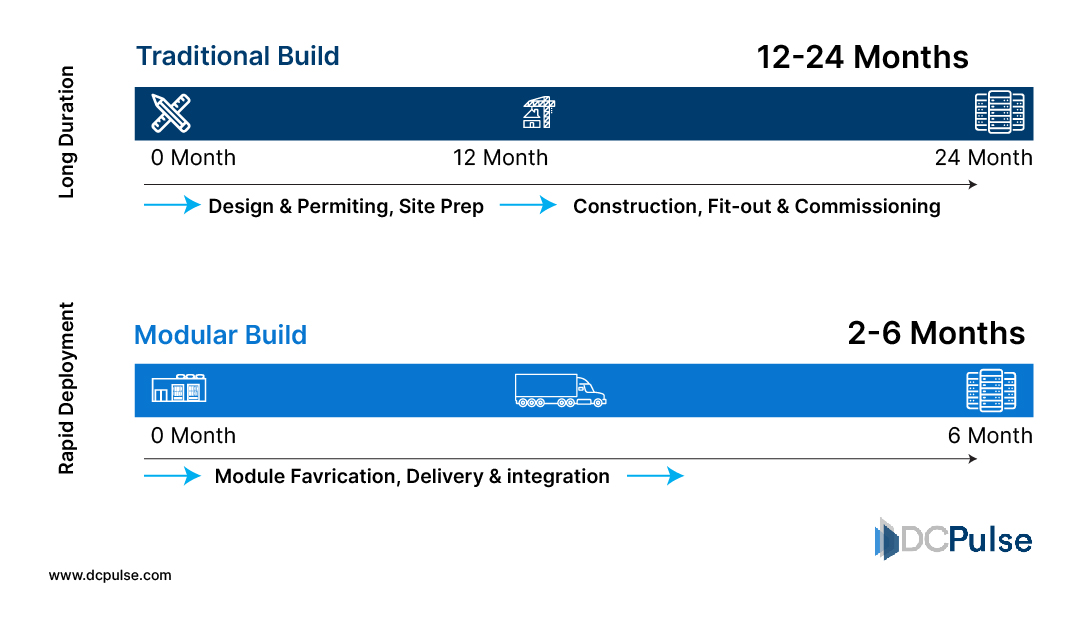
Industry reports indicate that traditional facilities often require 12-24 months or more from design to operation, a timeline that can delay revenue capture and compromise agility in fast-moving markets. Modular builds, in contrast, use prefabricated units assembled off-site, compressing deployment timelines to as little as 2-6 months and helping organizations respond rapidly to capacity needs.
Timeframe—traditional build versus modular deployment
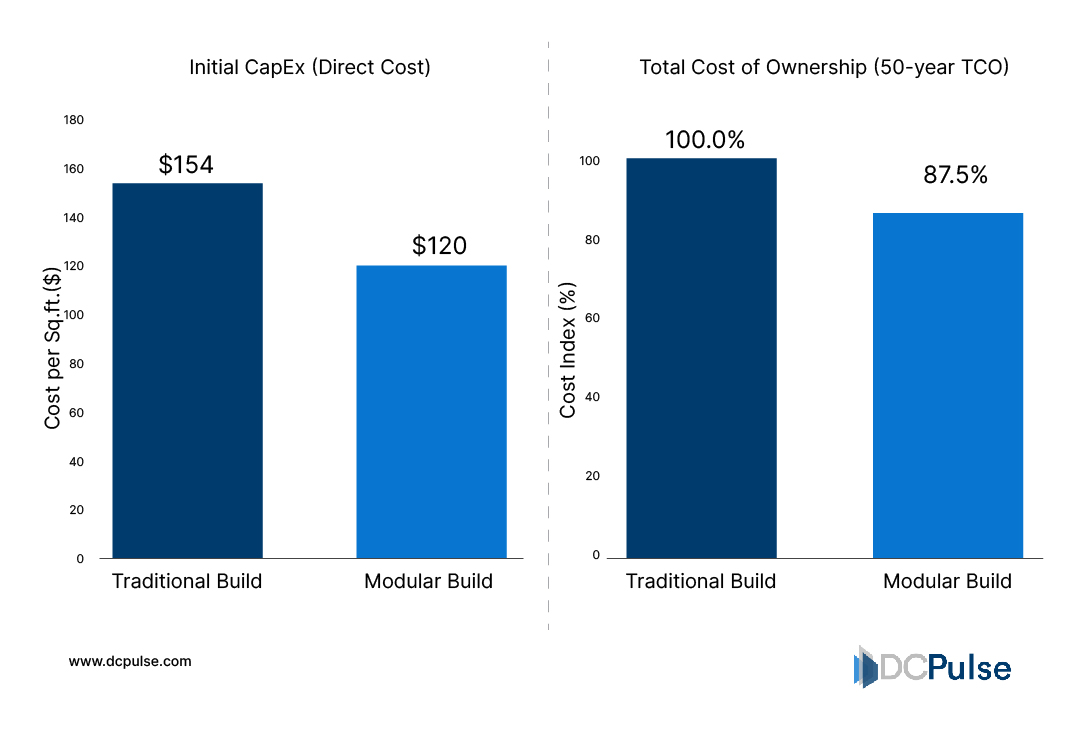
Cost remains a core differentiator. Modular construction typically reduces upfront capital expenditure through standardized, factory-controlled production lines and enables phased expansion aligned with demand rather than committing to full build-out upfront. One industry analysis found prefabricated solutions can deliver 20-40% lower CapEx and improved total cost of ownership due to lower labor and material costs.
CapEx and TCO for modular vs traditional builds
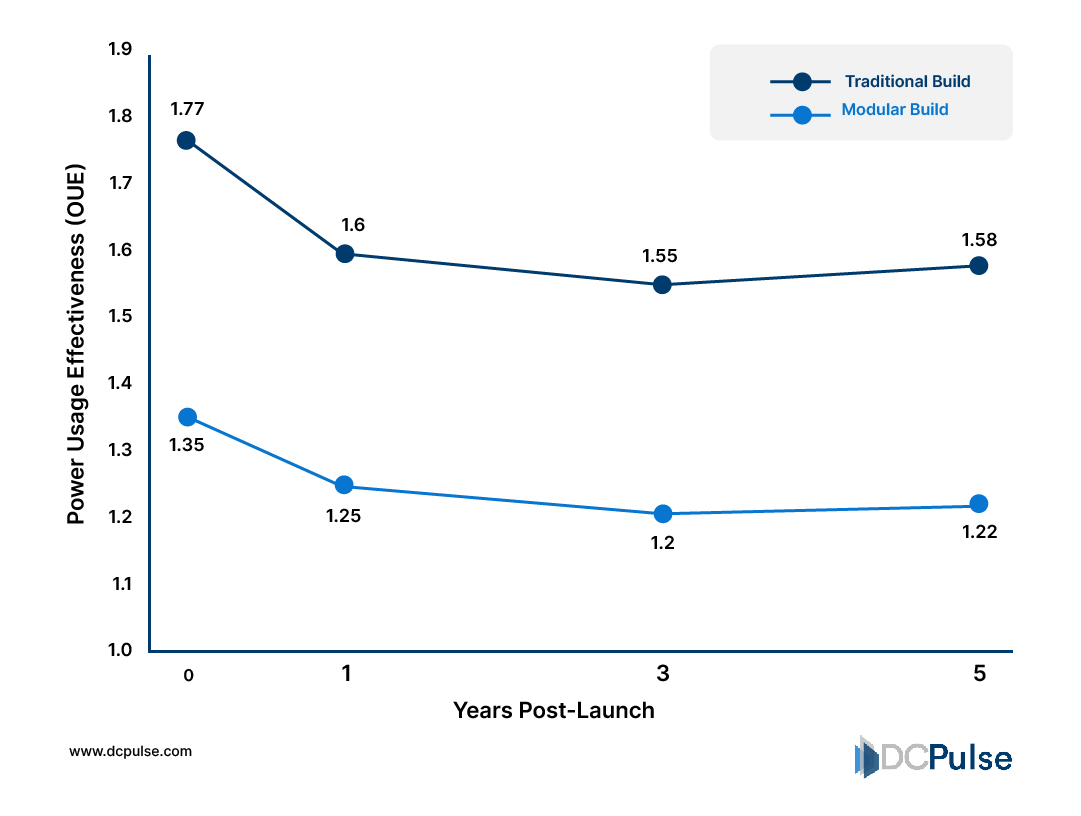
Energy and operational efficiency also differ. Modular units often achieve better power usage effectiveness (PUE) out of the gate due to optimized, compact designs, while traditional facilities may reach similar efficiency only after reaching full load.
PUE Trajectory Comparison (0–5 Years)
Today’s landscape is not binary; both approaches serve distinct strategic needs, but the adoption of modular builds reflects a growing emphasis on speed, predictability, and cost discipline in infrastructure planning.
How Build Models Are Quietly Being Re-Engineered`
The most important innovations in data center construction today are happening inside the build process itself, not in headline choices between modular and traditional approaches. Operators are redesigning how infrastructure is delivered to reduce uncertainty, improve repeatability, and stay flexible as workloads evolve.
In modular construction, innovation is centered on industrialized delivery. Hyperscalers increasingly rely on prefabricated power, cooling, and IT blocks that are assembled and tested off-site before deployment. Google has detailed how standardized infrastructure components allow faster replication across regions while maintaining consistent performance and reliability across its global fleet.
Traditional builds are evolving in parallel, not standing still. Large campuses are now designed with phased activation in mind, where core civil and structural elements are built upfront, but electrical and mechanical systems are deployed incrementally. Microsoft explains how this approach allows long-lived facilities to adapt to changing density and cooling requirements without major redesign.
Across both models, operators are prioritizing standardization over customization. AWS describes its data centers as highly repeatable environments, enabling predictable performance, streamlined operations, and faster scaling regardless of whether components arrive modularly or are assembled on-site.
Innovation, then, is less about choosing a construction ideology and more about engineering adaptability into the footprint itself.
How Operators Are Translating Strategy into Footprints
Across the industry, recent build decisions show that operators are no longer choosing between modular and traditional approaches in isolation. Instead, they are combining them pragmatically, based on geography, speed requirements, and capital exposure.
Hyperscalers are leading this shift. Microsoft has expanded multiple campuses using phased build strategies, where core facilities are constructed traditionally while internal power and cooling systems are deployed incrementally. This allows capacity to come online in step with demand, rather than being locked in upfront.
At the same time, Google continues to rely on highly standardized infrastructure designs across regions, enabling faster replication while maintaining operational consistency. Its data center program emphasizes repeatable layouts and modularized internal systems to support global scale without bespoke redesigns for each site.
Colocation providers are also reshaping their strategies. Equinix and Digital Realty have both highlighted modular and prefabricated components as a way to accelerate expansion in emerging and secondary markets, where speed-to-market and cost control are critical.
Modular Data Center Adoption (Estimated 2025)
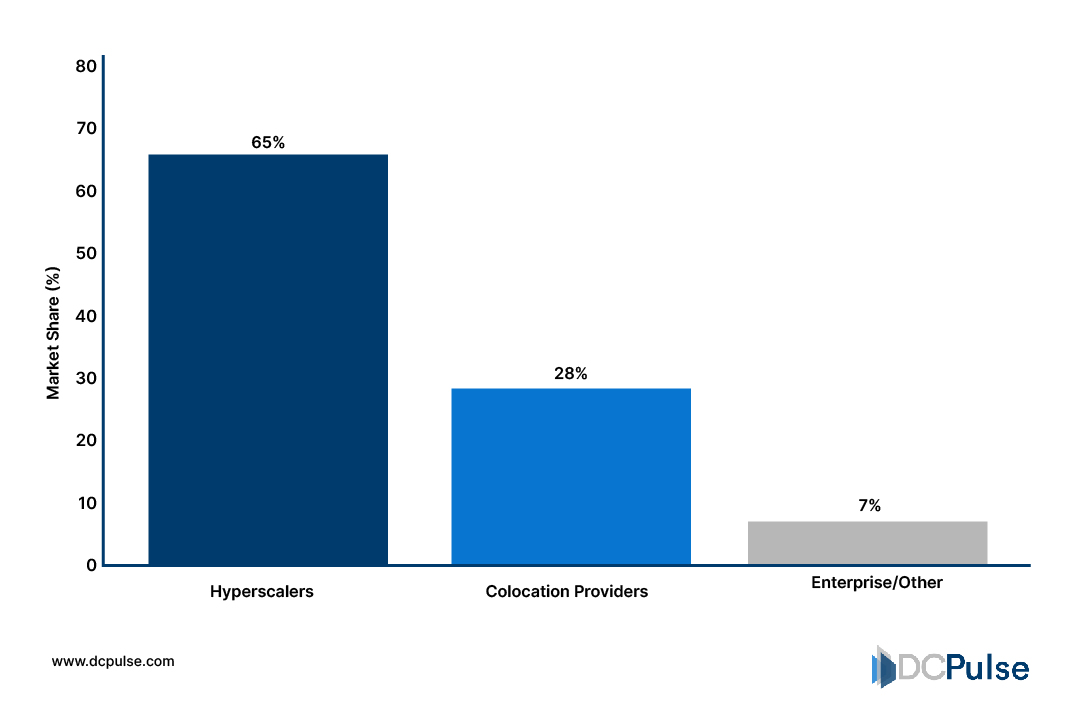
Together, these moves signal a shift from ideology to execution, where build models are selected as tools, not doctrines.
Choosing Flexibility Over Dogma
The debate between modular and traditional data center builds is steadily losing relevance. What matters more now is how effectively operators design for uncertain demand, shifting workloads, and capital discipline. The most successful strategies emerging across the industry prioritize flexibility over fixed assumptions.
Hyperscalers and large operators are increasingly treating data centers as long-lived platforms rather than static assets. This means combining traditional construction, where durability and scale matter most, with modular or prefabricated systems, where speed and repeatability reduce risk. Public disclosures from Google and Microsoft both emphasize standardization, phased growth, and infrastructure reuse as core principles of long-term efficiency rather than one-time build choices.
For executives, the takeaway is clear: building models should be evaluated as tools in a portfolio, not binary decisions. Capital timing, regional constraints, and workload volatility should guide deployment choices. In that context, success is less about how fast a facility is built and more about how well it adapts over time.