Pranav Hotkar
Inside a modern factory, decisions are no longer made minutes or even seconds after something happens. They’re made in real time. A robotic arm adjusts its motion mid-cycle to avoid a defect. A vision system flags a micro-fracture before it becomes scrap. An automated guided vehicle reroutes itself instantly when an aisle becomes congested. None of this works if the computer arrives late.
Smart factories depend on real-time computing because industrial processes are unforgiving. Latency isn’t just an inconvenience; it translates directly into wasted materials, unplanned downtime, and safety risks. As manufacturers push toward higher automation, tighter tolerances, and mass customization, the margin for delay keeps shrinking.
This shift is reshaping how compute is deployed on the factory floor. Traditional centralized IT models, where data travels to distant data centers for processing, struggle to meet millisecond-level response requirements. Instead, manufacturers are blending on-prem systems, edge computing, and tightly integrated cloud platforms to keep decision-making as close to machines as possible.
Understanding how this real-time infrastructure works, and where it’s evolving next, starts with a look at the current landscape of compute inside smart factories today.
How Real-Time Compute Supports Today’s Smart Factories
Modern smart factories rely on a layered compute architecture that combines on-premises industrial controllers, localized edge nodes, and cloud platforms to handle both deterministic and high-volume workloads.
At the factory floor, programmable logic controllers (PLCs) and industrial PCs execute sub-millisecond operations, controlling robotic arms, conveyors, and sensors. These systems ensure predictable performance even if external connectivity fails. Edge nodes complement this setup by processing large streams of sensor and vision data in near real time, enabling quality inspection, motion optimization, and autonomous logistics. According to SUSE, edge computing allows manufacturers to process critical workloads locally while sending aggregated data to the cloud for further analysis.
Response Time Comparison - PLC vs. Edge vs. Cloud
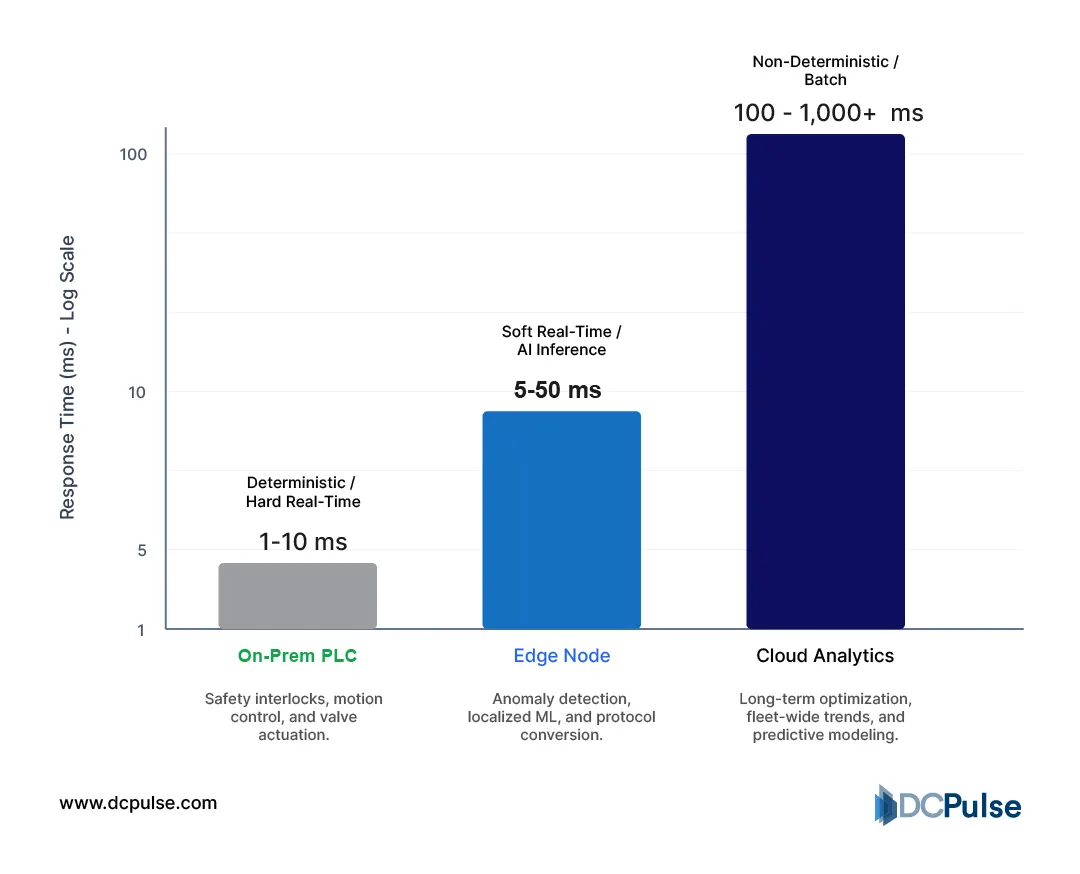
Cloud platforms remain essential for cross-site coordination, AI model training, and digital twin management, but latency-sensitive control tasks stay on-prem or at the edge. Industrial Ethernet notes that edge computing significantly reduces response times compared to centralized cloud-only architectures.
Distributed Industrial Clusters & Regional Edge Hubs (2026)
.webp)
This hybrid setup defines the current smart factory landscape, balancing millisecond-level decision-making with centralized oversight and analytics.
Where Real-Time Compute in Smart Factories Is Advancing
As smart factories mature, innovation is increasingly focused on tightening latency budgets and distributing intelligence closer to machines. One major shift is the rise of edge AI inference, where vision models and predictive algorithms run directly on factory-floor edge servers instead of centralized systems. NVIDIA notes that manufacturers are deploying edge AI to perform real-time defect detection and process optimization without introducing network delay.
Another critical innovation is the adoption of time-sensitive networking (TSN) and deterministic Ethernet. TSN enables precise timing and guaranteed delivery for industrial traffic, allowing IT and operational workloads to coexist on the same network without compromising control performance. Intel outlines how TSN is becoming foundational for next-generation industrial automation.
Standard Ethernet vs. TSN Performance (2026)
.webp)
Wireless infrastructure is also evolving. Private 5G networks with ultra-reliable low-latency communication (URLLC) are being tested to support mobile robots and flexible production lines. Ericsson highlights how private 5G enables real-time control where wired connections are impractical.
Together, these innovations are reshaping how real-time compute is delivered, making factories more adaptive, autonomous, and latency-resilient.
How Industrial Players Are Putting Real-Time Compute into Practice
Real-time compute is no longer confined to pilot projects. Major industrial players are now deploying edge infrastructure at scale, embedding low-latency processing directly into production environments.
Siemens has expanded Industrial Edge beyond monitoring into real-time analytics and AI-driven applications running close to machines. The platform allows manufacturers to deploy containerized workloads at the field level while maintaining centralized governance, reducing latency without sacrificing operational visibility. This shift reflects a broader move toward distributed compute models that prioritize immediate response on the factory floor.
Rockwell Automation is making similar moves through its OptixEdge platform, designed to process industrial data locally and enable faster decision-making for quality, maintenance, and throughput optimization. According to Rockwell, placing compute at the edge reduces reliance on centralized systems while preserving deterministic control.
Industrial Response Times (Cloud-Only vs. Edge-Enabled)
.webp)
Rockwell is also partnering with NVIDIA to bring AI-powered reasoning to the industrial edge, enabling advanced analytics and real-time intelligence without introducing network delays.
Together, these moves show that real-time compute is becoming embedded infrastructure, critical to how modern factories operate, scale, and compete.
Real-Time Compute as a Manufacturing Imperative
As smart factories evolve, real-time compute is shifting from a performance enhancer to a core operational requirement. Manufacturers are no longer asking whether edge and on-prem compute are necessary, but how deeply they should be embedded across production lines. The ability to act on data instantly, rather than analyze it after the fact, is becoming central to efficiency, safety, and competitiveness.
Looking ahead, factory architectures will continue to decentralize. More intelligence will move closer to machines, supported by standardized platforms that allow workloads to be deployed, updated, and governed consistently across sites. This will help manufacturers scale automation without increasing complexity or risking downtime.
Strategically, real-time compute will also influence how factories are designed. Layouts, network topology, and power distribution will increasingly account for local compute density, not just machinery placement. At the same time, tighter integration between edge systems and cloud platforms will remain essential for optimization, coordination, and long-term planning.
For manufacturers investing in smart factories, the takeaway is clear: real-time compute is no longer a future consideration. It is a foundational capability that determines how fast, resilient, and adaptable modern production can be.