Pranav Hotkar
Retail has always lived and died by timing, but infrastructure planning has never moved at retail speed. Demand surges rarely arrive politely. They erupt around seasonal campaigns, influencer-driven spikes, regional events, or sudden shifts in consumer behavior that no spreadsheet forecast ever anticipated.
When compute falls short, transactions stall, recommendation engines lag, and customer experience fractures in seconds. When capacity overshoots, retailers quietly absorb the cost of idle infrastructure, inflated cloud bills, and underutilised edge deployments. For decades, this imbalance was treated as inevitable.
That assumption is now breaking.
Artificial intelligence is beginning to alter how retailers think about compute itself, not as a fixed resource to be provisioned conservatively, but as a dynamic capability that can be anticipated, reshaped, and reallocated ahead of demand. Instead of reacting to traffic spikes after systems strain, retailers are training models to predict where, when, and how much compute will be needed across stores, warehouses, edge locations, and cloud platforms. The transformation underway isn’t about automation alone. It’s about replacing intuition-driven infrastructure planning with foresight, precision, and measurable economic control.
Why Retail Compute Planning Is Breaking
Retail today is powered by data, but the infrastructure that supports it is not keeping pace with the volatility of demand signals across channels and geography. Historic compute planning in retail relied on predictable cycles, holiday peaks, weekly promotions, and quarterly resets, using simple averages or seasonal trend models to provision capacity. But in the age of omnichannel commerce and hyper-personalised shopping, those assumptions are no longer sufficient.
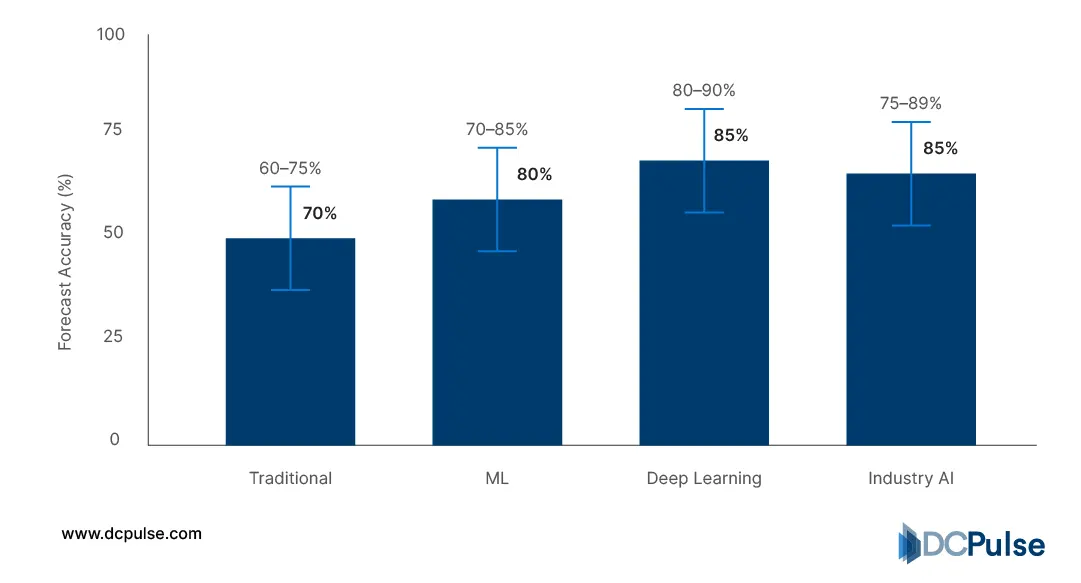
AI-driven demand forecasting is reshaping how retailers predict sales and infrastructure needs. Companies are embedding machine learning deep into their supply chain and IT architectures, feeding models hundreds of internal and external variables, including point-of-sale data, online traffic patterns, promotions, weather events, and social trends. These AI models uncover complex relationships that legacy forecasting tools cannot, enabling more accurate predictions of product demand and associated compute needs.
Demand Forecast Accuracy: AI vs Traditional Methods
The retail cloud ecosystem is responding. Solutions like Google Cloud’s Vertex AI Forecast allow retailers to build hierarchical forecasting models that align SKU-level predictions with store-level and regional demand patterns, reducing misallocations and smoothing compute load across cloud and edge platforms. These models train rapidly and adapt as new data arrives, enabling forecast-based compute adjustments rather than static, capacity-overprovisioned designs.
Market research confirms this shift at scale. Cloud-based AI forecasting platforms in regions such as the Gulf Cooperation Council (GCC) are already growing rapidly as retailers seek predictive demand insight to optimise both inventory and compute infrastructure, improving performance while reducing idle capacity.
These moves show a critical truth: retail compute is not just about handling transaction loads. It must be predictive, connected, and aligned to consumer demand signals in real time, or risk costly under-utilisation or performance failures when volatility strikes.
How AI Is Advancing from Demand Forecasting to Predicting Retail Compute Needs
Retailers’ embrace of AI for forecasting demand is now moving past inventory and staffing and into the domain of infrastructure planning itself. As AI systems ingest richer demand signals, such as point-of-sale data, customer behaviour, promotions, traffic patterns, and external drivers like weather, these models provide far more nuanced and timely forecasts than legacy methods.
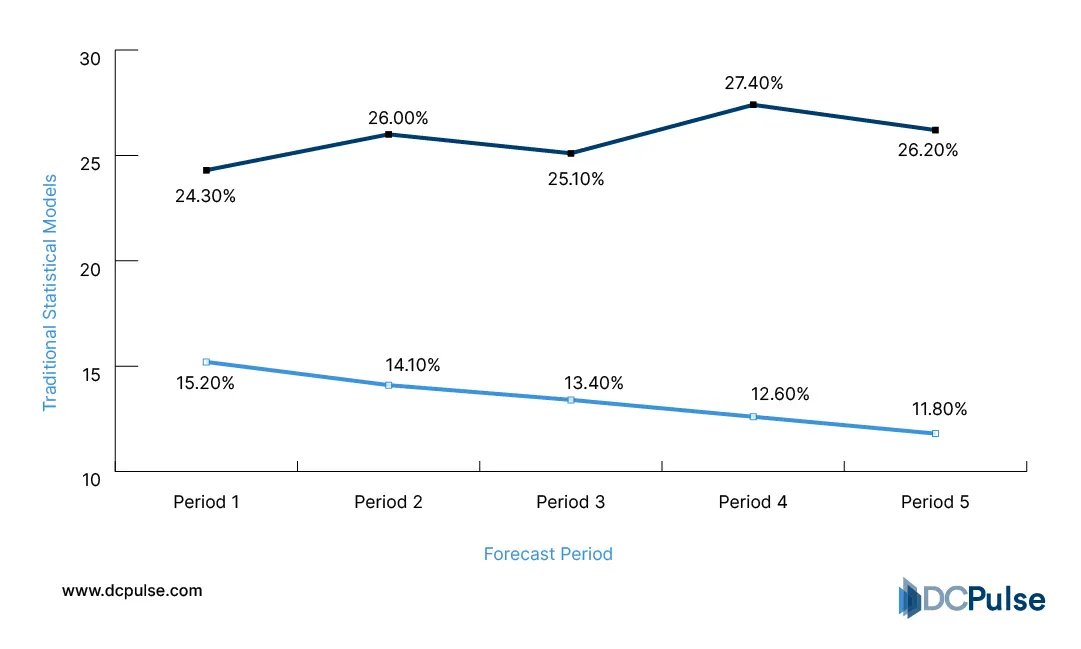
Accurate demand forecasting, as delivered by platforms like Google Cloud’s Vertex AI Forecast, can evaluate hundreds of variables across item, store, and region levels, helping retailers align SKU-level predictions with broader operational needs. This granular forecasting capability reduces forecast errors and allows compute planners to correlate expected demand with projected infrastructure loads.
Forecast error rates over time – traditional vs AI-enhanced demand models
But predicting compute demand requires more than just sales forecasts; it demands models that translate demand intensity into resource usage patterns. When predictive AI anticipates surges, such as a Black Friday peak or flash online promotion, retailers can simulate how those surges ripple through their technology stack, from point-of-sale servers to cloud services and edge compute clusters. Research into advanced predictive frameworks shows that machine learning models that incorporate seasonality, external events, and dynamic features consistently outperform static models at anticipating future trends.
Another critical innovation is predictive analytics optimisation. Retailers increasingly use platforms that not only forecast demand but also recommend how much compute should be provisioned, where it should sit (cloud vs edge), and when resource shifts should occur to meet forecasted loads. These platforms can reduce idle capacity costs and avoid performance bottlenecks by simulating what-if scenarios before demand spikes materialise. Tools from cloud providers and specialist AI solution vendors now offer predictive engines that tie operational forecasts directly to provisioning logic, making compute readiness a proactive part of retail decision-making.
Together, these innovations mark a clear evolution: AI is no longer just forecasting sales; it is predicting the infrastructure required to support those sales, enabling retailers to move from static capacity planning into real-time predictive provisioning that aligns compute resources with demand patterns.
How Retailers and Cloud Providers Are Operationalizing Predictive Compute
Retailers and cloud platforms are increasingly bridging the gap between demand forecasting and compute provisioning by deploying AI-driven capacity management systems that anticipate infrastructure needs before spikes occur.
One foundational move has been the integration of predictive autoscaling in cloud environments. Google Cloud’s predictive autoscaler, for example, uses historical utilisation trends and real-time signals to forecast future compute load and automatically provision virtual machine groups ahead of increases in usage. This lets applications add resources before latency or throttling occurs, effectively making infrastructure responsive to anticipated load rather than purely reactive.
Reactive scaling vs Predictive Autoscaling over time
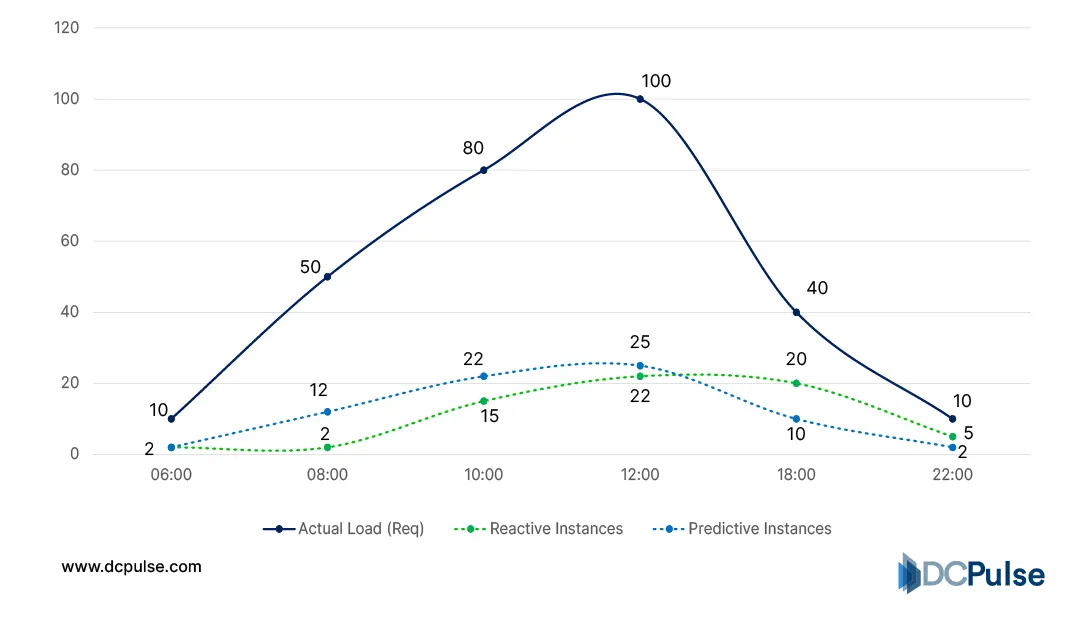
Major retailers themselves are embedding predictive compute planning inside AI platforms that span demand forecasting to capacity decisions. Google Cloud’s Vertex AI Forecast is already used by companies like Lowe’s and Magalu to generate hierarchical predictions across item, store, and region levels, and these forecasts are being integrated into broader infrastructure planning pipelines that consider compute and inventory jointly.
By tuning AWS, Vertex AI, or hybrid platforms to anticipate demand surges, retailers can align cloud and edge resources with predicted traffic patterns.
AI-powered forecasting tools are also influencing how planning teams operate. The AWS machine learning blog details how retailers such as Foxconn’s partners have used Amazon Forecast and SageMaker models to significantly increase forecasting accuracy for demand patterns, an outcome that directly influences how much cloud compute is provisioned and when. Improved forecast accuracy reduces both the risk of under-provisioning during surges and over-provisioning during lulls.
Behind the scenes, vendors are also innovating with end-to-end predictive capacity platforms, combining demand signals with cloud optimisation APIs. These systems not only forecast future loads but also actively recommend scaling policies and resource positioning (edge vs cloud) to minimise latency and cost while maximising resilience. As retail infrastructure sophistication grows, these predictive engines are becoming standard parts of the tech stack rather than experimental add-ons.
From Reactive Capacity to Predictive Advantage
The next phase of retail infrastructure will be defined by how effectively compute planning shifts from reaction to anticipation. As AI forecasting models mature, retailers are no longer sizing infrastructure around historical peaks but around probabilistic demand scenarios that update continuously. This allows compute capacity to follow demand patterns more closely, reducing idle resources while preserving performance during sudden surges.
Over time, predictive compute will become a core layer of retail operations rather than an optimisation tool. Hybrid architectures will increasingly rely on AI to determine not only how much capacity is required but also where it should reside, in centralised clouds for elasticity or at the edge for latency-sensitive workloads. The result is a tighter coupling between forecasting accuracy, infrastructure efficiency, and business outcomes.
Industry research from firms such as McKinsey suggests that organisations integrating advanced analytics into operational planning consistently outperform peers on cost control and service reliability.
For retailers, the strategic takeaway is clear: those that align AI-driven demand prediction with infrastructure decisions will gain resilience in an environment where volatility, not stability, defines growth.