Pranav Hotkar
For years, cloud strategy was defined by scale and efficiency. Data could live anywhere, managed centrally, optimized globally. That assumption is now breaking down.
Across regulated markets, governments are reasserting control over where data resides, who can access it, and which laws ultimately govern it. From Europe’s push for digital sovereignty to India’s localization mandates to national security-driven cloud requirements in the Middle East and Asia-Pacific, cloud infrastructure is becoming a matter of state policy, not just enterprise IT.
This shift is forcing a rethink of how cloud platforms are built and operated. Simply hosting workloads in a local region is no longer enough. Regulators are demanding jurisdictional control, operational independence, and enforceable legal oversight embedded into the cloud itself.
Sovereign cloud strategies have emerged as the industry’s response to this pressure, reshaping cloud architecture, governance models, and the role of data centers in regulated economies.
Why Sovereign Cloud Has Become a Structural Requirement
Sovereign cloud strategies are emerging because the regulatory environment governing data has become both stricter and more fragmented. In regulated markets, cloud adoption is no longer assessed only on performance, resilience, or cost. It is evaluated on jurisdictional control: where data is stored, who can access it, and which legal framework prevails in the event of disputes, audits, or national security interventions.
In Europe, this shift is most visible in the enforcement of GDPR and the broader push toward digital sovereignty. Regulators have made it clear that data residency alone is insufficient if foreign authorities can still exercise extraterritorial control over infrastructure or encryption keys. This has forced enterprises and cloud providers to rethink operating models, particularly in sectors such as finance, healthcare, and public administration.
European Data Residency & Lawful Access Constraints (2026)
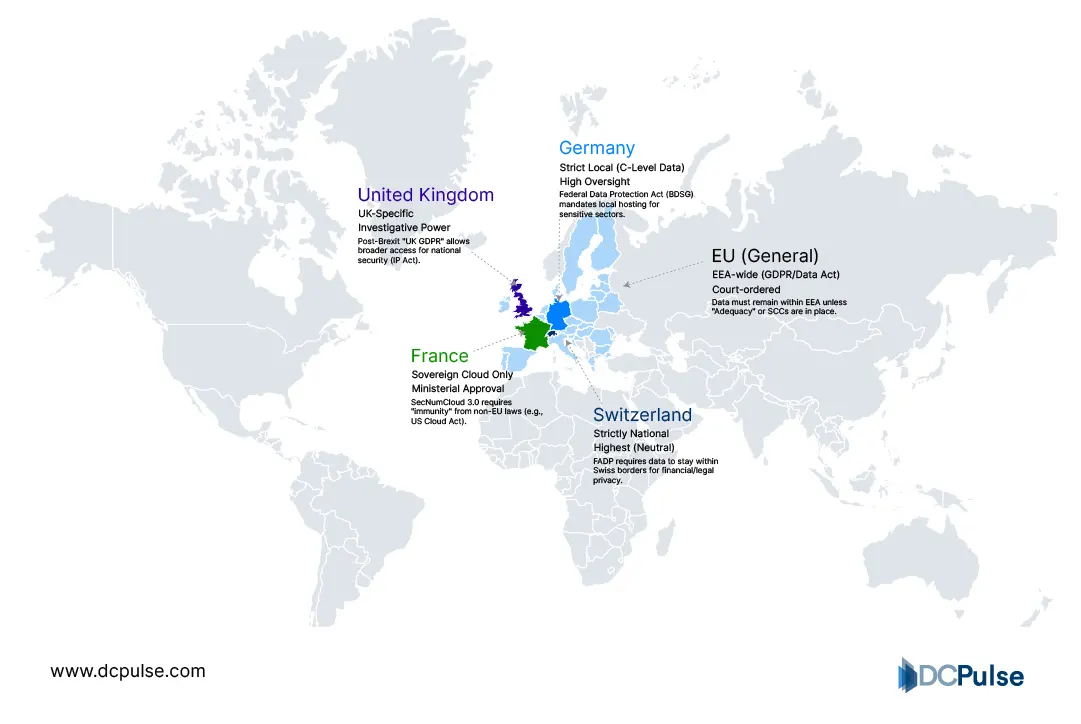
A similar pattern is playing out across Asia and the Middle East. India’s Digital Personal Data Protection Act reinforces localization and accountability requirements for sensitive data, while financial regulators increasingly expect critical workloads to remain under domestic legal oversight. In markets like Singapore, cloud usage by financial institutions is permitted, but only under strict guidelines governing risk management, auditability, and operational control.
As a result, traditional hyperscale cloud models are under pressure. Global control planes, centralized administration, and cross-border data movement conflict with the expectations of regulators who require transparency, enforceability, and local accountability.
Sovereign cloud has therefore become less a niche offering and more a baseline requirement in regulated markets, reshaping how cloud infrastructure is designed, governed, and deployed.
How Sovereignty Is Engineered, Not Promised
By the time regulators demand sovereignty, contractual assurances are no longer enough. What matters is whether a cloud platform can technically prevent data, metadata, and operational control from crossing jurisdictional lines. This is where sovereign cloud strategies stop being policy conversations and start becoming infrastructure design problems.
At the core is physical and logical separation. Sovereign deployments increasingly rely on dedicated regions, in-country availability zones, or on-premises extensions that are legally and operationally fenced.
This is why architectures such as AWS Outposts, Azure Stack Hub, and Google Distributed Cloud exist at all, not as hybrid conveniences, but as sovereignty tools that anchor compute and storage inside a specific legal boundary while still maintaining cloud control planes. When implemented correctly, data residency is enforced by topology, not trust.
The second layer is control-plane sovereignty, which is often overlooked. Even if data sits inside national borders, regulators now ask who can access it, who can update systems, and under which legal authority. Sovereign cloud designs, therefore, isolate management access, logging, identity systems, and encryption key ownership.
Customer-managed keys, locally operated HSMs, and nationally governed identity services are no longer optional features; they are prerequisites for regulated workloads. The European Union’s GDPR and emerging digital sovereignty frameworks make this explicit by tying compliance not just to storage location but to access and governance rights.
Operational independence follows next. Regulated markets increasingly require that local operators, sometimes government-approved entities, can run, maintain, and audit cloud infrastructure without relying on foreign personnel or remote administrative access. This has led to “operator-partner” models where hyperscalers provide the technology stack, but certified local entities handle day-to-day operations, incident response, and compliance reporting. Sovereignty, in this sense, becomes a shared responsibility enforced through architecture rather than organizational promises.
What emerges from these building blocks is a clear pattern: sovereign cloud is not a separate product but a constrained version of cloud where latency, automation, and scale are deliberately traded for jurisdictional control. For data center operators, this has direct design implications. Facilities must support segmented networks, dedicated security domains, isolated management planes, and audit-ready logging infrastructure from day one. Retrofitting sovereignty after deployment is rarely viable.
How Sovereign Cloud Strategies Are Being Built and Adopted
Sovereign cloud architecture is not just a marketing label; it reflects a fundamental redesign of cloud infrastructure to satisfy regulatory and jurisdictional requirements that standard public clouds cannot meet on their own. In regulated markets, especially in Europe and Asia, sovereign cloud strategies must balance compliance, control, and innovation with clear technical and operational boundaries.
Major cloud providers and regional frameworks have begun articulating how these strategies work in practice. Microsoft’s Sovereign Cloud portfolio is explicitly designed to help governments and regulated industries meet stringent data residency and operational sovereignty requirements while leveraging cloud services. The platform supports sovereign public, private, and partner-operated clouds that maintain local data control and compliance enforcement mechanisms without abandoning modern cloud capabilities.
Google Cloud’s Sovereign Cloud offering emphasizes configurable data boundaries, robust residency, and administrative control tailored to regional compliance needs. It highlights options including local partners, dedicated infrastructure, and even air-gapped operations for environments requiring total isolation. This helps enterprises ensure that both data and administrative access remain within the legal domain of the target market.
Independent analyses also show how hyperscalers and regional providers are positioning sovereign solutions worldwide. A Boston Consulting Group overview categorizes sovereign cloud approaches from hyperscaler control with enhanced sovereignty features to fully localized stacks that separate governance, key management, and operations from global public cloud control planes.
These deployments have real effects on how data centers are designed and operated. Sovereign clouds often require segmented networks, localized key management systems, and audit-ready control planes that can be independently inspected by regulators. They also influence site selection and staffing policies, as regulators may mandate local operational control and in-jurisdiction personnel to meet compliance expectations.
What unites the sovereign cloud strategy across regions is a shift from data location alone to enforceable operational sovereignty, where control, auditability, access governance, and legal jurisdiction are engineered into the infrastructure itself.
From Compliance Obligation to Strategic Control
As sovereign cloud strategy moves from niche compliance projects toward core infrastructure planning, its future is clearer than ever: regulated markets will treat sovereignty as an integral part of digital strategy, not an optional add-on. Enterprises and public institutions are beginning to classify sovereign platforms as foundational components of their cloud estates, especially for critical workloads requiring local governance, resilience, and transparency.
Regulatory enforcement is intensifying across jurisdictions. In Europe, evolving frameworks from GDPR to the Digital Services Act and emerging sovereign cloud criteria are pushing organizations to go beyond simple data residency toward operational autonomy that regulators can audit and enforce. This means infrastructure design must incorporate customer-managed encryption, localized identity controls, and multi-zone deployment plans tailored to national legal regimes.
Investment patterns also signal where the market is headed. Providers are expanding sovereign offerings, and enterprises are broadening their cloud strategies to include multi-vendor and multi-zone sovereign footprints that support resilience and compliance without sacrificing innovation. As digital sovereignty becomes a competitive lens, organizations that align cloud strategy with regulatory imperatives, interoperability goals, and local governance controls will be best positioned to manage risk and unlock new operational capabilities in the years ahead.