Pranav Hotkar
Across major markets, the value of a data center is no longer defined only by racks, power density, or uptime. It is increasingly shaped by zoning envelopes, land optionality, entitlement timelines, and proximity to transmission corridors, factors traditionally reserved for commercial real estate underwriting.
As demand accelerates for AI workloads and cloud capacity, the real estate beneath the facility is no longer a passive foundation. It has become an active lever in return on investment.
This shift is subtle but consequential. In Northern Virginia, a permitted megawatt is often worth more than the building itself. In Singapore and Tokyo, scarcity has turned verticality into a financial instrument. In emerging markets, land banking and pre-entitlement strategies are determining which operators scale and which stall.
The implication is clear: data center ROI is now inseparable from real estate strategy.
What follows is not a story about rising rents or headline land prices. It is about how site selection, entitlement risk, densification, and infrastructure adjacency are quietly reshaping capital efficiency across the global data center market, and why operators, investors, and developers who treat real estate as a secondary concern are increasingly leaving money on the table.
What is the current real estate landscape and ROI?
Before the data center boom, land cost was a predictable line item in project budgets. Today, real estate trends are actively shaping ROI outcomes because site selection influences capital efficiency, development timelines, and long-term operational costs. Land is no longer just square footage; it’s a strategic financial variable.
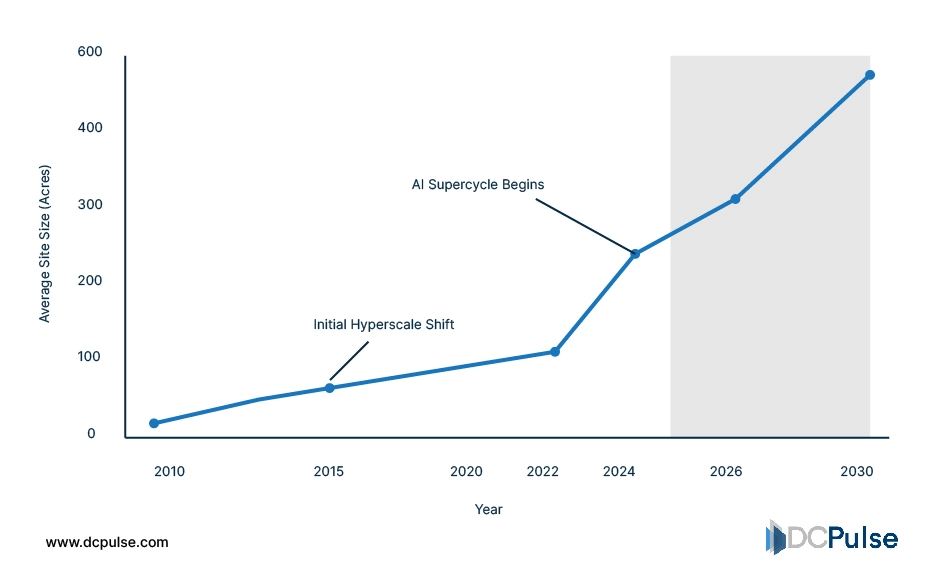
First, land scarcity and rising prices are tightening ROI margins in traditional hubs. Across major markets, average parcel sizes have jumped sharply as developers compete for space with reliable power access, fiber connectivity, and room for campus expansion.
According to industry analysis, land transactions are up more than 140% in acreage size since 2022, reflecting how much ground operators now need, not just for buildings but for power, cooling, and future growth.
Average Data Center Campus Land Acreage (2010–2030)
Second, regulatory readiness and zoning affect risk and time to revenue. Sites already zoned for industrial or tech use, with entitlements and expedited permitting paths in place, attract a premium because they accelerate construction schedules. Faster time-to-market directly improves IRR by shortening the period before revenue starts flowing.
Finally, infrastructure adjacency, especially proximity to power substations and high-capacity fiber, has become a central influence on valuation. Parcels without strong energy access often require additional investment to secure power, eroding ROI, whereas land near major utility corridors can command higher rents due to operational reliability and cost savings.
In today’s market, real estate decisions, from acreage and zoning to utilities and fiber, aren’t background factors. They are core inputs to ROI modeling, directly affecting costs, risk, and growth potential.
Innovations Shaping ROI in a Land-Constrained Market
As land scarcity and zoning hurdles tighten the economics of data centers, operators are increasingly relying on innovative strategies to protect and optimize ROI. The industry’s response is not just about building more efficiently; it’s about extracting more value from every square foot of real estate.
One major approach is vertical densification. In high-cost, constrained markets such as Singapore, Tokyo, and Hong Kong, developers are designing multistory facilities that stack racks and cooling infrastructure, effectively turning expensive land into a premium revenue driver. While construction costs rise, the revenue per square foot improves significantly, protecting long-term returns. According to the Singapore Economic Development Board, vertical designs are now a prerequisite for new approvals in dense urban zones.
Campus consolidation is another trend. Operators increasingly cluster multiple facilities on contiguous parcels, creating internal economies of scale for power, cooling, and connectivity. This not only lowers per-megawatt deployment costs but also strengthens ROI by reducing redundancy in land acquisition and utility infrastructure.
Strategic land banking has emerged as a forward-looking tool. In emerging markets like India and Brazil, developers are securing parcels near planned substations and fiber corridors, sometimes years before grid upgrades are completed. Though this ties up capital upfront, it ensures faster deployment and lower operational risk, ultimately enhancing internal rates of return when the sites go live.
Finally, modular and prefabricated construction allows operators to rapidly scale on existing parcels, making high-value land more productive. By reducing construction time and costs, these innovations compress payback periods and amplify ROI even when real estate costs are high.
In short, emerging operational and design innovations are directly translating real estate challenges into ROI opportunities, showing that the smartest strategies now leverage land scarcity as a value multiplier rather than a constraint.
What are the strategic moves in a changing real estate landscape?
Operators and investors are now treating real estate as a strategic lever for ROI, not just a cost line. In Northern Virginia, land scarcity near core interconnection hubs has prompted companies to acquire entitlement-ready parcels at premium prices, knowing that faster deployment and proximity to fiber and power hubs accelerate revenue and improve internal rates of return. Digital Realty’s 2025 purchases, including a 13-acre site in Ashburn, illustrate this approach, paying more upfront for land that reduces entitlement risk and shortens development cycles.
In Asia-Pacific, operators like Keppel Data Centres in Singapore combine vertical design with campus-style layouts on limited parcels, extracting maximum revenue per square foot. By stacking racks and cooling systems, they mitigate high land costs while sustaining premium colocation pricing, directly protecting ROI.
Emerging markets demonstrate a third strategy: preemptive land banking near planned infrastructure. In India, AdaniConneX is securing parcels near upcoming substations and fiber corridors, ensuring rapid deployment and predictable returns once grid upgrades come online. This forward-looking approach reduces operational risk and locks in long-term ROI despite high upfront investment.
Across geographies, these moves show a consistent principle: strategic real estate execution now shapes cost efficiency, deployment speed, and revenue potential, making it a core determinant of data center ROI.
Navigating Real Estate for Maximum Returns
Looking ahead, real estate will play an even more decisive role in determining data center ROI. As demand from AI, cloud, and digital services continues to rise, operators will face tighter land availability, longer entitlement timelines, and growing competition for power-adjacent sites. In this environment, ROI will be shaped less by headline demand and more by how intelligently real estate risk is managed.
In mature markets, premium pricing for entitled, infrastructure-ready land is likely to persist. While upfront costs may rise, faster deployment and predictable revenue timelines will continue to justify those premiums for well-capitalized operators. In contrast, projects that underestimate zoning friction or grid proximity risk slower ramp-ups and compressed returns.
Emerging markets present a different but equally strategic opportunity. Early land acquisition near future substations, fiber routes, or industrial corridors can improve long-term ROI by reducing exposure to land repricing and infrastructure delays. However, this approach demands patient capital and disciplined planning.
The broader takeaway is clear: real estate is no longer a passive backdrop to data center economics. It is a strategic input that shapes capital efficiency, deployment speed, and long-term financial performance. Operators that integrate real estate strategy directly into ROI modeling will be better positioned as the market tightens further.