Pranav Hotkar
For years, security conversations revolved around networks, endpoints, and data. But as infrastructure has scaled, the real exposure has shifted outward, to the physical assets that keep digital systems running. Data centers, substations, factories, logistics hubs, and campuses now sprawl across vast footprints, operating continuously with limited human oversight. Traditional safeguards were never designed for this level of scale or complexity.
At the same time, threats have evolved. Incidents are no longer limited to forced entry or visible sabotage; they include subtle reconnaissance, insider movement, and coordinated activity that unfolds gradually rather than all at once. Human operators, watching fragmented camera feeds and rule-based alerts, struggle to spot these patterns early enough to act.
This is where AI threat detection enters the picture, not as a replacement for physical security, but as an intelligence layer. By interpreting behavior, context, and anomalies in real time, AI is redefining how physical assets are protected before incidents escalate into disruptions.
How Are Physical Assets Protected Today, and Where Do Traditional Systems Fall Short?
Physical security for infrastructure, from data centers and substations to industrial campuses, has long relied on classic tools like CCTV cameras, access cards, alarm panels, and security patrols. These systems are familiar and widespread, but they were designed for post-event documentation and reactive response, not real-time threat anticipation.
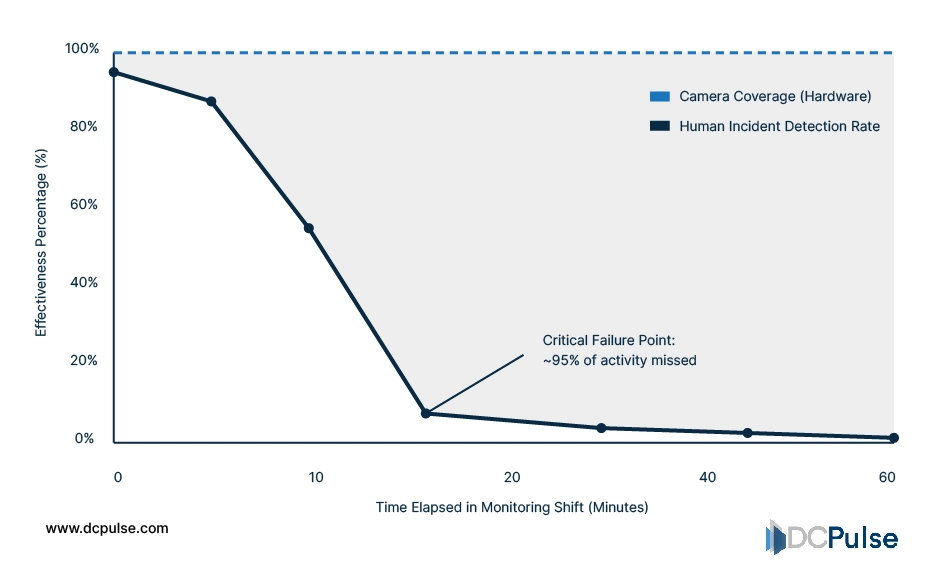
Traditional CCTV and monitoring systems depend heavily on human operators to watch multiple screens, interpret motion, and make judgment calls, a task that is labor-intensive and error-prone.
Research shows that humans struggle with consistent vigilance across many feeds, especially over long shifts, leading to missed incidents and delayed reactions. At best, legacy cameras record events for later review; at worst, they generate so many nuisance alerts that teams become desensitized.
Human Performance vs. CCTV Coverage
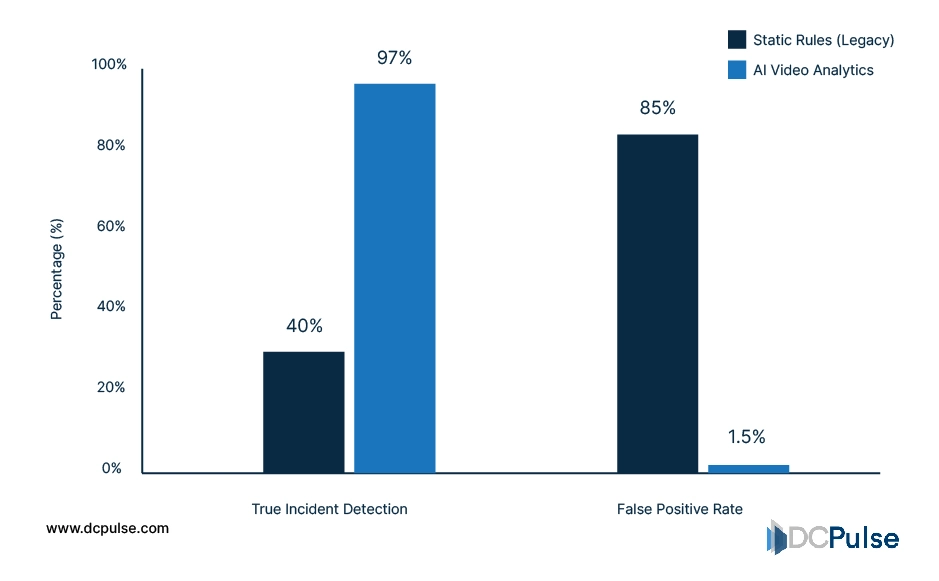
Another core limitation is context blindness. Basic systems cannot distinguish between benign motion (e.g., animals, shadows) and genuine threats, causing a high rate of false positives and wasted response effort. Without analytics that tie video to behavior or anomaly patterns, traditional alarm systems often trigger too late, after an intrusion has already occurred.
Finally, isolated security subsystems, cameras, badge readers, and alarms often operate in silos, preventing coordinated threat response and slowing decision-making.
These gaps create vulnerable windows where threats can escalate before being detected or acted upon, setting the stage for AI-driven threat detection to fill the gap.
What Does AI Threat Detection Actually Change on the Ground?
AI threat detection is not just a technological buzzword; it is fundamentally altering how physical security systems identify and interpret risk in real time, moving far beyond static rule-based alerts. Modern AI systems combine machine vision, behavioral analytics, and sensor fusion to detect threats that traditional systems would miss, reduce false alarms, and support faster intervention.
AI-powered machine vision can automatically analyze live video feeds to recognize unusual behavior, objects, or patterns without human direction. By processing data from cameras, access controls, and IoT sensors in real time, these systems turn passive surveillance into proactive threat detection. This approach significantly reduces manual workload and improves detection accuracy over legacy methods.
Behavioral analytics adds another layer by identifying anomalous movement or activity patterns that don’t match historical norms, whether someone is loitering near a restricted area or an unexpected after-hours presence. These models adapt over time, enabling predictive insights rather than reacting only after a breach is detected.
Static Rules (VMD) vs. AI Video Analytics
Beyond cameras, AI is integrated with autonomous agents such as drones or robotic patrol units that inspect large or hard-to-reach spaces, enhancing coverage without proportional increases in staffing costs. Autonomous systems can flag anomalies and guide human responders precisely to where they’re needed.
These innovations collectively transform security from reactive observation to anticipatory detection and response, making physical asset protection both stronger and more scalable than ever before.
Who Is Deploying AI for Physical Threat Detection, and Why Now?
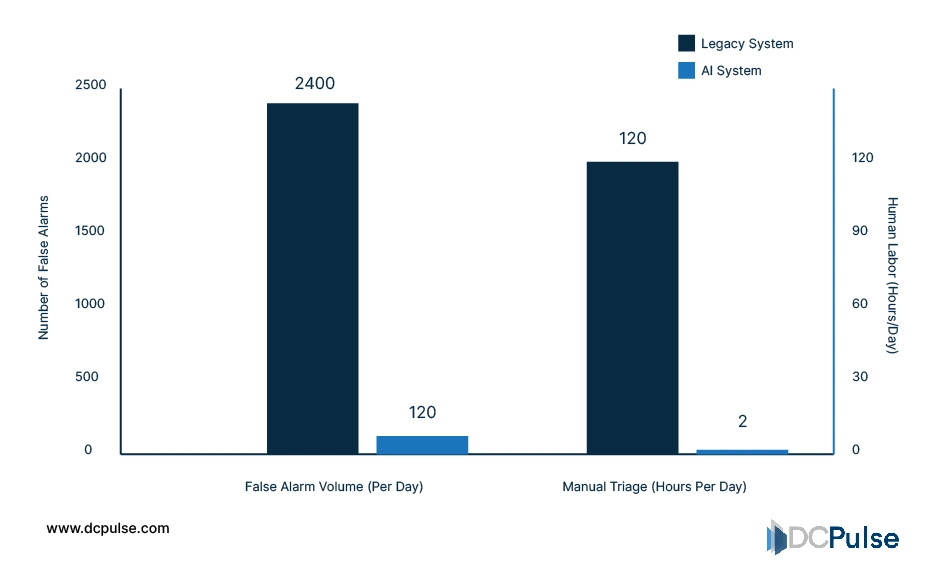
Across industries, organizations are shifting from reactive security to AI-driven threat detection systems that safeguard physical assets by spotting and escalating genuine risks faster and with fewer false alarms. One compelling real-world example comes from ServiceNow, which deployed an AI platform across 13 of its U.S. sites to augment existing surveillance infrastructure. In the first half of 2025, this system processed over 240,000 alarms and automatically cleared 94% of false positives, saving more than 15,000 hours of manual triage work and over USD 500,000 in operational costs, demonstrating how AI directly strengthens ROI by reducing workload and improving accuracy.
AI deployment - manual hours saved vs false alarm reductions (2025-2026)
AI is also being used to protect critical infrastructure at the national scale. Hyderabad-based Indrajaal has rolled out an AI-driven anti-drone system capable of monitoring and defending wide areas of sensitive infrastructure, including naval ports, power grids, and refineries, against aerial threats. This deployment underscores how AI threat detection now extends to physical asset perimeter defense, not just surveillance analytics.
In heavy industries, AI-enhanced perimeter and intrusion systems are being applied to utilities and energy sites, where advanced intrusion analytics and real-time alerting replace siloed sensor feeds with integrated, context-aware monitoring.
These moves reflect a broader industry shift: organizations are investing in AI threat detection not just for efficiency, but because faster, smarter physical threat identification materially improves asset safety and operational ROI, from reduced losses and downtime to lower security staffing costs and improved compliance.
What Does the Next Phase of AI-Driven Physical Security Mean for Asset Protection?
AI threat detection is steadily shifting physical security from a cost center into a measurable protection layer for high-value assets. As models mature, the focus is moving away from simply detecting intrusions toward anticipating risk, prioritizing response, and minimizing disruption. This evolution matters most for environments where downtime, safety incidents, or asset loss carry outsized financial and operational consequences.
Over the next few years, AI systems are expected to become more context-aware and autonomous, correlating video, access data, environmental sensors, and historical behavior without constant human oversight. This does not eliminate human decision-making, but it narrows attention to incidents that truly matter. For operators, that translates into fewer false alarms, faster response times, and more predictable security operations.
Strategically, organizations that adopt AI-based threat detection early are likely to see compounding benefits. Reduced incident response costs, lower staffing strain, and better protection of critical assets directly support long-term ROI. Just as importantly, these systems create a security foundation that can scale with larger sites, denser infrastructure, and more complex physical risk profiles.
In short, AI is redefining physical security as an active, intelligence-driven safeguard, not just a passive line of defense.