Pranav Hotkar
Power has always been the silent dependency of data centers. But as digital infrastructure pushes into regions with unstable grids, rising energy costs, and tighter sustainability mandates, that dependency is being re-examined. Increasingly, the question is no longer how data centers connect to the grid, but how much they can operate without it.
Microgrids are emerging as a strategic answer. By combining on-site generation, energy storage, and intelligent control systems, microgrids allow data centers to produce, manage, and optimize their own power in real time. What began as a resilience solution for outages is evolving into a foundation for autonomous operations, where facilities can dynamically balance performance, cost, and carbon without constant human intervention.
This shift is arriving at a critical moment. AI workloads demand uninterrupted power quality, edge deployments require local energy independence, and regulators are scrutinizing grid strain more closely than ever. In this environment, reliance on centralized utilities alone is becoming a strategic vulnerability rather than a given.
As data centers move toward self-governing infrastructure, capable of responding instantly to grid events, price signals, and load changes, microgrids are no longer optional add-ons. They are becoming central to how the next generation of autonomous data centers is designed, financed, and operated.
When Data Centers Meet Power Realities
The traditional assumption that utility grids can always support data center growth is being challenged on multiple fronts. As compute demand surges, driven by AI, cloud services, and high-density edge workloads, grids are aging, congested, and increasingly vulnerable to extreme weather and supply constraints. This exposes data centers to risks that conventional backup systems, such as diesel generators and UPS arrays, can no longer fully mitigate. According to analysis by Microgrid Knowledge, more than 60% of data center operators have reported a power outage in recent years, and the cost of downtime can reach up to hundreds of thousands of dollars per minute, underscoring the urgency of more resilient power approaches.
Microgrids, local energy networks integrating generation, storage, and smart controls, address these realities by enabling facilities to operate both grid-connected and independently. A microgrid’s ability to “island” itself during outages and balance on-site generation with grid supply provides continuity that traditional backup systems can’t sustain over prolonged disruptions.
Industry reports highlight that this model enhances both reliability and cost predictability and supports integrating renewables such as solar or hydrogen-ready generation into the power mix, reducing reliance on volatile utility tariffs.
Data Center Outage Frequency vs. Financial Impact (2025–2026)
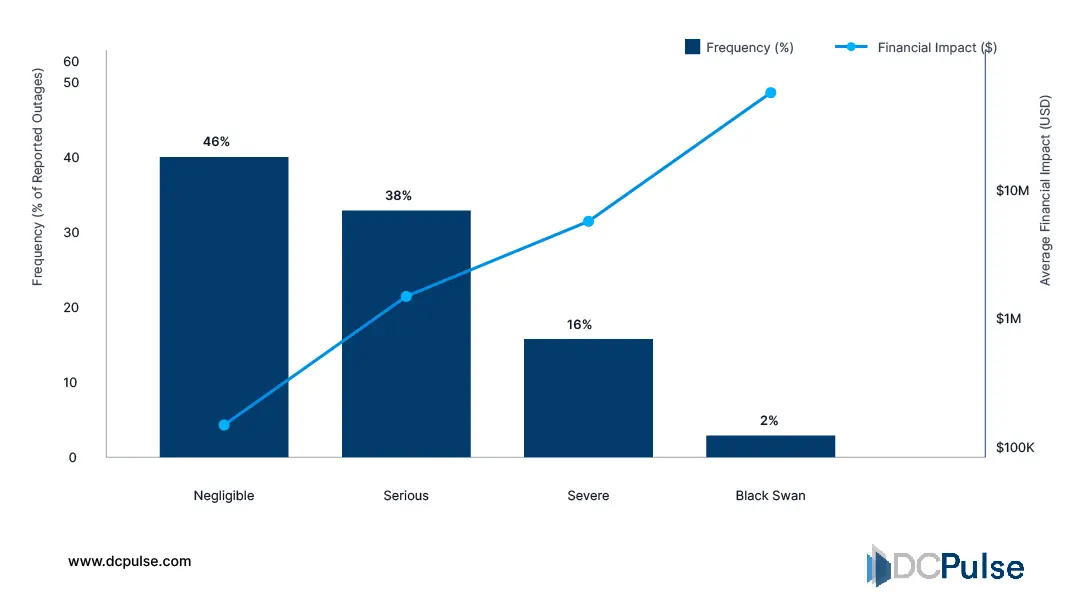
In markets where grid constraints are acute or where sustainability commitments are high, microgrids are no longer experimental add-ons; they’re becoming core infrastructure that enables continuous operations and long-term planning for autonomous data centers.
Innovations Powering Microgrid Evolution
Microgrids are advancing beyond basic resilience systems into dynamic, software-defined energy ecosystems that reshape how data centers source and manage power. Three innovations are driving this transformation: real-time energy management, hybrid generation portfolios, and modular microgrid deployment.
The intelligent energy control systems are enabling microgrids to operate autonomously with minimal human intervention. These controllers integrate distributed energy resources (DERs), such as on-site solar, fuel cells, and battery storage, with grid connectivity, optimizing load dispatch and energy flows in real time.
Advanced management platforms also enable participation in demand response and frequency regulation markets, creating new revenue pathways while stabilizing operations.
Secondly, the microgrid innovation increasingly emphasizes hybrid generation portfolios that blend renewable sources with conventional on-site power. Examples include solar photovoltaic arrays paired with battery storage and fuel cells, enabling continuous operation and emissions reduction. These hybrid systems reduce reliance on fossil backup and align microgrids with corporate sustainability and ESG goals.
Finally, modular microgrid deployments are making autonomous power more scalable. Pre-engineered microgrid units, as seen in projects such as Enchanted Rock’s bridge-to-grid services, allow data centers to install resilience infrastructure with minimal disruption and accelerated timelines. This modular approach supports phased expansion of power capacity alongside computing growth.
Together, these innovations are pushing microgrids from supplementary backups to core, autonomous power platforms that enhance reliability, sustainability, and operational flexibility.
How Industry Leaders Are Turning Microgrid Strategies into Reality
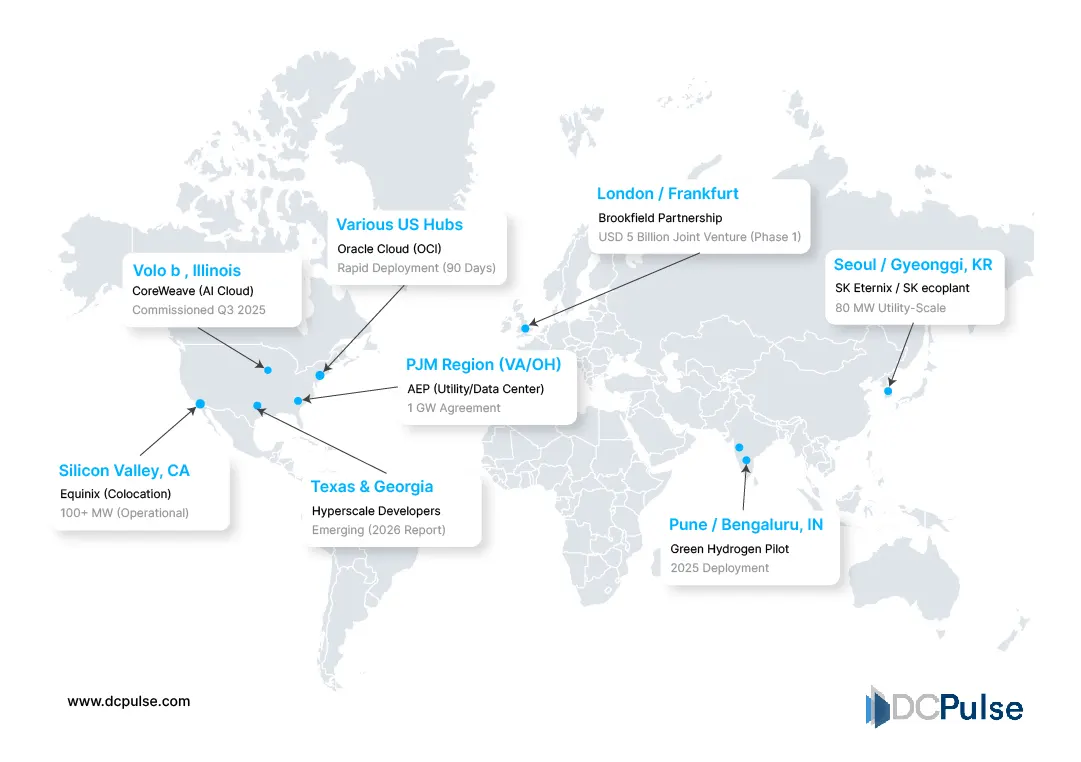
Data center operators and energy partners are increasingly integrating microgrid solutions into live infrastructure rather than treating them as experimental add-ons. One major move comes from Bloom Energy, whose solid-oxide fuel cell microgrids are being deployed at scale as primary power for high-performance data centers that can’t wait for grid upgrades.
Its systems are now powering facilities such as CoreWeave’s Illinois data center, and partnerships with energy companies aim to deliver gigawatts of behind-the-meter capacity to support AI workloads and resilience imperatives.
Bloom Energy Microgrid & AI Deployment Data Table (2024–2026)
Elsewhere, operators and startups are innovating with co-located renewable microgrids that optimize cost and sustainability. In Texas, partnerships are building AI data centers adjacent to wind and solar sites, capturing curtailed energy and reducing reliance on volatile grid tariffs. This approach shows how microgrids can be used not only for resilience but also for strategic cost management.
On the traditional hyperscale side, major cloud providers are piloting microgrid-enhanced continuity projects. For example, Microsoft contracted with microgrid specialists to power its San Jose data center, reducing diesel reliance and improving operational sustainability. This marks a shift from backup generators to integrated on-site energy ecosystems that support Tier III/IV operations with clean and reliable power flows.
These industry moves show microgrids transitioning from resilience adjuncts to strategic infrastructure platforms that control cost, improve uptime, and integrate clean energy at scale, signaling a broader shift in how data centers plan power footprints.
Microgrids as a Strategic Control Layer, Not a Backup Plan
Microgrids are no longer a peripheral resilience investment; they are becoming a strategic control layer for autonomous data centers facing grid congestion, energy volatility, and sustainability pressure. As AI and high-density workloads accelerate power demand, operators that rely solely on centralized grids and diesel backup risk deployment delays, cost overruns, and regulatory friction.
The takeaway is clear: microgrids enable optionality. They allow data centers to decouple growth from grid timelines, stabilize operating costs through hybrid generation, and meet carbon targets without sacrificing uptime. More importantly, software-driven microgrids create a foundation for autonomous operations, where power sourcing, load balancing, and grid interaction are optimized in real time.
For executives, the question is no longer whether microgrids make sense, but how early they are integrated into site planning. Those that treat microgrids as core infrastructure, not contingency, will gain faster market entry, greater resilience, and long-term cost control.