Pranav Hotkar
When a government plans a new digital backbone, whether it’s a national fiber grid, a sovereign cloud, or a hyperscale data campus, it rarely builds it alone anymore. The capital is too heavy, the technology moves too fast, and the operational risk is too high to sit entirely on public balance sheets.
Instead, states are turning to private partners not just to fund infrastructure but to co-own the future of national connectivity. These partnerships decide who controls data flows, how fast regions digitize, and who ultimately captures the economic upside of digital growth. For private investors, the appeal is stability and scale. For governments, it’s acceleration without surrendering strategic control.
But public-private partnerships in digital infrastructure are not neutral arrangements. They redistribute risk, redefine accountability, and quietly shape national competitiveness for decades. Understanding how they work and where they fail is now essential to understanding how digital economies are being built.
How PPPs Are Shaping Digital Infrastructure Today
Public-private partnerships are no longer limited to roads or bridges; they are now core delivery models for digital infrastructure where the scale, capital, and long-term operational demands exceed what purely public or private models comfortably handle.
In Europe, the 5G Infrastructure Public-Private Partnership (5G PPP) brings together the European Commission with network operators, vendors, and research institutions to accelerate advanced communications systems that underpin smart cities, intelligent transport, and IoT platforms. These alliances blend public strategy with private execution capacity.
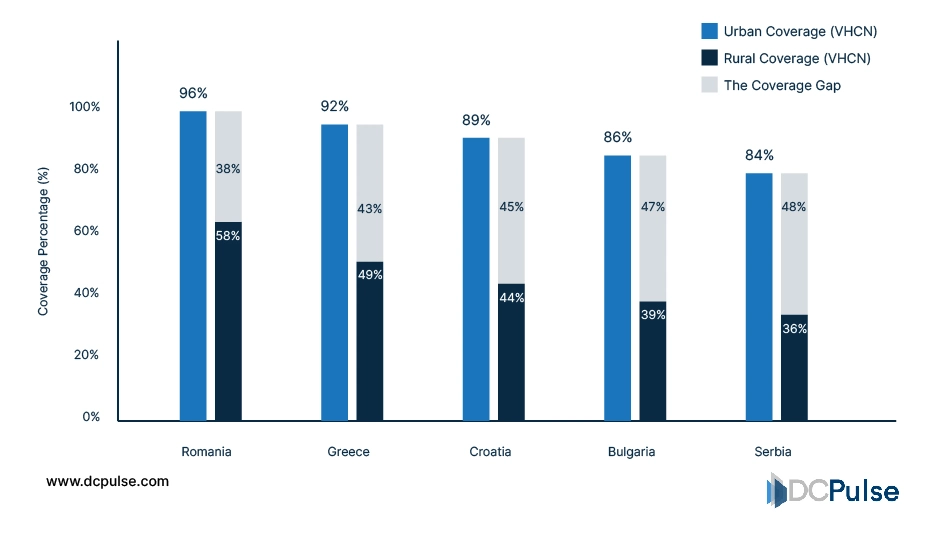
Connectivity gaps in broadband are also being addressed through PPPs. The PPP4Broadband initiative in South-East Europe helps public authorities work with private network builders to deploy fiber where market incentives alone fall short, showing how blended funding and shared risk can expand coverage efficiently.
Broadband Coverage Disparity in SEE (2025-2026)
In the United Kingdom, Building Digital UK (BDUK) contracts with private operators to extend high-speed broadband nationwide, a model that embeds performance targets and shared investment returns.
Across regions, these PPPs are distributing risk, harnessing private technical expertise, and translating public policy goals, such as universal access and digital inclusion, into measurable network expansion.
How PPP Models Are Evolving for the Digital Era
Public-private partnerships in digital infrastructure are no longer limited to build-and-operate contracts. New PPP models are emerging to reflect how data, compute, and connectivity behave very differently from physical assets like roads or power plants. Flexibility, shared governance, and long-term adaptability are becoming just as important as capital deployment.
One visible shift is the rise of sovereign and federated cloud partnerships, where governments collaborate with private cloud and infrastructure providers while retaining policy control over data residency, standards, and access. Europe’s GAIA-X initiative exemplifies this approach, setting a governance framework while relying on private operators to deliver compliant cloud and data services.
Another innovation is the use of open-access and neutral-host models in fiber and edge infrastructure. Instead of exclusive concessions, PPPs increasingly mandate shared physical infrastructure that multiple service providers can access, improving utilization and lowering long-term costs. The World Bank has highlighted open-access PPPs as a way to align public inclusion goals with private returns.
Finally, PPP contracts themselves are becoming more adaptive. Performance-based clauses tied to uptime, latency, energy efficiency, and scalability are replacing static service definitions, allowing digital infrastructure to evolve over decades rather than locking partners into outdated specifications.
The Evolution of Digital Partnerships
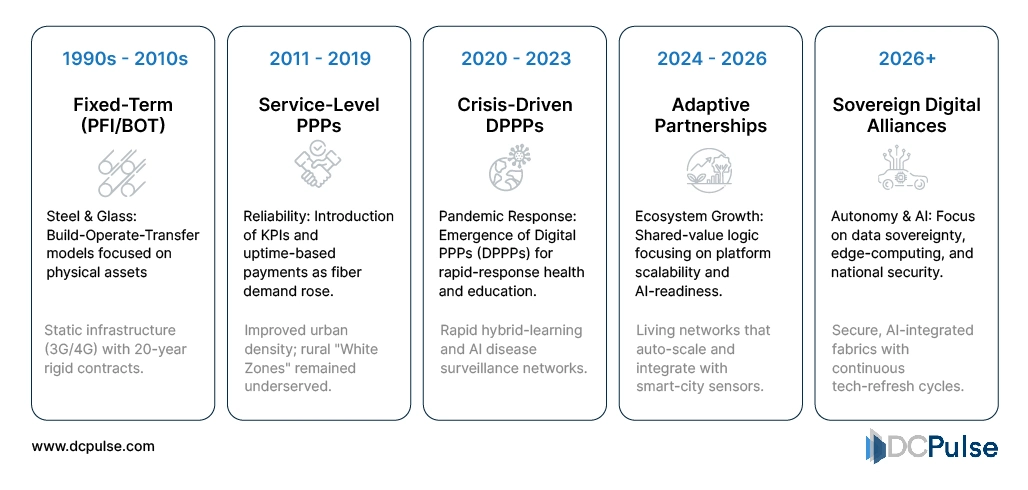
These innovations signal a shift from infrastructure ownership toward shared stewardship of digital systems, a necessary evolution as digital assets become national utilities in their own right.
Who Is Driving Public-Private Digital Partnerships Today
Across the world, governments are turning digital infrastructure goals into tangible public–private partnerships (PPPs) that expand connectivity, share risk, and leverage private delivery expertise.
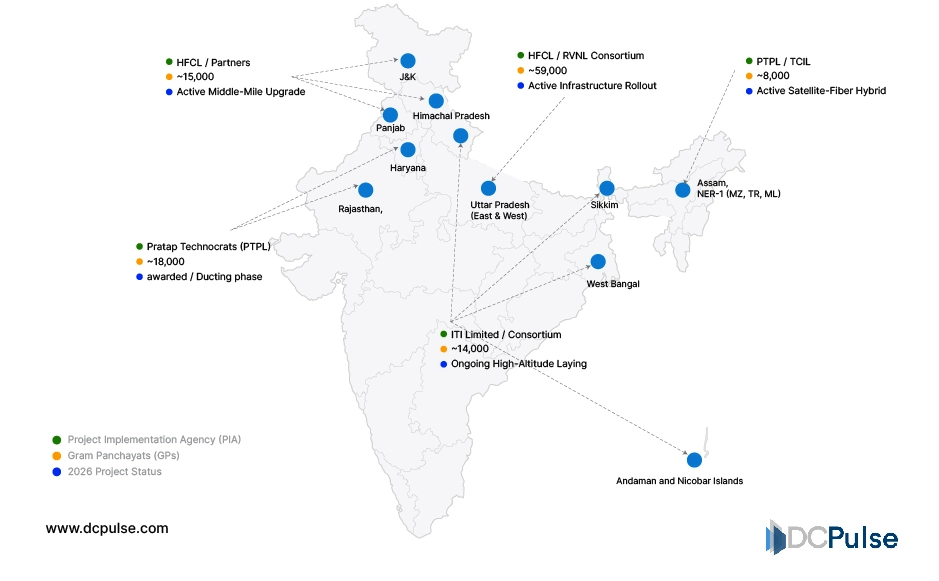
In India, the national broadband initiative BharatNet has evolved into a large-scale PPP model. In 2021, the Union Cabinet approved a revised implementation strategy under PPP for 16 states, extending broadband connectivity to all inhabited villages by combining government viability-gap funding with competitively selected private sector partners responsible for building, operation, and maintenance. This model is expected to accelerate rollout and improve service delivery by tapping private technical and operational expertise while aligning with national connectivity goals.
BharatNet Phase III PPP Package Implementation (Jan 2026)
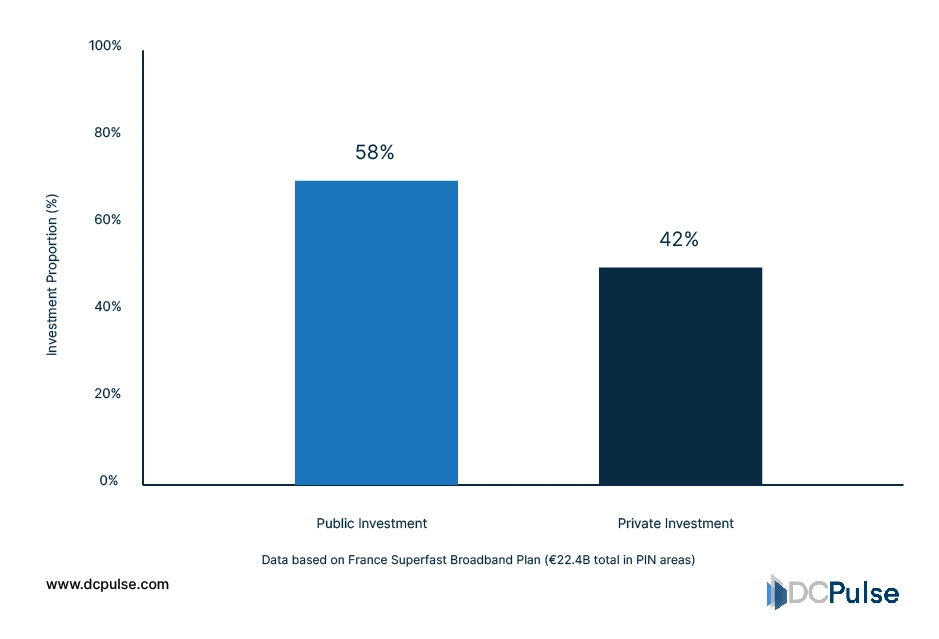
A similar PPP approach is seen in France’s public initiative networks (PINs) for fiber-to-the-home (FTTH) deployments. In these models, regional authorities contract with private operators to finance, build, and manage fiber infrastructure in areas where purely commercial investment would be limited, blending public funding with private execution capability.
Investment Proportions in PIN Fiber Projects
At the subnational level in developed economies, PPPs are also facilitating advanced digital infrastructure. OECD analyses note that cities and regions increasingly leverage PPP frameworks to mobilize private capital and technical capacity for broadband, smart infrastructure, and ICT platforms, although capacity building within government remains critical to effective partnership design.
These real industry moves illustrate how PPPs are being structured not just as funding tools but as delivery mechanisms that align public goals with private efficiency and scalability.
Designing Partnerships That Outlast the Technology
Public-private partnerships are becoming a defining mechanism for how digital infrastructure is financed, governed, and scaled. As connectivity, compute, and data platforms increasingly underpin economic resilience, PPPs offer a pragmatic way to align long-term public objectives with private sector execution and capital discipline.
Looking ahead, the success of these partnerships will hinge less on headline investment figures and more on structure and governance. Clear risk allocation, adaptive contracts, and shared accountability will determine whether PPPs remain flexible over multi-decade lifecycles or become constrained by outdated assumptions. Digital infrastructure evolves faster than traditional assets, and partnership models must reflect that reality.
For governments, the strategic opportunity lies in using PPPs to accelerate deployment while preserving sovereignty over critical systems and standards. For private players, the appeal is stable demand, predictable returns, and participation in nationally significant platforms. However, misaligned incentives or rigid frameworks can erode value on both sides.
Ultimately, well-designed PPPs can turn digital infrastructure into a durable public utility with private-sector efficiency, but only if both partners treat adaptability as a core design principle rather than an afterthought.