Pranav Hotkar
In modern manufacturing, the hardest part of building a product is no longer machining, assembly, or even sourcing. It is deciding what to build and proving that decision before a single part is made. Design simulations sit at the center of that challenge, allowing engineers to test aerodynamics, structural limits, thermal behavior, and failure modes long before physical prototypes exist.
But as products grow more complex and timelines shrink, simulations themselves are hitting limits. Models are larger, solver fidelity is higher, and design teams are expected to run dozens, sometimes hundreds, of iterations under tight deadlines. When compute capacity falls short, teams simplify physics, reduce scenarios, or delay decisions, quietly trading accuracy for speed.
High-performance computing is changing that balance. By removing compute as a constraint, HPC is turning simulation from a validation step into a real-time design engine, one that increasingly determines who innovates faster, wastes less, and reaches production with confidence.
Where Design Simulation Meets Compute Limits
In modern manufacturing, simulations such as finite element analysis (FEA) and computational fluid dynamics (CFD) are essential for validating structural integrity, fluid behavior, and thermal performance before physical prototypes are built. These workflows underpin product development in aerospace, automotive, consumer goods, and industrial equipment, and they are only increasing in complexity as design targets tighten around weight, safety, and efficiency. However, traditional compute environments are struggling to keep up with the demands engineers place on them.
Most design teams still start simulations on individual workstations. These systems can handle small models or initial studies, but once model fidelity rises, involving millions of elements and coupled physics, the processing power, memory, and I/O capabilities of a single machine become a bottleneck. Engineers often limit model size or detail simply because their workstation cannot complete runs in a practical time frame, slowing iteration and delaying decisions.
High-performance computing (HPC) has emerged as the next logical step when traditional compute resources hit their limits. Clusters and distributed systems let engineers run multiple simulation scenarios in parallel, dramatically reducing turnaround times compared with sequential runs on workstations. This shift not only accelerates design cycles but also enables more comprehensive exploration of the design space.
Simulation Time and Speedup Comparison (Jan 2026)
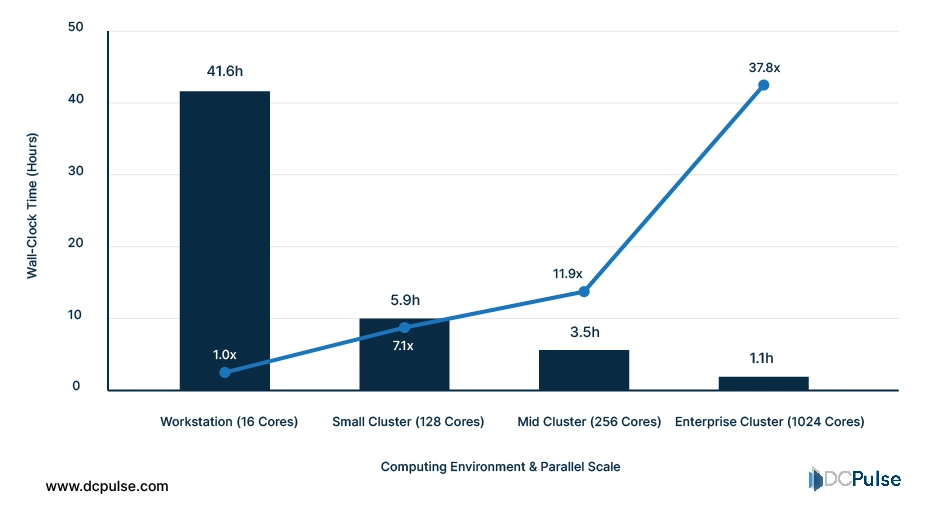
Yet today’s landscape is transitional: many manufacturers run a mix of workstation-based simulation and HPC cluster jobs, often constrained by internal IT resources, software licensing, and the expertise to manage larger compute environments.
Expanding HPC for Better Design Simulation
Manufacturing is undergoing a shift as high-performance computing (HPC) moves from specialized research clusters into everyday simulation workflows. Advanced compute enables engineers to solve large-scale multiphysics models, from fluid dynamics to structural analysis, far faster than was previously possible, opening up broader exploration of design alternatives and deeper optimization.
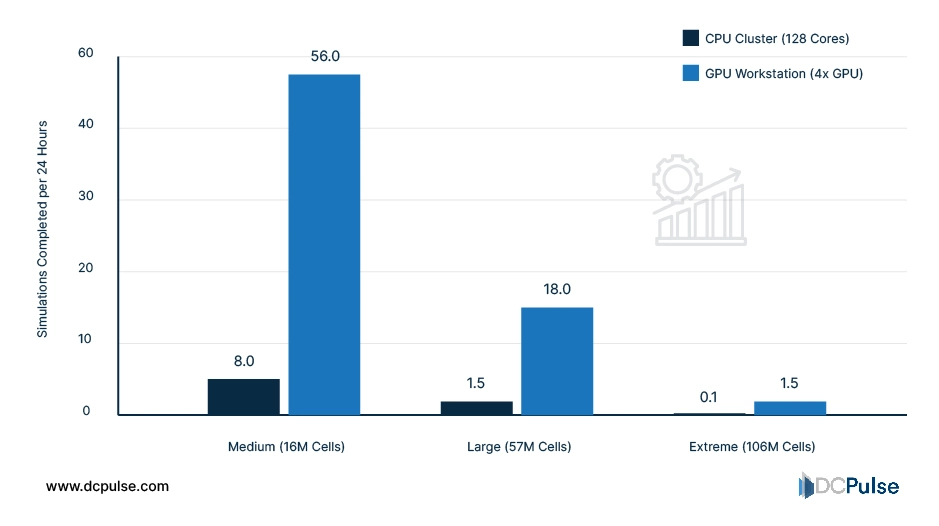
One major innovation is GPU-accelerated simulation, where graphics processors drastically reduce runtime for computational fluid dynamics (CFD) and other compute-intensive solutions. Engineers using GPU-enabled HPC systems have reported order-of-magnitude speedups compared with CPU-only setups, enabling more iterations without sacrificing model fidelity.
Productivity Comparison (Simulations per 24h)
Cloud-based HPC is also expanding access to scalable performance on demand. Platforms such as Google Cloud’s HPC services allow traditional CAE tools like Siemens Star-CCM+ and Ansys Fluent to run at scale without local cluster investment, making high-end compute more accessible to mid-tier manufacturers.
Another emerging innovation is AI-assisted and reduced-order modeling. These hybrid techniques use machine learning to approximate complex physics, speeding early-stage exploration while reserving full HPC fidelity for final validation, blending speed and precision.
Together, these advancements are breaking past traditional compute limits, letting manufacturers simulate more scenarios faster and arrive at better-informed design decisions.
How Manufacturers Are Leveraging HPC for Competitive Advantage
Manufacturers across sectors are increasingly deploying high-performance computing (HPC) at scale to accelerate design simulations, not as a fringe experiment but as a core strategic capability that directly impacts time-to-market, product performance, and cost efficiency.
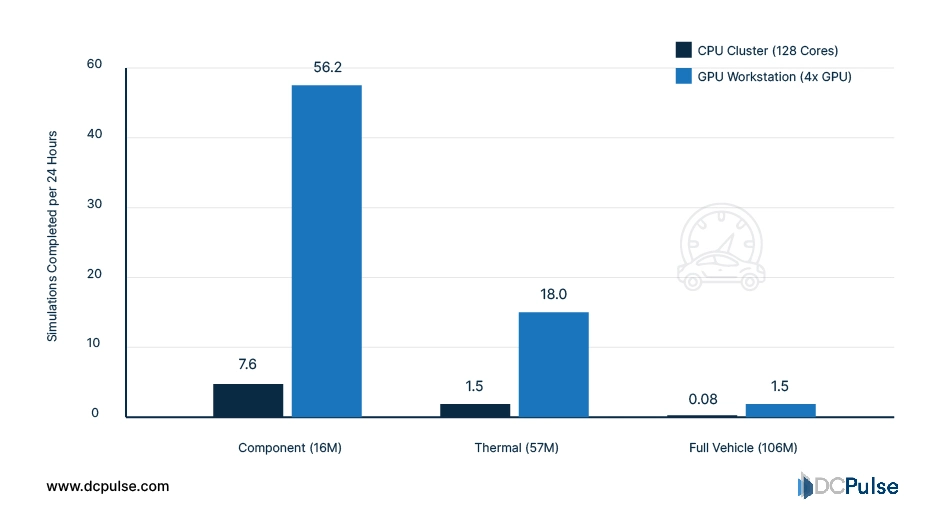
In the automotive industry, manufacturers are using GPU-accelerated HPC to dramatically speed up complex simulations that once took days or weeks. For example, collaborations involving advanced CFD tools running on GPU clusters have shown simulation speedups of 12.6× with NVIDIA H100 GPUs compared with CPU-only configurations, enabling engineers to iterate on designs multiple times per day rather than weekly. This capability shortens development cycles and improves aerodynamic performance.
Automotive CFD Performance Data (Jan 2026)
In aerospace, HPC is being used to run large-scale multiphysics models, such as high-resolution external aerodynamics or rotorcraft simulations, that would be infeasible on smaller compute environments. Research collaborations leveraging GPU-based supercomputers have demonstrated performance increases over massive CPU clusters, showing how cutting-edge hardware enables next-generation aircraft design at scale.
HPC adoption is not limited to vehicles and aircraft. Industrial manufacturers and materials innovators use HPC to optimize advanced composites, thermal systems, and structural adhesives with direct ROI outcomes. For instance, simulation-driven design enabled a material provider to capture new markets and significantly improve margins by validating product performance early in the development cycle.
Amid rising simulation demand, cloud-based HPC services are also facilitating adoption across mid-tier manufacturers, letting teams burst into large compute pools without heavy upfront investment.
This trend broadens access to HPC and embeds high-fidelity simulation deeper into engineering processes across industries.
From Faster Iterations to Strategic Advantage
High-performance computing for design simulations is no longer just about reducing runtimes; it’s becoming a structural advantage for manufacturers navigating tighter margins and faster product cycles. As simulation workloads scale in complexity, the real ROI comes from compressing decision timelines: fewer physical prototypes, earlier fault detection, and faster convergence between design and manufacturing teams.
What’s emerging is a shift from “HPC as infrastructure” to HPC as a design operating model. Cloudbursting allows firms to handle peak simulation loads without permanent overbuild, while hybrid deployments keep sensitive IP and latency-critical workloads on-prem. At the same time, AI-augmented simulation is starting to reshape workflows by prioritizing high-value design paths instead of brute-force iteration, improving engineer productivity as much as raw performance.
Strategically, the manufacturers that win will be those that treat simulation as a continuous process rather than a late-stage validation step. This requires closer alignment between engineering, IT, and facilities planning, especially around power density, cooling, and long-term scalability of compute environments. In that sense, HPC investment decisions are increasingly business decisions, shaping how quickly companies can move from concept to production in a globally competitive market.