Pranav Hotkar
For most of history, interacting with government meant going somewhere: a building, a counter, a queue. Service reliability depended on office hours, staffing, and paperwork flow. If the office closed, the service stopped.
Today, the same interaction happens through a screen. A tax filing, licence renewal, subsidy claim, identity verification, or benefit payment is expected to work at midnight as reliably as it does at noon. The citizen no longer experiences the institution; they experience the system’s responsiveness.
That change quietly redefined what “public service” means. Availability is no longer administrative; it is technical. A portal that times out feels like a closed office. A delayed verification feels like a rejected application. Trust forms not at the policy level but at the moment a request succeeds.
Modern governance now operates at the speed and reliability of the infrastructure behind it.
Public Services Now Run on Availability, Not Office Hours
Digital government services no longer follow administrative schedules; they follow citizen behavior. Usage concentrates around evenings, deadlines, and benefit release cycles rather than working hours. Tax portals spike near filing cutoffs, transit apps surge during commute windows, and welfare platforms experience bursts on disbursement days. The demand pattern resembles consumer platforms more than traditional institutions.
Governments therefore measure performance differently. Success is not only completion rate but also completion under load. A service that works at low usage but slows during peak demand is experienced as unreliable, even if technically functional.
Evolution of Access (1960s – 2026)
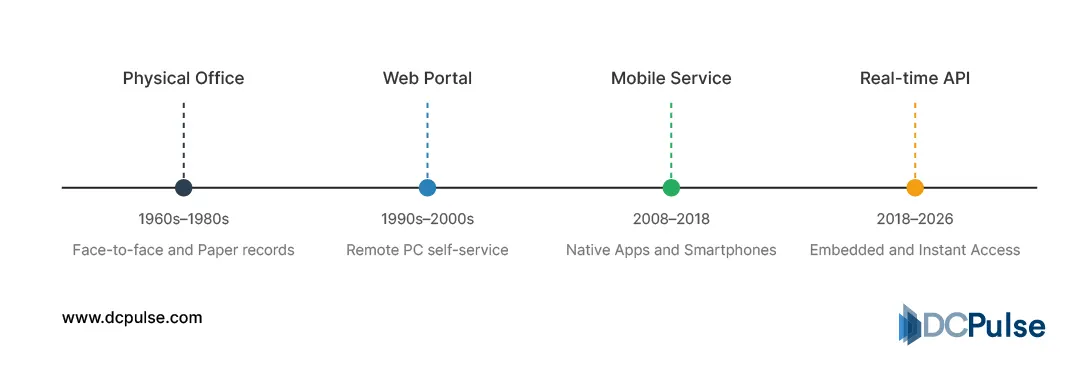
This shift changes infrastructure expectations. Services must remain continuously reachable because public access is continuous. Outages now affect eligibility windows, payments, and identity validation rather than just convenience. Reliability becomes part of service delivery rather than a supporting function.
Hourly Citizen Usage Patterns (Traffic Intensity %)
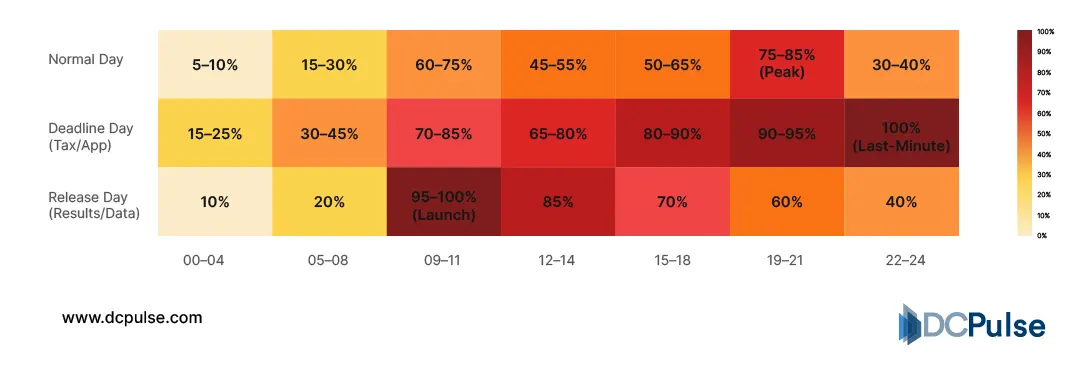
Because participation depends on accessibility, availability directly influences adoption. A system that responds consistently becomes the service; a system that delays becomes the barrier.
Digital public services are no longer defined by process completion; they are defined by uninterrupted reachability.
From Central Systems to Service-Proximity Computing
Early digital government platforms were built like traditional IT systems: one national data center, one authoritative database, and a web interface layered on top. The model worked while the services were informational. It struggled once services became interactive.
Identity verification, eligibility checks, and benefit transfers now happen during the session, not after submission. The system must confirm who a citizen is and what they can access before the page finishes loading. The distance between the user and the processing environment therefore becomes part of the service outcome.
To maintain responsiveness, governments increasingly distribute service logic across multiple locations. The core record remains centralised, but verification, session handling, and request validation occur closer to the user. This reduces retry loops, session expirations, and duplicate submissions, common causes of perceived service failure.
Service Completion Success vs. Latency (2026)
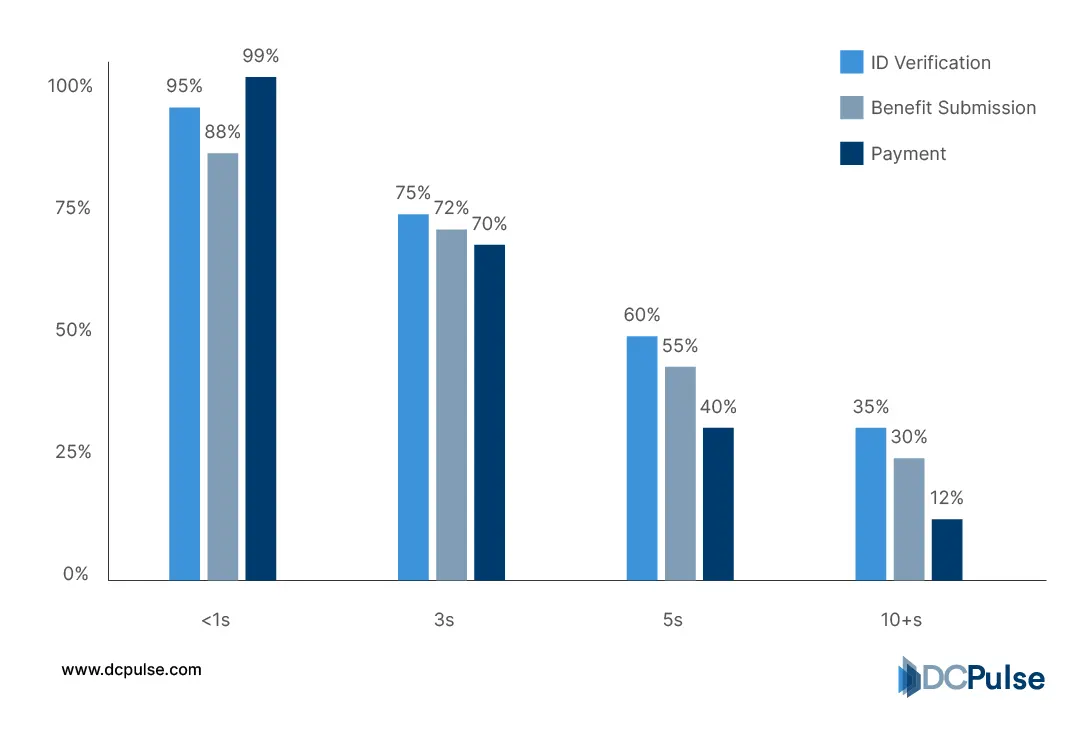
The architecture change is subtle; data stays authoritative in one place, but decisions happen in several. Instead of pulling every interaction into a single system, platforms allow nearby systems to validate requests and confirm consistency afterward.
Public digital services are no longer centralized applications accessed remotely. They are distributed services coordinated centrally.
Governments Don’t Build Alone Anymore
Digital public infrastructure today is no longer a purely government-owned stack. Instead, it is assembled through partnerships between cloud providers, telecom operators, and national agencies, with the data center acting as the trust anchor that keeps sovereign services compliant, local, and continuously available.
India’s public digital ecosystem illustrates this shift clearly. The national identity and payments layers operated by UIDAI and NPCI run on geographically distributed data center clusters to ensure fault tolerance and regional redundancy. Meanwhile, the government cloud MeghRaj extends compute capacity using certified private data center operators.
Internationally, the same pattern is accelerating. Europe’s sovereignty initiative GAIA-X is designed around federated national data centers rather than centralised hyperscalers, while in the Middle East, G42 operates national-scale infrastructure supporting digital government and AI citizen services.
Even hyperscalers are adapting. Public sector regions from Microsoft Azure and Amazon Web Services now deploy “sovereign controls” where data residency laws require services to remain inside national data center boundaries.
The pattern is clear; governments design the services, but reliability, compliance, and scale increasingly come from a shared infrastructure ecosystem anchored in certified data centers.
How Compute Placement Shapes the Future of Public Digital Services
Digital public services are no longer defined only by software platforms; they are defined by how reliably compute is delivered to citizens at scale. As welfare systems, identity platforms, taxation portals, and healthcare registries shift toward real-time interaction, the reliability, geographic distribution, and policy alignment of data centers become a governance capability rather than an IT decision.
Governments will increasingly prioritise jurisdiction-aware architectures: national core facilities for sovereignty, regional edge presence for responsiveness, and cloud federation for elasticity. The winning strategy will not be centralisation or decentralisation alone but coordinated placement, matching service sensitivity to compute proximity. Payment rails, emergency services, and identity verification will demand sub-second locality, while analytics and archival systems will tolerate centralised processing.
The next phase of digital governance therefore depends on operational trust: predictable uptime, predictable latency, and predictable data residency. Countries that design public platforms with computer geography in mind will deliver smoother citizen experiences and fewer service disruptions. Those that treat infrastructure as an afterthought will face rising friction, even if their applications are well designed.
Public digitalisation, ultimately, becomes a question of where computation lives.