DCPulse
Artificial intelligence is changing how organizations discover, analyze, and respond to cybersecurity vulnerabilities. As AI-powered security tools become more capable of scanning infrastructure, identifying weaknesses, and correlating technical findings, the challenge is shifting from finding vulnerabilities to understanding which ones create the greatest risk. For data centers, cloud platforms, and digital infrastructure providers, this distinction is becoming increasingly important as environments grow more distributed and interconnected.
Modern data center environments contain a complex combination of physical servers, virtual machines, cloud workloads, storage systems, network devices, management interfaces, and software dependencies. Each component introduces potential security considerations, while connections between these components can create additional exposure. AI can help security teams examine this complexity at scale, but discovery alone does not establish the significance of a vulnerability.
The next phase of vulnerability management will depend on context: understanding where a weakness exists, what systems it affects, whether it can be exploited, and how its exploitation could influence critical infrastructure operations. This approach could help organizations move beyond lengthy lists of technical findings toward risk-based decisions that reflect their operational priorities.
Why Vulnerability Discovery Is No Longer the Only Challenge
Traditional vulnerability management has largely depended on identifying known weaknesses, assigning severity ratings, and prioritizing remediation. These activities remain essential, but increasingly complex infrastructure can make it difficult to translate technical findings into a clear picture of organizational risk.
A vulnerability scanner may identify an outdated software package on a server, an exposed management interface, or a configuration weakness in a cloud environment. Each finding provides useful information, but its importance depends on the surrounding circumstances. A vulnerability affecting an isolated test system may require a different response from the same weakness on a production platform supporting essential services.
The challenge becomes more pronounced when organizations operate across multiple facilities, cloud regions, colocation environments, and interconnected networks. Different teams may use separate monitoring tools, asset inventories, and ticketing systems, making it difficult to assemble a unified view of exposure.
AI can help correlate information from these sources, identify relationships between assets, and highlight patterns that might otherwise require substantial manual analysis. However, the value of those capabilities depends on the accuracy, completeness, and timeliness of the underlying information.
For infrastructure operators, the objective is not simply to discover more vulnerabilities. It is to understand which weaknesses matter most and determine how to address them without introducing unnecessary operational disruption.
Context Connects Vulnerabilities to Business and Infrastructure Risk
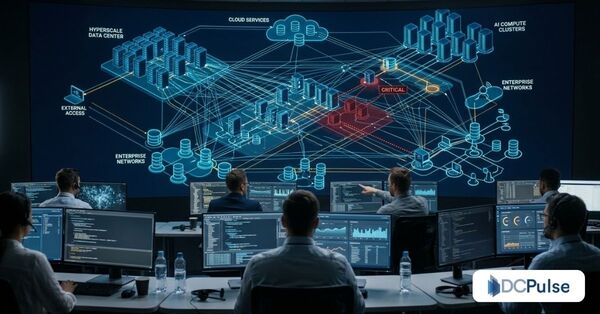
Contextual vulnerability management evaluates weaknesses alongside information about the systems they affect, their connectivity, their operational purpose, and the consequences of potential exploitation.
In a data center, this assessment may begin with asset criticality. A vulnerability affecting a customer-facing application, a shared virtualization platform, or a privileged management system can carry different implications depending on its role in the infrastructure. Dependencies between systems also matter because a weakness in one component may provide a pathway toward other resources.
Network reachability is another important consideration. A vulnerable service exposed to the public internet may present a different level of concern from a similar service isolated behind multiple security controls. Identity permissions, authentication requirements, segmentation policies, and existing defensive measures can further influence the likelihood and potential impact of exploitation.
Operational context is equally important. Data center environments support workloads with different availability requirements, maintenance windows, and recovery procedures. A remediation decision involving a noncritical development environment may be straightforward, while changes to a production platform could require testing, coordination, and an approved maintenance window.
AI-assisted systems could bring these factors together to produce more meaningful risk assessments. Rather than relying exclusively on a vulnerability's technical severity, security teams could evaluate how the weakness interacts with the actual architecture and operational responsibilities of the affected environment.
AI Is Expanding the Role of Infrastructure Security Teams
AI-powered security platforms can assist with vulnerability analysis by correlating asset inventories, configuration data, vulnerability findings, identity information, and network relationships. Depending on the tools and integrations available, these capabilities may help analysts identify vulnerable assets, investigate potential attack paths, and distinguish urgent exposures from lower-priority findings.
For data center operators, this could improve visibility across infrastructure that spans on-premises facilities, colocation sites, private clouds, and public cloud services. A centralized view of relevant findings could help security teams understand whether seemingly separate weaknesses contribute to a shared exposure.
AI may also support investigation by summarizing technical findings, explaining possible consequences, and recommending remediation options for human review. These capabilities could reduce repetitive analytical work and help teams communicate security priorities to infrastructure engineers and operational managers.
Nevertheless, AI-generated assessments require validation. Incomplete inventories, stale configuration records, misunderstood dependencies, and inaccurate assumptions can produce misleading recommendations. Security teams must also consider whether the models and tools have access to sufficiently reliable evidence to support their conclusions.
Automation introduces additional considerations. A system that recommends a patch or configuration change is not equivalent to one authorized to implement it across production infrastructure. Changes to network policies, identity permissions, or core platforms can affect availability and service dependencies. Human approval and established change-management processes therefore remain important safeguards for consequential actions.
Cloud and AI Infrastructure Make Relationships More Important
The expansion of cloud computing and AI infrastructure is increasing the variety of assets that organizations must secure. Modern environments can combine high-performance computing systems, accelerators, storage clusters, orchestration platforms, APIs, software supply chains, and management services.
These components often depend on one another. A vulnerability in an exposed service may become more consequential if that service has privileged access to internal systems. A weakness in a management platform may also deserve additional scrutiny when the platform controls numerous workloads or infrastructure components.
AI workloads introduce their own security considerations, including access to training data, model-serving infrastructure, orchestration systems, and the credentials used by automated processes. The precise risk depends on the deployment architecture, access controls, network exposure, and the sensitivity of the resources involved.
For hyperscale cloud providers and colocation operators, shared infrastructure creates further complexity. Responsibility for securing physical facilities, underlying infrastructure, operating systems, applications, and customer-managed resources can be distributed across different parties. Effective vulnerability management must account for these boundaries rather than assuming that every component is controlled by one organization.
Contextual analysis can help clarify where a vulnerability resides, who is responsible for addressing it, and which dependencies could influence remediation. This is particularly relevant when infrastructure teams must coordinate changes across service providers, customers, and internal operational groups.
Better Prioritization Can Reduce Operational Disruption
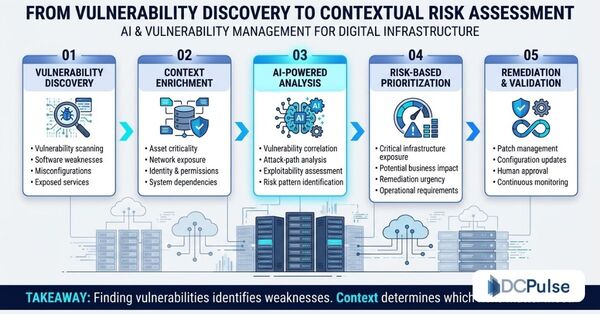
Large vulnerability backlogs can make remediation difficult, particularly when security teams have limited resources and infrastructure teams must maintain service availability. Treating every finding as equally urgent is rarely a practical approach.
Context-aware prioritization offers a more targeted alternative. Organizations can combine technical severity with exploitability, exposure, asset importance, identity privileges, and potential operational consequences. Evidence of active exploitation, where available and relevant, can further influence remediation urgency.
For example, a vulnerability affecting an internet-accessible management interface with elevated privileges may warrant immediate investigation. A similarly rated issue on a tightly isolated system may require a different response, depending on its role and the available compensating controls.
This distinction does not mean that lower-priority vulnerabilities should be ignored. Instead, it provides a framework for determining remediation order, assigning ownership, and setting deadlines based on documented risk.
For data centers, the approach can also help coordinate security work with capacity planning, hardware maintenance, software upgrades, and service availability requirements. Better prioritization may reduce unnecessary emergency changes while directing attention toward weaknesses with the greatest potential consequences.
Reliable Context Requires Better Data and Governance
The effectiveness of AI-driven vulnerability management depends heavily on the quality of infrastructure data. Asset inventories must reflect current deployments, ownership records must be accurate, and network relationships must represent actual connectivity rather than outdated assumptions.
Organizations may need to integrate information from vulnerability scanners, configuration management systems, cloud security platforms, identity providers, network monitoring tools, and operational databases. Consistent asset identifiers and clearly defined ownership can make these relationships easier to interpret.
Data governance is equally important. Security platforms may process sensitive configuration details, privileged access information, network maps, and infrastructure architecture. Access to this information should follow appropriate security policies, with controls designed to prevent unauthorized disclosure or misuse.
Explainability also matters. Security teams need to understand why a system has assigned a particular priority, which evidence supports its assessment, and what assumptions remain uncertain. Without this visibility, AI-generated recommendations may be difficult to validate or defend during audits and incident investigations.
A mature implementation should measure outcomes rather than simply counting vulnerabilities discovered. Useful indicators may include remediation time for critical exposures, the proportion of assets with verified ownership, the age of unresolved high-risk findings, and the recurrence of similar weaknesses. These measures can help organizations determine whether contextual analysis is improving security decisions.
The Future of Vulnerability Management Is Risk-Aware
AI is expanding the ability of security teams to discover weaknesses and analyze complex infrastructure relationships. Yet the growing volume of available information makes prioritization, validation, and operational understanding more important, not less.
For data center operators, cloud providers, and digital infrastructure businesses, vulnerability management must account for the realities of interconnected systems, distributed responsibilities, and demanding availability requirements. A vulnerability's technical rating remains useful, but it cannot independently explain the consequences of exploitation or determine the most appropriate remediation strategy.
Context provides the connection between a technical weakness and the infrastructure it could affect. AI can help establish that connection by correlating evidence, identifying dependencies, and supporting more informed decisions. Human expertise, reliable asset data, and disciplined change management remain necessary to ensure that those decisions are appropriate.
As AI becomes more deeply integrated into security operations, organizations that combine broad discovery with contextual risk assessment will be better positioned to direct attention toward meaningful exposures. The central objective is not to find everything faster, but to understand what matters, why it matters, and how to reduce risk without compromising the reliability of the digital infrastructure that businesses depend on.