DCPulse
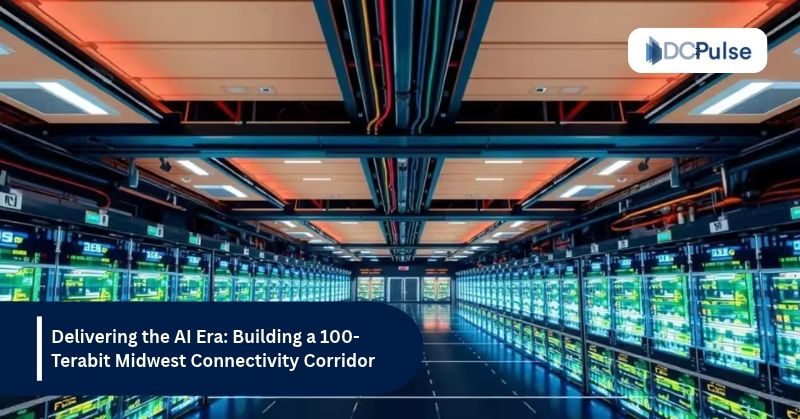
The rapid expansion of artificial intelligence is placing new demands on the telecommunications networks that connect data centers, cloud platforms, and high-performance computing facilities. As AI workloads become increasingly distributed, the ability to move large volumes of data between infrastructure locations is becoming just as important as the availability of computing power. In the United States, a new high-capacity fiber transport corridor across the Midwest highlights how network operators are responding to these changing requirements.
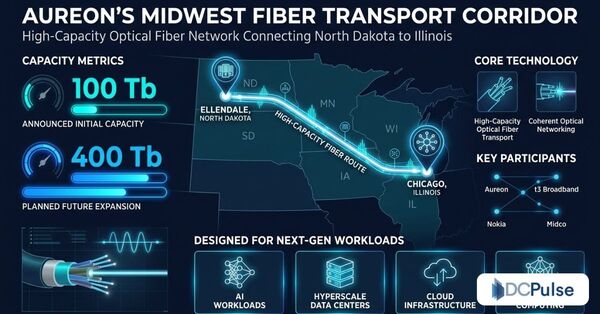
Aureon announced the delivery of a new 100-terabit long-haul transport route on May 19, 2026, developed in collaboration with t3 Broadband, Nokia, and Midco. The route connects Ellendale, North Dakota, with Chicago through a diverse, low-latency fiber corridor. Designed to support growing AI and cloud infrastructure requirements, the project also includes a planned expansion capability of up to 400 terabits.
The development reflects a broader shift in digital infrastructure investment. Data center expansion is no longer driven exclusively by server capacity, electricity availability, and cooling technology. High-capacity optical connectivity is becoming an essential component of the infrastructure required to support large-scale AI operations.
Midwest Connectivity Gains Strategic Importance
z
The Midwest is attracting greater attention as data center and AI infrastructure development expands beyond established coastal markets. Access to land, electricity infrastructure, and opportunities for large-scale development are among the considerations influencing investment decisions across the region.
States such as Iowa, North Dakota, and Illinois are part of a wider digital infrastructure landscape connecting regional markets with major metropolitan data center hubs. Chicago, in particular, serves as an important telecommunications and interconnection market, making connectivity to the city relevant for organizations seeking access to broader network ecosystems.
The new corridor between Ellendale and Chicago is intended to strengthen this regional connectivity. Its development demonstrates how long-haul fiber infrastructure can connect emerging infrastructure locations with established digital hubs.
For data center operators, regional fiber corridors can support communication between geographically distributed facilities, cloud infrastructure, enterprise networks, and external service providers. These connections become increasingly important as AI computing environments expand across multiple locations rather than remaining concentrated within individual facilities.
The z development also highlights the importance of connecting smaller regional markets with larger metropolitan networks. High-capacity transport can help improve the connectivity options available to businesses and infrastructure providers operating outside traditional data center centers.
A 100-Terabit Transport Network Designed for Expansion
The Aureon-led project introduces a high-capacity optical transport route designed around the growing bandwidth requirements of AI and cloud deployments. According to the company's announcement, the network was developed with t3 Broadband, Nokia, and Midco, combining their respective connectivity, optical networking, and infrastructure capabilities.
The announced route was expected to reach 100 Tb of capacity by July 2026, with an architecture designed to scale to 400 Tb as future requirements develop. The announcement establishes the planned capacity targets, although subsequent achievement of those milestones has not been independently confirmed.
The network uses a multi-carrier approach, bringing together infrastructure and services from multiple telecommunications participants. Such arrangements can help connect different fiber networks into a coordinated long-distance transport solution.
Optical transport technology is central to this approach. Modern coherent optical systems allow network operators to transmit substantial amounts of information over fiber infrastructure while improving spectral efficiency and network flexibility.
The project also involved a lit network solution, which uses active optical transmission equipment to provide operational connectivity over fiber infrastructure. This approach can offer a more direct path to delivering transport capacity compared with developing an entirely new physical fiber route.
The ability to expand capacity without treating every increase as a completely new infrastructure project is particularly relevant to data center operators and cloud providers facing changing bandwidth requirements.
AI Data Centers Increase Demand for High-Capacity Fiber

AI infrastructure depends on more than powerful processors and specialized computing hardware. Large AI clusters require extensive communication between GPUs, storage systems, networking equipment, and distributed computing resources.
During AI model training, interconnected accelerators exchange substantial volumes of information. The performance of these systems can depend on the speed and reliability of their internal networking infrastructure.
Connectivity requirements also extend beyond individual data center buildings. Organizations operating distributed AI environments may need to transfer datasets, synchronize workloads, connect storage locations, and maintain communication between facilities across different geographic markets.
This creates additional demand for long-haul optical transport networks. z can provide the underlying connectivity required to move data between data center campuses, cloud regions, and major interconnection locations.
The Midwest corridor addresses this broader infrastructure requirement by connecting North Dakota with Chicago. Its strategic relevance extends beyond the two endpoints, as regional transport networks can form part of larger national and international connectivity systems.
For hyperscale cloud providers and AI infrastructure developers, access to diverse transport routes can also become an important consideration when evaluating new facility locations.
Network Diversity and Resilience Become Infrastructure Priorities
Bandwidth availability alone does not determine the quality of data center connectivity. Network diversity, route resilience, latency, and operational support are equally important considerations for organizations operating mission-critical infrastructure.
A diverse fiber corridor can provide an alternative physical path for network traffic, helping reduce dependence on a single route. This becomes particularly important for data centers supporting cloud platforms, financial services, enterprise applications, and AI computing operations.
The Midwest deployment was described as a diverse, low-latency route. Its multi-carrier structure required coordination across network providers, equipment suppliers, and infrastructure teams.
For data center operators, network diversity can support business continuity planning and improve the ability to maintain connectivity when individual network segments experience disruptions. However, actual resilience depends on the physical separation of routes, shared infrastructure risks, and the design of the wider network.
The growing economic importance of AI computing adds another dimension to this requirement. Extended connectivity disruptions can affect distributed workloads, data transfers, and access to computing resources.
Consequently, telecommunications infrastructure is increasingly being evaluated as part of broader data center resilience strategies rather than simply as a bandwidth service.
Optical Technology and Supply Chain Challenges
The expansion of high-capacity fiber networks is also creating new technical and supply chain considerations. Large transport projects depend on the availability of optical equipment, fiber infrastructure, amplifiers, transmission components, and supporting network systems.
Industry discussions surrounding the Midwest deployment highlighted the importance of coordinating equipment suppliers, carriers, and integrators. Component availability and project scheduling can influence how quickly high-capacity network infrastructure is delivered.
Nokia contributed its coherent optical networking technology to the project. These systems are designed to improve the efficiency of information transmission across fiber networks, supporting higher-capacity services and evolving transport requirements.
The broader optical networking market is also moving toward greater spectral efficiency, lower power consumption, and improved cost per transmitted bit. These considerations are important as network operators seek to expand capacity while managing infrastructure costs and energy requirements.
Higher-capacity wavelength services, including 800G technologies discussed by industry participants, illustrate the direction of optical transport development. Their application depends on network design, equipment capabilities, distance, and operational requirements.
For data center infrastructure providers, the evolution of optical technology creates opportunities to improve connectivity between facilities while supporting increasingly demanding AI workloads.
Collaboration Becomes Essential for Large-Scale Connectivity
The Midwest corridor demonstrates the importance of partnerships in developing complex digital infrastructure. No single participant was responsible for every aspect of the deployment. Aureon, t3 Broadband, Nokia, and Midco contributed to different elements of the transport solution.
Aureon announced the project and is responsible for ongoing support and maintenance. t3 Broadband contributed network integration expertise, while Nokia supplied optical networking technology. Midco's fiber network provided an important part of the physical connectivity used for the route.
This collaborative approach reflects the structure of modern telecommunications infrastructure development. Long-distance transport projects can involve multiple network owners, equipment suppliers, construction teams, and service providers.
The same coordination challenges are relevant to data center development. Hyperscale projects require cooperation between developers, energy providers, telecommunications companies, equipment manufacturers, and local authorities.
Permitting, community acceptance, equipment availability, and infrastructure access can all influence project timelines. As AI data center campuses expand into additional markets, these considerations are likely to remain important to regional connectivity planning.
What the Corridor Means for Future AI Infrastructure
The development of the Midwest connectivity corridor highlights how the AI infrastructure expansion is reshaping investment priorities across the telecommunications industry. Computing capacity, electricity supply, and cooling systems remain essential, but high-capacity connectivity is becoming another critical requirement for scaling digital infrastructure.
For data center operators, access to diverse, scalable fiber networks can influence site selection, interconnection strategies, and the ability to support distributed computing environments. For cloud providers and AI companies, reliable transport infrastructure can help connect computing resources across different regions.
The planned expansion from 100 Tb toward 400 Tb also illustrates the importance of designing network infrastructure with future capacity requirements in mind. Long-term scalability can help operators respond to changing demand without repeatedly redesigning their entire transport architecture.
The Midwest's growing role in the digital infrastructure ecosystem will depend on how effectively its telecommunications networks, electricity infrastructure, and data center developments evolve together.
Ultimately, the next phase of AI expansion will require more than additional servers and larger computing campuses. The networks connecting these facilities will play an increasingly important role in determining how efficiently data moves across the digital economy. The Aureon-led corridor represents one example of how regional fiber infrastructure is being developed to support that transition.