Pranav Hotkar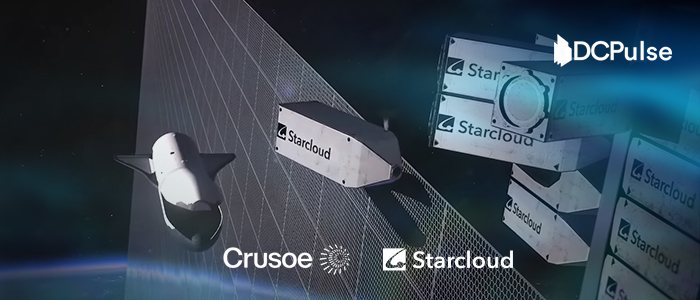
Denver, Colorado, October 22, 2025- Crusoe and Starcloud said on Wednesday they will put part of the public cloud into orbit, a move that the two companies call the first-time customers will be able to run cloud workloads from space. Crusoe will ship a dedicated module of its Crusoe Cloud platform on a Starcloud satellite due to launch in late 2026, with limited GPU services expected to be available by early 2027.
The idea is straightforward, instead of tying huge AI compute farms to local power grids and big tracts of land on Earth, this setup will use dedicated solar arrays in space to run GPUs and other high-performance compute. Crusoe says that co-locating compute with sunlight solves one of the toughest constraints for AI: finding abundant, consistent, low-carbon energy at scale. Starcloud adds that its orbital design avoids traditional cooling and land-use limits.
Both companies framed the project as an experiment with practical aims. Crusoe’s leadership stressed the company’s energy-first strategy and its track record in building rugged, efficient compute sites. Starcloud described the partnership as the first step toward a larger fleet of orbital data centers and highlighted plans to launch an NVIDIA H100 GPU into orbit later this year, a sign that the firms are testing real, powerful AI hardware beyond Earth.
For now, the scope is modest: Crusoe is promising “limited GPU capacity” from space early next year, not a full replacement for ground-based cloud. That choice makes sense, sending and operating hardware in orbit involves launch risk, latency tradeoffs for many applications, and complex regulatory and customer-data considerations. Still, the partners say the experiment will help prove whether solar-first compute in space can scale and be cost-effective for specialized workloads.
If the tests succeed, the partnership will open a new avenue for AI users who need bursts of compute and for projects where terrestrial energy limits are a bottleneck. Critics will watch for costs, launch reliability, data security, and how the companies manage latency-sensitive tasks. For now, Crusoe and Starcloud have put a clear stake in the ground: they intend to make the public cloud a presence off Earth as soon as their 2026 launch and 2027 service goal.