Pranav Hotkar
AI is rewriting the rules of data center infrastructure, and power is quickly becoming the biggest constraint.
As workloads scale and rack densities surge, the energy demands of modern data centers are rising at an unprecedented pace. Hyperscale facilities are now consuming as much electricity as small cities, pushing operators to look beyond traditional grid supply and renewable offsets. The challenge is no longer just sourcing clean energy but securing reliable, continuous power at scale.
That search is bringing hydrogen into focus.
Long positioned as a future fuel for heavy industry and transportation, hydrogen is now being explored as a potential power source for data centers, capable of delivering low-emission energy without the intermittency issues of renewables. Fuel cells, in particular, are being tested as alternatives to diesel generators and even as primary power sources in experimental deployments.
But the excitement comes with uncertainty.
Hydrogen production remains energy-intensive, infrastructure is limited, and large-scale deployment in data centers is still largely unproven. What’s emerging is a growing divide between ambitious announcements and operational reality.
The question is no longer whether hydrogen can power data centers.
It’s whether it can do so at scale or if it remains a promising idea ahead of its time.
Where Does Hydrogen Actually Fit in Data Centers Today?
Despite growing attention, hydrogen remains on the margins of data center power infrastructure today. Most facilities still rely on a familiar mix: grid electricity as the primary source, supported by renewables through power purchase agreements, and diesel generators for backup. This model continues to dominate because it is proven, scalable, and supported by existing infrastructure.
Hydrogen, by contrast, is largely confined to pilot deployments. Its most immediate role is emerging as a replacement for diesel backup systems, where fuel cells can provide low-emission standby power without the pollutants associated with traditional generators. The International Energy Agency notes that while hydrogen is gaining traction in energy systems, its adoption in data centers is still at an early stage, with most applications limited to demonstration projects.
Data Center Power Mix (2026 Estimates)
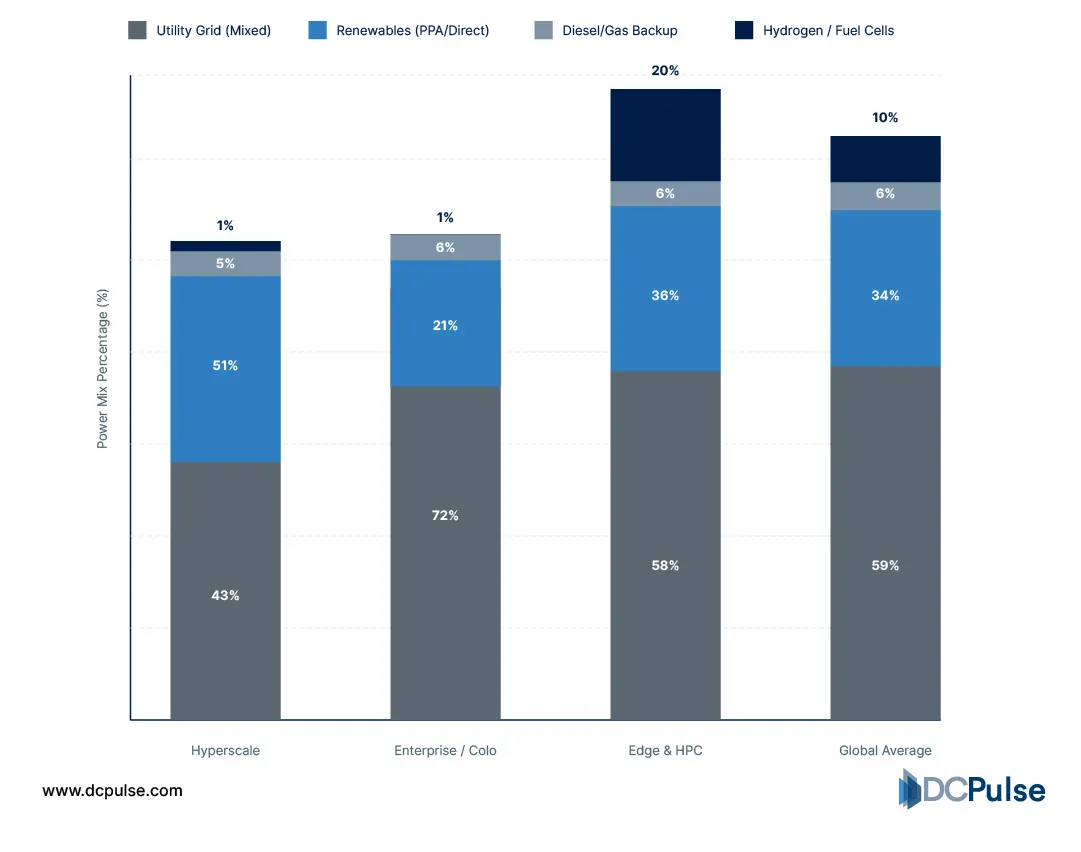
A few operators have begun testing hydrogen beyond backup scenarios, exploring its potential as a primary or supplemental power source. However, these efforts remain experimental, often tied to specific locations or partnerships rather than broad deployment.
Hydrogen Adoption Stages
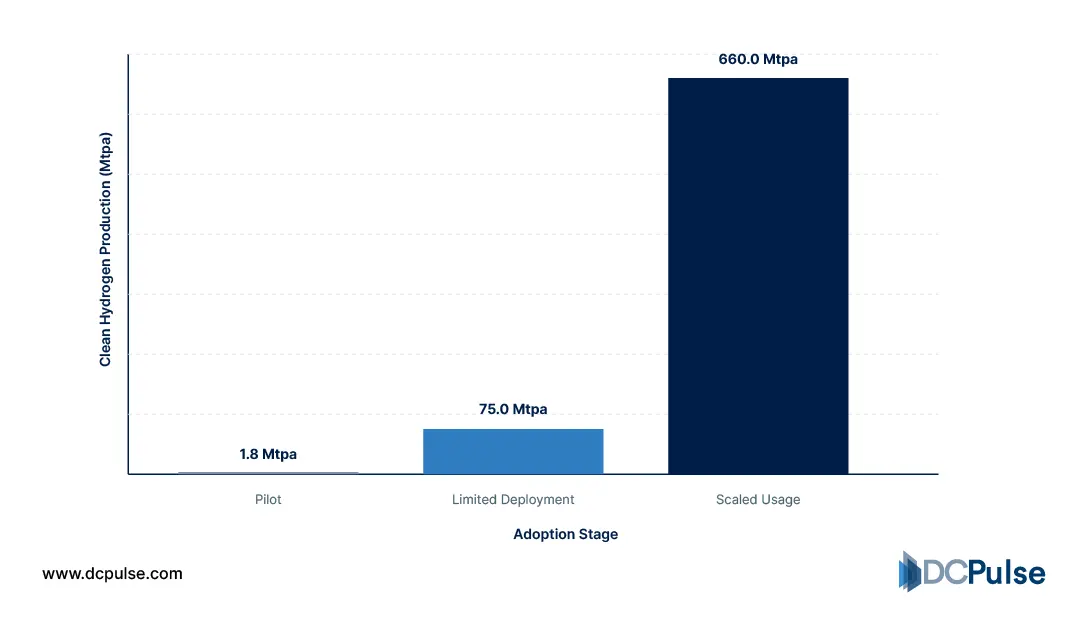
The gap between interest and implementation is driven by infrastructure limitations. Hydrogen production, storage, and distribution systems are not yet widely available at the scale required for data centers, creating a significant barrier to adoption.
As a result, the current landscape is defined by contrast: hydrogen is widely discussed as a future solution, but in practice, it remains a niche technology with limited real-world presence in data center operations.
Inside Hydrogen Power: What’s Actually Changing?
At the core of hydrogen’s potential in data centers are fuel cells, systems that generate electricity through an electrochemical reaction between hydrogen and oxygen, producing only water as a byproduct. Unlike combustion-based generators, fuel cells operate with higher efficiency and lower emissions, making them a promising alternative for backup and potentially primary power.
However, the environmental value of hydrogen depends heavily on its source. “Green hydrogen,” produced using renewable energy, offers near-zero emissions, while “blue” and “grey” hydrogen rely on fossil fuels, significantly reducing sustainability gains. Industry analysis shows that truly green hydrogen remains limited due to high production costs and infrastructure gaps.
Hydrogen Emissions Comparison
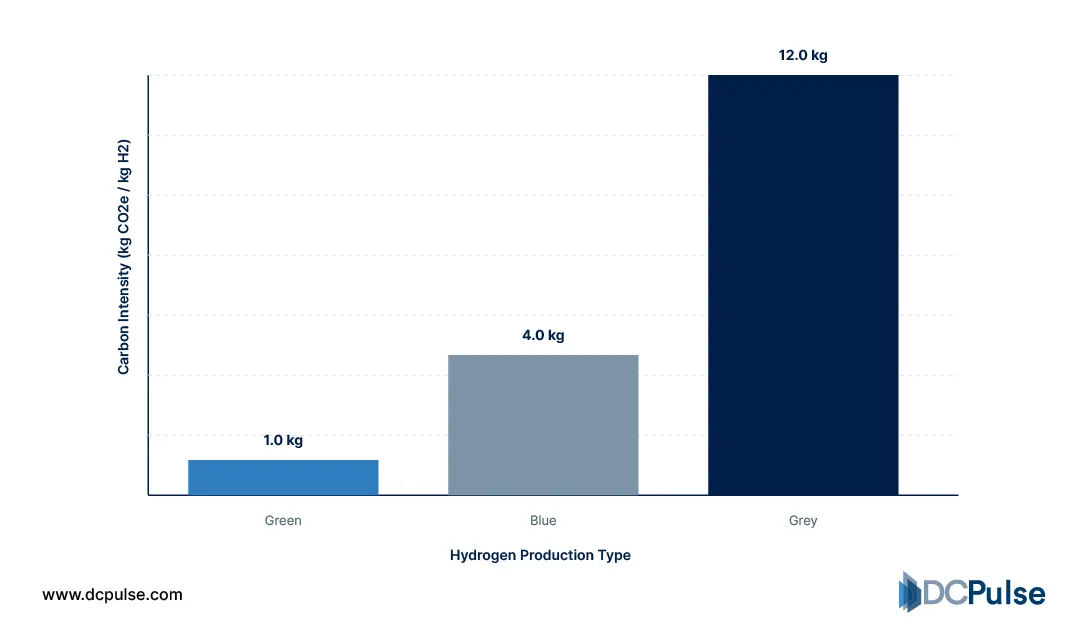
Efficiency presents another challenge. Hydrogen systems require multiple energy conversions, electricity to hydrogen, storage, and reconversion, each introducing losses that reduce overall system efficiency compared to direct electricity use
Storage remains a critical bottleneck. Hydrogen’s low energy density means it must be compressed or liquefied, both of which are energy-intensive and costly processes. IEEE highlights that storage complexity and infrastructure limitations are among the biggest barriers to commercialization.
Energy Storage Comparison (2026 Benchmarks)
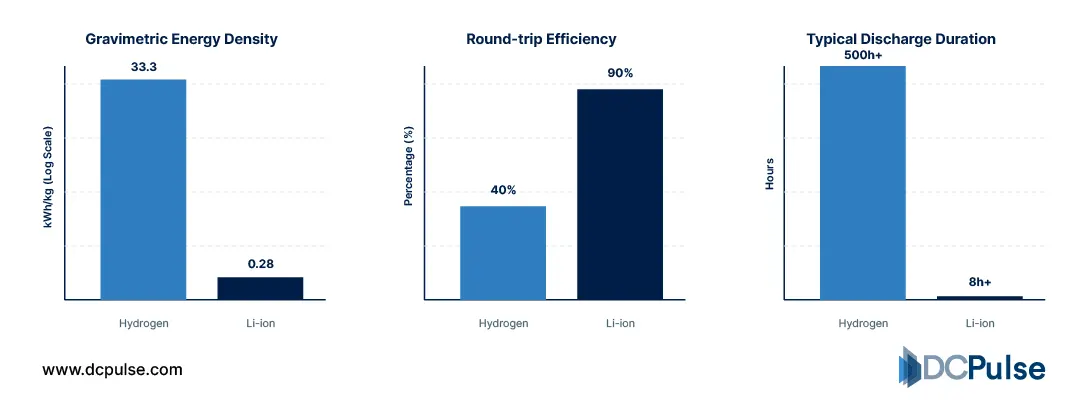
Together, these factors show that while hydrogen technology is advancing, its real-world deployment in data centers still hinges on overcoming efficiency losses and infrastructure constraints.
Who’s Investing? Inside the Industry Push
The momentum behind hydrogen-powered data centers is being shaped less by widespread deployment and more by a growing wave of pilots, partnerships, and strategic bets. What stands out is not scale, but intent.
Hyperscalers are beginning to test hydrogen, primarily as a diesel backup replacement. Microsoft, for instance, has successfully run data center backup systems on hydrogen fuel cells for extended periods, demonstrating technical feasibility without emissions from traditional generators.
Key Hydrogen Pilot Milestones (2020–2026)
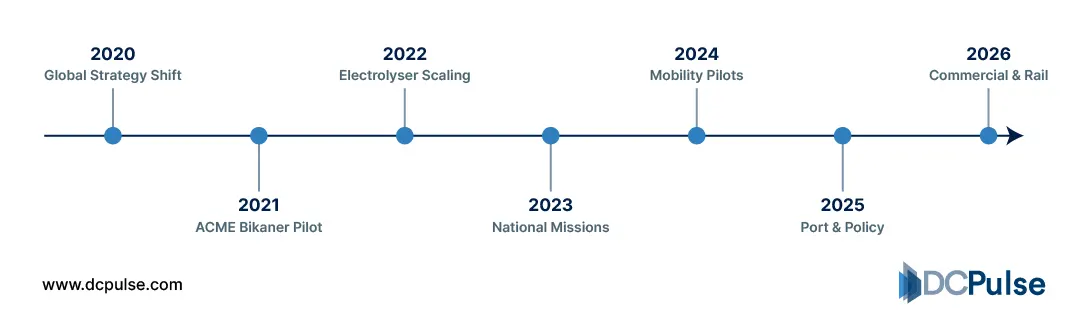
Energy companies are also moving into the space, seeing data centers as a future demand center for clean fuels. Partnerships between utilities, hydrogen producers, and data center operators are emerging to explore on-site generation and supply chains, though most remain in early-stage development.
At the vendor level, fuel cell manufacturers are positioning themselves as alternatives to diesel infrastructure, targeting backup power first before scaling toward primary energy roles. These systems are increasingly being tested for reliability, runtime, and integration with existing data center operations.
However, a gap remains between announcements and execution. Many projects are still limited to controlled pilots or demonstration sites, with few examples of large-scale, production-level deployment.
What emerges is a pattern: the industry is investing in hydrogen cautiously. Real progress is happening, but it is measured in experiments and partnerships, not yet in fully operational, hydrogen-powered data centers.
Can Hydrogen Power Data Centers at Scale?
Hydrogen can power data centers, but it won’t replace the grid anytime soon.
From a technical standpoint, hydrogen fuel cells have already proven they can deliver reliable, low-emission power. They offer a compelling alternative to diesel for backup systems and, in controlled scenarios, can even support primary workloads. But scaling this capability across the global data center ecosystem introduces challenges that go far beyond the technology itself.
The biggest barrier is economics. Producing green hydrogen remains expensive, and the multi-step process, generation, storage, transport, and reconversion, introduces efficiency losses that make it less competitive than direct electricity use. At scale, these inefficiencies translate into significantly higher operational costs.
Infrastructure is the second constraint. Unlike electricity, hydrogen lacks a mature, widespread distribution network. Building the required production and storage systems at or near data centers will take time, capital, and coordinated investment across industries.
That said, hydrogen has a clear role to play. It is well-positioned to replace diesel in backup power and to serve as a strategic solution in regions with limited grid capacity or strict emissions targets.
The outcome is not dominance, but specialization. Hydrogen will grow as a critical niche solution, complementing, not replacing, the grid in the future of data center power.