Pranav Hotkar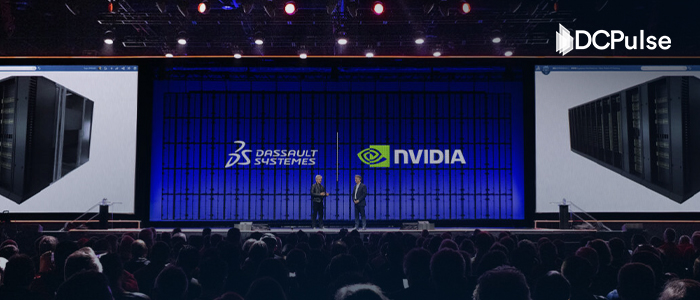
Houston, United States - 3 February 2026 - NVIDIA and Dassault Systèmes today announced a long-term strategic partnership to develop a shared industrial artificial intelligence platform that integrates accelerated AI infrastructure with advanced digital twin technologies, aiming to transform how complex systems are designed, simulated and operated across industries.
Unveiled at the 3DEXPERIENCE World 2026 event in Houston, the collaboration will combine Dassault Systèmes’ Virtual Twin technologies with NVIDIA’s AI computing stack, open models and accelerated software libraries to establish what the companies describe as science-validated industry “World Models.” These models will serve as mission-critical platforms that go beyond traditional simulations to enable real-world engineering and operational workflows grounded in physics and validated industrial knowledge.
“Artificial intelligence will be infrastructure,” NVIDIA founder and CEO Jensen Huang said, emphasizing that the partnership represents the largest collaboration between the two companies in over 25 years. Huang explained that the joint platform will allow engineers, designers and researchers to virtually prototype, validate and optimize systems at scales far beyond conventional methods, helping industries tackle design complexity with greater confidence and speed.
Dassault Systèmes CEO Pascal Daloz highlighted how the platform will unify AI with digital twin factories, software representations that mirror real-world performance, creating “knowledge factories” where new products and processes can be tested and refined before physical deployment. Daloz noted that virtual twins, acting as trusted, physics-informed digital counterparts, will accelerate innovations in biology, materials science, engineering, manufacturing and beyond.
Under the agreement, Dassault Systèmes will leverage its OUTSCALE sovereign cloud strategy to deploy AI “factories” on multiple continents, enabling customers to operate AI models within Dassault’s 3DEXPERIENCE platform while maintaining data privacy, intellectual property protection and regulatory compliance. NVIDIA, in turn, will apply Dassault’s model-based systems engineering (MBSE) techniques to design and scale AI factory infrastructure using its Omniverse™ and Rubin platforms.
The joint platform aims to support a wide range of advanced applications, including AI-driven materials discovery, physics-based virtual-twin behaviour simulation, and software-defined autonomous production systems, all powered by NVIDIA’s AI tools, such as CUDA-X™ libraries and Nemotron™ open models. Industry partners featured in early use cases include firms in automotive design, industrial automation and aviation research, all seeking to compress innovation cycles and boost computational fidelity.
Analysts say the partnership reflects a broader industry shift in which AI infrastructure and digital twin technologies converge, demanding scalable, high-performance computing resources typically hosted in modern data center environments. By tightly integrating AI and physics-based simulation, the platform could help enterprises reduce time-to-market, improve operational efficiency and unlock new levels of automated decision-making.
The announcement underscores both companies’ confidence in AI’s role as a foundational layer for industrial innovation, reimagining digital twin capabilities as intelligent, mission-critical systems rather than isolated simulation tools.