Pranav Hotkar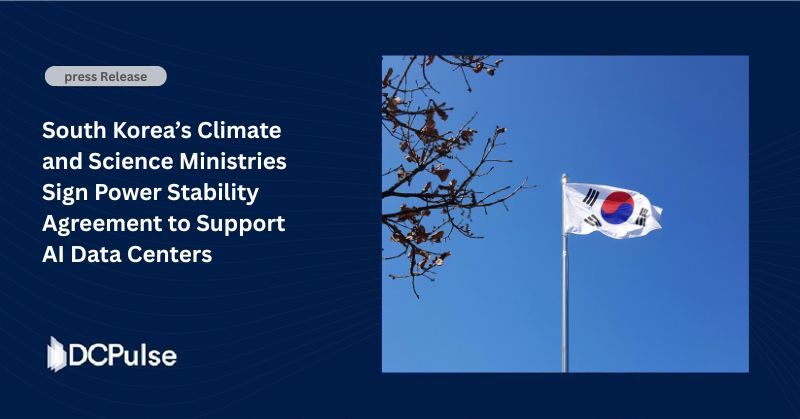
Seoul, South Korea - May 12, 2026 - South Korea’s Ministry of Environment and Ministry of Science and ICT have signed a memorandum of understanding aimed at securing stable power supplies and improving energy coordination for the country’s rapidly expanding AI and data center sector.
The agreement comes as South Korea faces mounting electricity demand driven by hyperscale AI infrastructure, semiconductor manufacturing, and cloud computing growth. Government officials said the partnership is intended to strengthen coordination between energy, climate, and digital infrastructure policy as AI workloads increasingly strain national power systems.
Under the agreement, the ministries will cooperate on long-term strategies tied to grid stability, renewable energy integration, and infrastructure planning for large-scale digital facilities. The initiative also includes joint efforts around energy efficiency technologies, emissions reduction, and power supply forecasting for high-density AI operations.
South Korean authorities have increasingly identified AI infrastructure as a strategic national priority. The country has seen a sharp rise in proposed hyperscale data center developments over the past two years, particularly in the Seoul metropolitan region, where electricity constraints and transmission bottlenecks have become growing concerns for operators and utilities alike.
Officials involved in the agreement said future AI facilities will require closer coordination between environmental regulation and digital infrastructure planning to avoid grid instability and ensure sustainable growth. The ministries also plan to expand information sharing related to electricity consumption patterns and carbon reduction initiatives across the technology sector.
The move reflects a broader global trend in which governments are increasingly intervening in AI infrastructure planning due to the enormous power demands associated with GPU-intensive workloads. Industry analysts estimate that next-generation AI campuses can require electricity capacity comparable to small cities, creating new challenges for utilities, regulators, and national energy systems.
South Korea has been aggressively positioning itself within the global AI ecosystem through investments in semiconductor manufacturing, sovereign AI initiatives, and domestic cloud infrastructure. Major technology firms including Samsung Electronics, SK Telecom, KT, and Naver have all expanded AI-related infrastructure initiatives in recent years. (reuters.com)
The government has also been promoting low-carbon infrastructure strategies as part of broader climate goals, with policymakers increasingly emphasizing the importance of energy-efficient AI data centers and renewable-powered digital infrastructure.
Industry observers view the new inter-ministerial agreement as a sign that South Korea is moving toward a more centralized and coordinated approach to AI infrastructure development, particularly as electricity availability becomes a critical competitive factor in the global AI race.