DCPulse
Artificial intelligence is changing the electrical profile of modern data centers. Large AI clusters can place substantial demands on power infrastructure, while the operation of specialized compute hardware can introduce rapid changes in electrical load.
That shift is putting greater attention on batteries. Historically, batteries in data centers have been closely associated with uninterruptible power supply (UPS) systems and short-duration backup. AI infrastructure is broadening the discussion toward power-quality management, peak management, energy storage and coordination with the wider electrical system.
Uptime Institute has identified rapid power fluctuations associated with large AI compute as an electrical infrastructure challenge, with additional energy storage and updated UPS controls among the approaches being investigated to manage those fluctuations.
The result is a more complex question for data-center operators: not simply how much battery capacity is required, but where batteries should be deployed, what role they should perform and how they should interact with the rest of the power architecture.
From Backup Battery to Infrastructure Resource
A conventional UPS battery is primarily designed to provide continuity during a power interruption. Its role is closely tied to maintaining power to critical IT equipment while another source, such as utility power or generation, is restored.
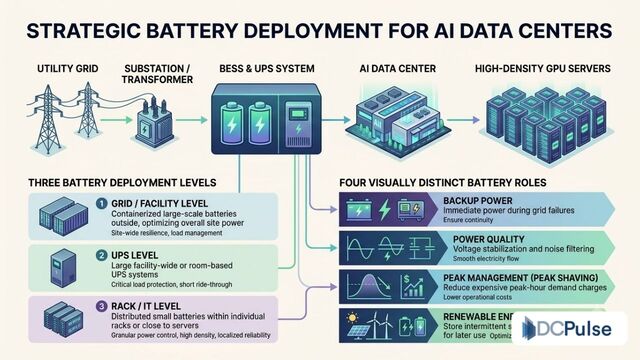
Battery energy storage systems (BESS) can serve a broader set of functions. Uptime Institute identifies applications including UPS support, demand response, peak shaving, renewable-energy shifting and power balancing.
Those functions create different technical requirements.
A battery designed for short-duration UPS support has different operating requirements from a system intended to shift energy over several hours. Similarly, a battery used to respond to rapid fluctuations may prioritize power delivery and response characteristics rather than maximum stored energy.
For AI-oriented facilities, this distinction becomes increasingly important because the electrical architecture has to accommodate both conventional reliability requirements and the changing behavior of high-density compute.
AI Is Increasing Attention on Power Quality
The relationship between AI compute and battery systems extends beyond backup power.
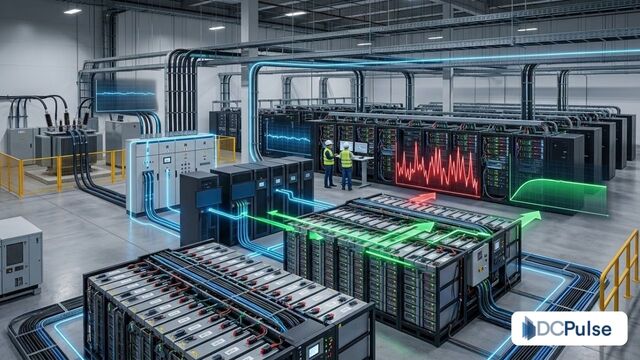
Large GPU-based systems can operate at high power densities and may produce changes in electrical demand that are different from more traditional enterprise computing environments. Uptime Institute has reported that specialized AI compute can create large power swings and frequent power surges, prompting investigation into additional rapid-discharge and recharge storage.
Battery systems can potentially act as a buffer between the electrical supply and demanding compute loads. The exact configuration depends on the facility architecture, the utility connection, the UPS design and the characteristics of the IT workload.
This makes battery strategy part of a larger electrical-engineering decision rather than an isolated equipment purchase.
Multiple Battery Locations Are Emerging
Battery storage does not necessarily have to sit in one location within a data center's electrical chain.
Research examining AI data-center power systems has considered storage at several levels, including grid-scale batteries, UPS systems, rack-level battery backup units and even storage associated with individual compute systems.
Each location addresses a different problem.
At the UPS level, batteries provide established ride-through functionality. At the facility level, larger BESS installations can potentially help manage demand, smooth power requirements or interact with onsite generation. At the IT level, smaller battery systems can provide localized buffering.
A recent review of AI data-center grid integration also identifies battery storage as one component of a broader architecture that can include grid-scale storage, UPS systems, rack-level storage and chip-level buffering.
The practical challenge is determining which combination provides the required reliability without creating unnecessary complexity.
BESS Could Expand Beyond Traditional UPS Applications
The growing interest in BESS is also changing how operators view energy storage.
Uptime Institute describes BESS deployment in data centers as an emerging area, with applications beyond conventional UPS and renewable-energy shifting still developing. That suggests operators are likely to evaluate storage according to specific operational requirements rather than treating every battery installation as interchangeable.
Peak shaving is one potential application. A facility with sufficient storage could use batteries during selected periods of high electricity demand, depending on its utility tariff, grid connection and operating strategy.
Renewable integration presents another possibility. Battery systems can help shift when electricity generated from variable renewable sources is consumed, although the economics and operating requirements depend heavily on the individual project.
Power balancing provides another potential role, particularly where compute loads and available grid capacity do not always align.
Battery Chemistry Is Becoming a Design Question
AI-era battery planning also raises questions about battery chemistry and system design.
Lithium-ion technology remains widely deployed for data-center UPS applications, according to Uptime Institute. At the same time, other battery technologies are being considered for different infrastructure requirements.
The choice cannot be reduced to energy density alone. Data-center operators also have to consider power characteristics, operating temperature, safety requirements, footprint, maintenance, lifecycle expectations, monitoring and integration with electrical systems.
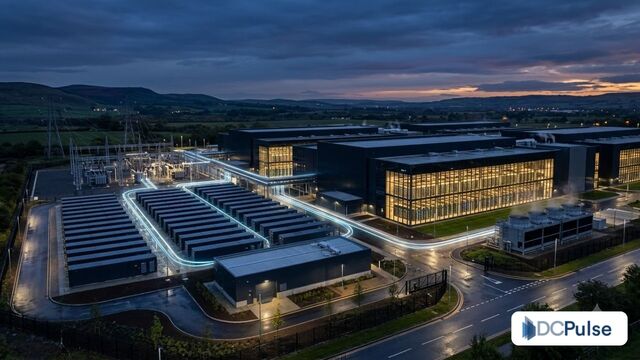
Facility design can become particularly important as storage systems increase in scale. Larger battery installations may require dedicated space, thermal management, fire-safety measures and electrical infrastructure that must be incorporated into the site plan.
For new AI campuses, these considerations can influence building layouts and equipment yards before the first servers are installed.
Data Center Design May Need a Different Electrical Architecture
Battery strategy is also connected to the evolution of data-center electrical distribution.
Uptime Institute has discussed medium-voltage UPS and downstream distribution as one potential direction for facilities dealing with increasing power requirements. Higher-voltage architectures can alter how power is distributed through large facilities and how electrical equipment, UPS systems and storage are arranged.
The implications extend beyond batteries.
Transformers, switchgear, UPS equipment, generators, busways, cooling systems and utility interconnections all have to work together. A battery installation that solves one electrical problem but creates constraints elsewhere may not provide an effective overall solution.
AI infrastructure therefore encourages a systems-level approach in which storage is considered alongside generation, distribution and compute architecture.
Reliability Remains the Primary Requirement
Despite the broader range of potential applications, reliability remains central to battery deployment in data centers.
AI workloads can support valuable services, but the underlying digital infrastructure still requires predictable power. Storage systems must therefore operate within carefully defined reliability and safety parameters.
Redundancy, battery monitoring, thermal conditions, maintenance procedures and failure modes all become important considerations. The growing size and complexity of storage installations also means operators must evaluate how batteries interact with emergency power systems and other critical infrastructure.
The objective is not simply to add more batteries. It is to develop an electrical architecture in which storage performs a clearly defined function without compromising availability.
A More Strategic Role for Batteries
AI growth is pushing batteries beyond their traditional identity as backup components. In some data-center designs, storage can become part of the facility's broader strategy for managing power quality, demand, renewable generation and electrical flexibility.
That transition is still developing. Many potential applications remain dependent on project economics, regulatory conditions, utility arrangements and technology maturity.
For data-center developers, the important change is the scope of the discussion. Battery planning increasingly involves questions about electrical architecture, workload behavior, grid capacity and long-term infrastructure strategy.
As AI facilities become more power-intensive, those questions are likely to become part of the earliest stages of data-center design rather than decisions made after the electrical system has already been defined.