DCPulse

Amazon Web Services (AWS) is preparing to launch its first cloud infrastructure region in Saudi Arabia, marking a major expansion of cloud and AI infrastructure capacity in the Kingdom. The new Region, expected to become operational in December 2026, will provide organizations with access to AWS cloud services hosted within Saudi Arabia, supporting local data residency requirements, application deployment, and digital transformation initiatives.
The expansion represents a significant step in the development of Saudi Arabia's digital infrastructure ecosystem, as cloud adoption, artificial intelligence, and data-intensive applications continue to drive demand for computing capacity. AWS has committed more than $5.3 billion to its planned infrastructure investment in the Kingdom, reinforcing the growing importance of the Middle East as a destination for cloud and AI infrastructure development.
Saudi Arabia Cloud Region Targets December Launch
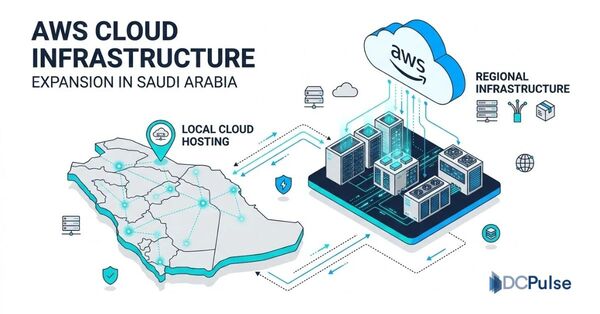
AWS announced its Saudi Arabia infrastructure region in March 2024, initially outlining plans for a 2026 launch. In August 2026, the company said the region was on track to launch in December 2026. The deployment is expected to include three availability zones, providing geographically separated infrastructure locations within the region to support availability and resiliency strategies.
The new region will allow customers to run cloud workloads and store data within the kingdom rather than relying exclusively on AWS infrastructure in other countries. This is relevant for government entities, financial institutions, healthcare providers, enterprises, startups, and other organizations with operational or regulatory requirements related to data location.
The Saudi Region will become part of AWS's global infrastructure network, allowing customers to build applications using cloud services while selecting infrastructure closer to their users and business operations. Regional deployment can also help organizations design applications around local latency requirements and data residency considerations.
The planned launch reflects the broader transition in Saudi Arabia from cloud adoption toward the development of locally hosted digital infrastructure supporting enterprise applications, AI services, and digital public services.
$5.3 Billion Infrastructure Investment
AWS has announced plans to invest more than $5.3 billion, equivalent to approximately SAR 19.88 billion, in Saudi Arabia. The investment is intended to support the development and operation of cloud infrastructure in the Kingdom and reflects the company's long-term commitment to the regional market.
Large-scale cloud infrastructure investment involves more than the construction of data center buildings. It requires computing equipment, storage systems, networking infrastructure, power delivery, cooling systems, security, and operational capabilities designed to support cloud services continuously.
The development of a new cloud region also creates demand across the wider infrastructure supply chain, including data center construction, electrical systems, fiber connectivity, equipment deployment, facilities management, and technical operations.
For Saudi Arabia's infrastructure industry, the AWS investment adds to the country's effort to attract technology companies and expand the domestic capacity required for cloud computing and AI development.
Three Availability Zones and Regional Resilience
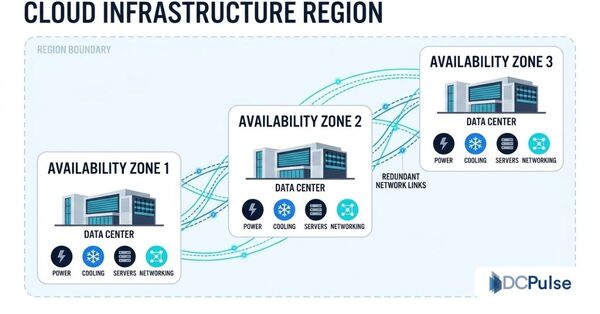
The planned Saudi AWS Region is expected to include three Availability Zones at launch. Availability zones are separate infrastructure locations within an AWS region designed to support applications that require high availability and resilience. AWS describes these locations as having independent power, cooling, and physical security, connected through redundant, low-latency networking.
This architecture enables organizations to distribute applications and workloads across multiple Availability Zones. Such deployments can help reduce the impact of infrastructure failures affecting a single location, depending on how customers design and operate their applications.
For enterprises moving critical workloads to the cloud, the presence of multiple Availability Zones can be an important factor in application architecture, disaster recovery, and business continuity planning.
The region will also give Saudi organizations another option for building cloud applications within the country while retaining the ability to connect with services and infrastructure across AWS's wider global network.
AI Infrastructure Expands Alongside Cloud Capacity
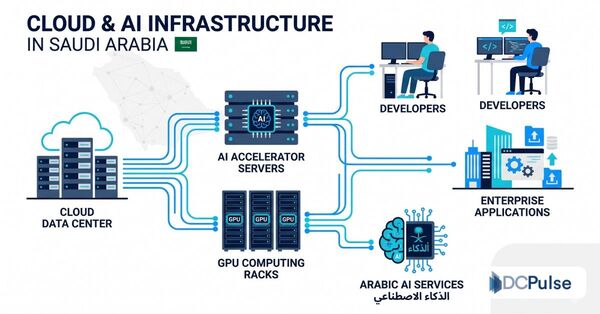
Artificial intelligence is becoming a major component of AWS's Saudi Arabia strategy. Alongside the planned cloud region, AWS and HUMAIN have announced a collaboration to provide up to 50 megawatts of capacity in Saudi Arabia's first AI Zone by 2028. The infrastructure is expected to include AWS Trainium chips and NVIDIA AI infrastructure to support AI training and inference workloads.
The planned AI Zone adds another dimension to the cloud region announcement. AI training and inference workloads require different infrastructure configurations from conventional enterprise applications, including accelerator-based computing, high-performance networking, data storage, and power systems capable of supporting dense computing environments.
The combination of regional cloud services and dedicated AI infrastructure could help organizations develop and deploy AI applications within the Kingdom. Potential users include enterprises, technology developers, government organizations, and businesses building services for Arabic-speaking markets.
However, cloud infrastructure and specialized AI capacity serve different requirements. The cloud region provides a broader foundation for application development and cloud services, while the AI zone is intended to support more demanding AI computing workloads.
Arabic AI and Amazon Bedrock Integration
The AWS-HUMAIN collaboration also includes plans to make HUMAIN's ALLAM Arabic large language model available through Amazon Bedrock. This could provide developers with access to Arabic-language AI capabilities through AWS's managed generative AI platform.
The integration could support the development of Arabic-language applications, enterprise AI assistants, document processing systems, customer service platforms, and other AI-based services. Local cloud infrastructure combined with managed AI services may also simplify the deployment process for organizations seeking to build applications for the Saudi market.
The development highlights the importance of language-specific AI models in regional infrastructure strategies. AI adoption is not limited to computing hardware or cloud capacity. Access to models designed for regional languages, datasets, and business requirements can also influence how organizations use AI services.
For infrastructure providers, these workloads may create additional demand for accelerator systems, storage, networking, and high-density data center environments as AI applications move from development toward production deployment.
Data Residency and Digital Sovereignty
The Saudi Arabia Region is expected to provide customers with greater flexibility to host applications and store data within the Kingdom. This is particularly relevant to organizations managing sensitive information or operating under data residency and regulatory requirements.
Local cloud infrastructure can simplify certain deployment decisions by providing an in-country hosting option. Organizations will still need to evaluate applicable regulations, service availability, security requirements, architecture, and data flows for their individual workloads.
AWS has positioned its infrastructure around digital sovereignty controls, but the presence of a local region alone does not automatically ensure regulatory compliance. Customers remain responsible for configuring their cloud environments and determining whether particular services and workloads meet applicable legal and operational requirements.
The availability of local cloud infrastructure may nevertheless expand the range of applications that organizations are willing or able to migrate from on-premises environments or other cloud platforms.
Saudi Arabia's Digital Infrastructure Strategy
The AWS expansion aligns with Saudi Arabia's wider ambitions to develop technology capabilities, attract digital investment, and accelerate economic diversification under Vision 2030.
Cloud computing has become a foundational requirement for many digital transformation programs. Government services, enterprise software, fintech applications, e-commerce, analytics, connected systems, and AI applications increasingly depend on scalable computing and storage infrastructure.
AWS has also announced plans for innovation centers in Saudi Arabia and workforce-development initiatives focused on cloud computing and AI skills. These programs are intended to support startups, developers, students, and businesses as the country's digital ecosystem expands.
The development of cloud infrastructure can create opportunities beyond direct data center operations. Construction contractors, technology partners, systems integrators, cybersecurity providers, managed service providers, and technical training organizations may also benefit from an expanding cloud ecosystem.
The long-term impact will depend on the extent to which local businesses adopt cloud services, develop new digital products, and expand AI-based applications using the available infrastructure.
Implications for the Data Center Industry
AWS's Saudi Arabia Region illustrates the increasing strategic importance of regional cloud infrastructure in the Middle East. The investment combines local cloud availability with plans for specialized AI infrastructure, creating a broader digital infrastructure footprint in the Kingdom.
For the data center industry, continued cloud and AI expansion can increase demand for power capacity, cooling technology, fiber networks, high-performance computing infrastructure, and specialized facilities capable of supporting different workload requirements.
Saudi Arabia's ability to accommodate these developments will depend on infrastructure planning, electricity supply, connectivity, construction capacity, operational expertise, and the pace of customer adoption. As cloud and AI workloads grow, these supporting systems will remain central to the expansion of digital infrastructure.
The planned December 2026 launch of AWS's Saudi Arabia Region marks an important milestone in the country's cloud infrastructure development. Alongside the company's investment commitment and collaboration with HUMAIN, the Region could help strengthen Saudi Arabia's position in regional cloud computing and AI services while creating new opportunities across the data center and technology ecosystem.