DCPulse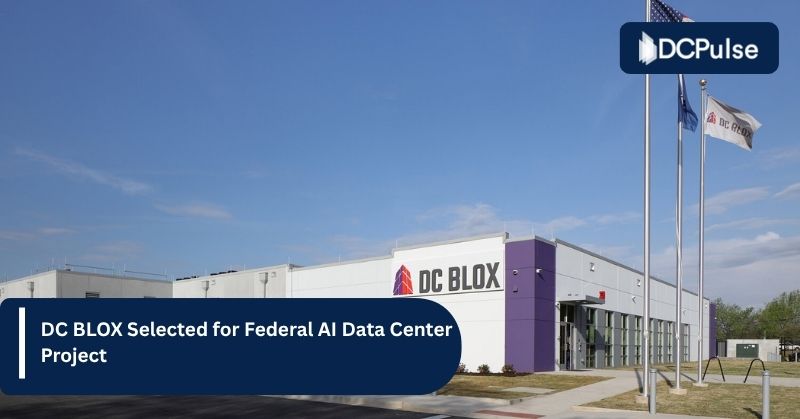
The U.S. Department of Energy’s National Nuclear Security Administration has selected DC BLOX as part of a consortium led by Amentum to negotiate a phased lease for an artificial intelligence data center and dedicated energy generation project at the Savannah River Site in South Carolina. The selection places data center infrastructure, on-site power generation, and federal land within a single development framework.
The proposed project includes a planned 1 GW AI data center campus and approximately 2 GW of on-site energy generation. The consortium selection was announced on July 20, 2026, with the parties moving into negotiations for the phased lease rather than beginning construction immediately.
Federal Land Becomes a Platform for AI Infrastructure
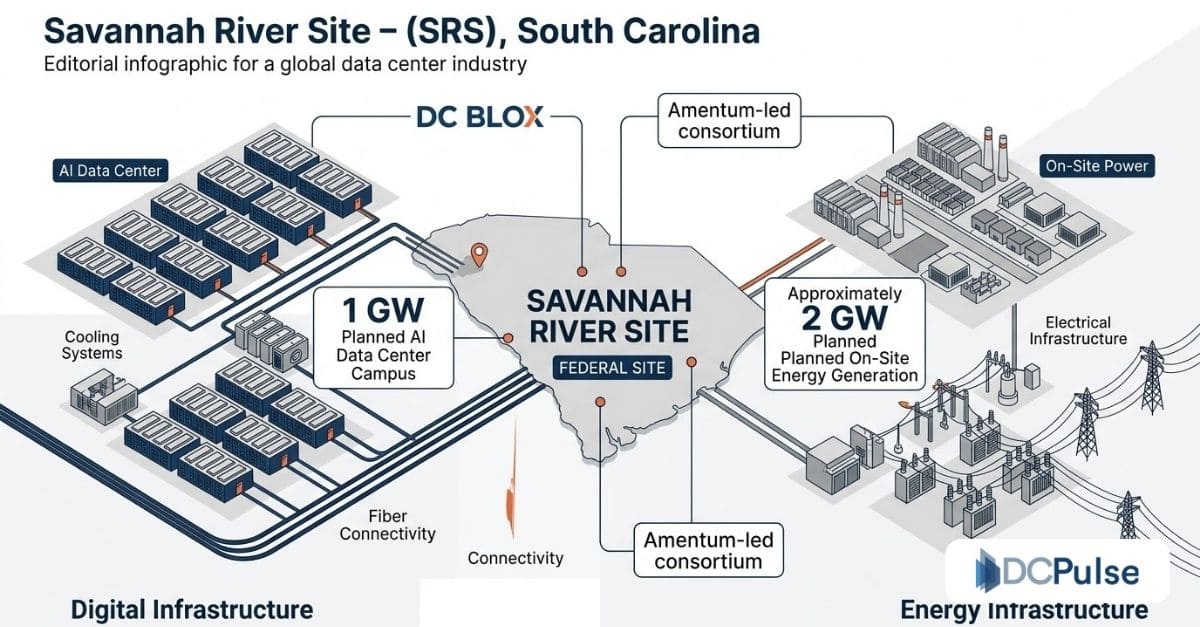
The Savannah River Site provides the setting for a development model in which federal land is being considered for large-scale digital infrastructure and associated energy projects. The NNSA's competitive selection is part of a broader federal effort to use government-owned sites for AI data center development and energy infrastructure.
For data center developers, the model connects several normally separate development requirements. Land availability, power generation, electrical infrastructure, and high-density computing capacity are being considered within the same project framework, potentially changing how large AI campuses are planned and deployed.
The proposed Savannah River development is particularly relevant because the data center and energy components are being advanced together. DC BLOX's role gives the consortium a digital infrastructure partner with experience in data centers, fiber networks, and connectivity infrastructure across the Southeast.
A 1 GW AI Campus With Dedicated Energy Generation
The planned campus is designed around approximately 1 GW of data center capacity and roughly 2 GW of on-site energy generation. Those figures describe the proposed project rather than commissioned infrastructure, and the development remains subject to the lease negotiations and other project requirements.
The relationship between the two capacity figures is an important part of the infrastructure model. Dedicated generation is intended to provide a power source for the data center while creating an energy infrastructure component that is developed alongside the digital facility rather than relying entirely on conventional grid delivery.
For AI operators, this type of arrangement addresses one of the central requirements of large computing campuses: access to substantial and dependable electrical capacity. The project therefore illustrates how future AI data center developments may increasingly be planned around power availability from the earliest stages.
DC BLOX Brings Data Center and Connectivity Experience
DC BLOX's participation extends its existing focus on vertically integrated digital infrastructure into a federal development environment. The company operates and develops data centers, regional dark fiber networks, and cable landing stations across the Southeastern United States.
The company's infrastructure portfolio includes hyperscale-ready campuses as well as network and subsea connectivity assets. That combination is relevant to AI infrastructure because large computing facilities require more than electrical capacity. Fiber connectivity and network access are also important components of the infrastructure supporting cloud, enterprise, and AI workloads.
DC BLOX has also been expanding its hyperscale-ready infrastructure portfolio. In May 2026, the company announced an increase in its green loan financing to $850 million, providing additional capital capacity for its data center development activities across the Southeast.
On-Site Power Changes the Data Center Development Equation
Power availability has become a central consideration in large data center development as AI workloads require higher-density computing infrastructure. DC BLOX has previously highlighted the importance of securing power and investing in infrastructure that can accelerate the availability of electricity for hyperscale and enterprise customers.
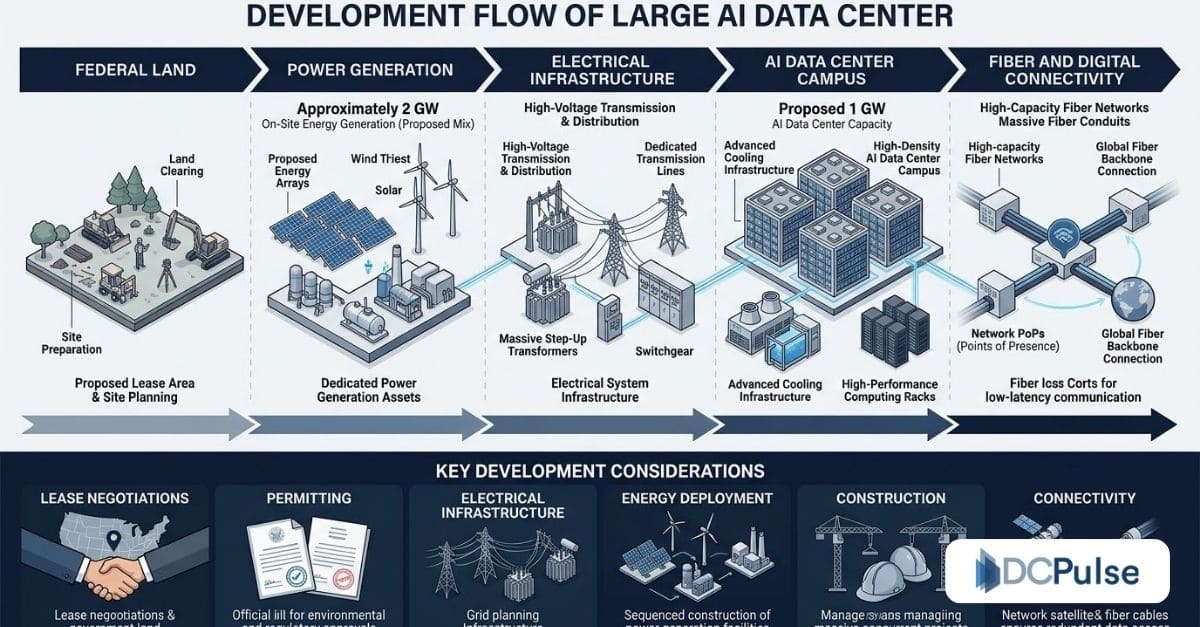
The Savannah River project takes that concept further by pairing a proposed AI campus directly with dedicated energy generation. The structure can potentially reduce the dependence on a conventional sequence in which a developer first secures a site, waits for grid interconnection, and then proceeds toward large-scale computing deployment.
That does not eliminate the complexity of power development. Generation technology, fuel or energy sources, electrical systems, permitting, environmental requirements, grid interfaces, and construction schedules remain important considerations. The proposed project will therefore provide a test of how closely integrated power and data center development can be executed on federal property.
Savannah River Site Offers a Distinct Infrastructure Setting
The Savannah River Site is a federal government-owned complex in South Carolina with a long history of energy and nuclear-related activity. Its existing infrastructure and federal ownership distinguish the location from conventional privately developed data center sites.
The use of federal property also introduces requirements that differ from standard commercial development. Lease negotiations, federal processes, site-specific requirements, and coordination among government agencies and private-sector participants will shape the project's development path.
The selection of DC BLOX and Amentum does not represent a completed data center campus. The companies are entering negotiations for a phased lease, meaning additional development milestones will be required before the proposed computing and power infrastructure can become operational.
AI Data Centers and Energy Infrastructure Converge
The project reflects a broader movement toward combining digital infrastructure with dedicated energy resources. AI data centers are placing greater emphasis on power planning because computing density and campus scale can create electrical requirements that are difficult to accommodate through conventional infrastructure timelines alone.
Recent federal initiatives are also exploring similar connections between data center development and new energy infrastructure. In July 2026, the Department of Energy announced a separate partnership involving the Paducah Site in Kentucky, where a proposed data center campus is being paired with new energy infrastructure.
The developments indicate that federal sites are becoming part of the conversation around AI infrastructure deployment. Rather than treating data centers and power projects as completely separate investments, these initiatives examine how the two can be developed in coordination.
Implications for Hyperscale and AI Infrastructure
For hyperscale and AI operators, the Savannah River project highlights the importance of power as a site-selection consideration. A location with the potential for dedicated generation can offer a different development pathway from markets where data center projects depend primarily on existing grid capacity and future utility upgrades.
The approach also has implications for campus design. Electrical generation, substations, distribution systems, cooling infrastructure, computing halls, fiber networks, and supporting facilities must operate as interconnected elements of a larger digital infrastructure system.
The proposed 1 GW campus represents a scale that requires this coordination from the outset. At the same time, the project's approximately 2 GW energy component demonstrates that the power infrastructure is being treated as a major project element rather than a secondary utility consideration.
A Test Case for Federal AI Infrastructure
The DC BLOX selection gives the Savannah River Site a potentially important role in the development of federal AI infrastructure. The project brings together a federal agency, a major engineering and technology services company, a digital infrastructure developer, and energy partners around a proposed large-scale computing and power development.
The next stage will center on lease negotiations and project development rather than immediate operation. The eventual outcome will depend on the completion of those negotiations, regulatory and technical requirements, financing, construction, energy infrastructure deployment, and customer demand.
For the broader data center industry, the initiative provides a concrete example of how AI infrastructure and energy development are becoming increasingly interconnected. The Savannah River project will be particularly relevant to the industry if its proposed model demonstrates that federal land can support coordinated development of high-density computing and dedicated power infrastructure at scale.