DCPulse

MaiaEdge has introduced its PBC 100 Series, a new customer premises equipment (CPE) solution designed to help fiber operators and service providers extend private Ethernet connectivity beyond their existing fiber networks. Announced on October 13, 2026, the new Path Border Controller product family aims to connect off-net customer locations using available internet and IP transport infrastructure, reducing the need for expensive fiber construction. The development addresses a growing connectivity requirement across data centers, cloud infrastructure, and AI infrastructure, where operators need flexible ways to connect customers, enterprise locations, and distributed computing resources. By combining automated path provisioning with encrypted Layer 2 connectivity, the PBC 100 Series is designed to simplify network expansion and help service providers deliver private connectivity to locations outside their physical fiber footprint.
Extending Private Ethernet Beyond Traditional Fiber Networks
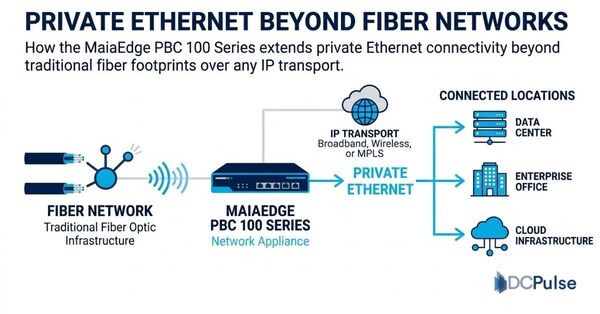
Traditional private Ethernet services are closely linked to the physical reach of an operator's fiber infrastructure. Businesses and data center customers located outside these networks may require additional fiber construction or arrangements with other network providers before private connectivity can be established. These requirements can increase deployment costs and extend service activation timelines.
MaiaEdge's PBC 100 Series addresses this limitation by allowing operators to use existing transport options to extend private Layer 2 Ethernet services directly to customer premises. Available transport can include dedicated internet access (DIA), existing fiber connections, satellite connectivity, and other IP-based networks.
The approach separates the underlying transport infrastructure from the Ethernet service delivered to customers. As a result, service providers can potentially reach locations where building new fiber would be commercially or operationally difficult.
The PBC 100 Series is part of MaiaEdge's Path Border Controller product family and is designed to complement the company's PBC 2000, which operates at an operator's point of presence (PoP), Metro Ethernet edge or data center.
How the PBC 100 Series Works
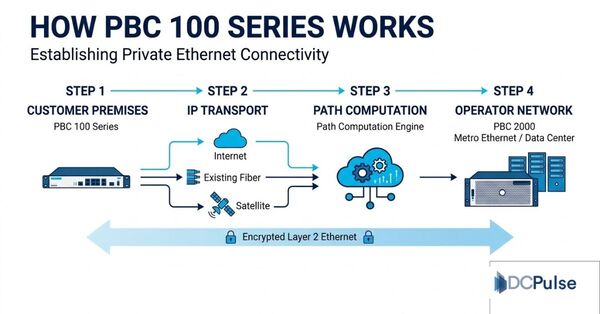
The PBC 100 Series introduces a compact network appliance at the customer premises, while the PBC 2000 handles the operator-side connection. Both devices work together to establish an encrypted Layer 2 Ethernet path across available IP transport infrastructure.
The system uses MaiaEdge's cloud-based Path Computation Engine to calculate the network path. The Path Border Controllers then establish the connection and monitor service performance.
This architecture provides a consistent Ethernet handoff at the customer location while allowing operators to use different underlying transport networks. It also helps maintain separate customer Ethernet segments, supporting private connectivity between customer locations and services delivered through the operator's network.
The system is built on MaiaEdge's SD-Ethernet architecture, which is designed to extend Ethernet services programmatically across different networks and transport types.
For operators, this approach can reduce the need for repeated network redesign and manual configuration whenever a new customer or service is introduced.
Supporting Data Center and Cloud Connectivity
The introduction of the PBC 100 Series has potential implications for data center operators and cloud infrastructure providers that need to connect distributed customer environments.
Data centers increasingly operate as connectivity hubs for enterprise applications, cloud platforms, AI infrastructure, and partner networks. Their ability to provide reliable private connections to customers outside traditional fiber coverage can influence service availability and customer onboarding.
The PBC 100 Series is designed to help service providers extend customer Ethernet segments to services available through their own networks or connected partners. These services can include private connectivity, cloud access, and access to AI infrastructure.
For data center operators, the architecture could help simplify the process of connecting new tenants and customer locations. Instead of requiring a separate network integration approach for every service, operators can use an existing Ethernet connection as a consistent handoff point for additional services.
This capability is particularly relevant to distributed AI infrastructure, where access to computing resources may involve multiple locations and network providers. However, actual performance will depend on the available transport network, its capacity, latency, and reliability.
Reducing Network Deployment Complexity
One of the main objectives of the PBC 100 Series is to reduce the operational complexity associated with extending private Ethernet services beyond an operator's existing network.
Traditional approaches can require additional routing configurations, network address translation (NAT) changes, and manual coordination between providers. These activities may become more complicated when operators need to support multicast services, multiple customer segments, and different connectivity requirements.
MaiaEdge's SD-Ethernet architecture provides a consistent Ethernet-based service handoff that can reduce the need for repeated changes to customer-side WAN configurations.
The company also highlights automated provisioning as a key feature. By using its Path Computation Engine and Path Border Controllers, operators can establish connections across available transport infrastructure without relying on a new fiber build or manually negotiated network-to-network interface (NNI) for each connection.
The objective is to shorten service activation processes and allow network teams to manage additional customer connections through a more consistent operating model.
Creating New Opportunities for Network Operators
Beyond connectivity, the PBC 100 Series could provide service providers with additional opportunities to expand their commercial offerings.
Operators can use an established customer Ethernet connection to deliver multiple services, including cloud on-ramps, private network connectivity, and access to distributed AI infrastructure. These services can originate from the operator's own network or from MaiaEdge-enabled partners.
This model could help operators serve customers outside their existing fiber footprint without making every new customer connection dependent on physical network expansion.
The company also sees opportunities for network operators to increase the value of their existing infrastructure by using available IP transport to reach additional locations.
For data center and cloud infrastructure providers, the ability to connect more customer environments through a consistent Ethernet architecture may support broader service distribution and more flexible connectivity arrangements.
PBC 124-C Becomes the First Device in the Series
The PBC 100 Series is designed specifically for customer premises, where equipment requirements can differ from those of larger operator network locations. The compact appliance complements the PBC 2000 and extends MaiaEdge's Path Border Controller architecture closer to the end customer.
The first device in the product family, the PBC 124-C, is available now, according to the company's announcement.
MaiaEdge develops cloud-managed networking hardware for service providers, data center operators, and AI infrastructure companies. Its technology focuses on automating private Layer 2 Ethernet connectivity across different networks and transport environments.
The company was founded by professionals associated with the development of Session Border Controllers at Acme Packet and Session Smart routing at 128 Technology.
Implications for the Digital Infrastructure Industry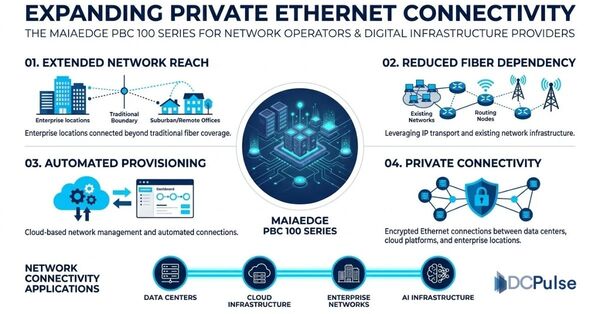
The PBC 100 Series reflects a broader need for flexible connectivity across an increasingly distributed digital infrastructure environment. Data centers, cloud platforms, and AI computing facilities depend on network connections that can reach customers, partners, and computing resources across multiple locations.
Traditional fiber expansion remains important for high-capacity digital infrastructure, but extending physical networks to every customer location can involve considerable investment and deployment time. Solutions that use existing IP transport to establish private Ethernet paths offer another approach to extending network reach.
For data center operators, service providers, and cloud infrastructure companies, automated connectivity could help simplify customer onboarding and expand access to distributed services. The actual benefits will depend on network conditions, service requirements, and integration with existing infrastructure.
MaiaEdge's PBC 100 Series adds a customer-premises component to its Path Border Controller portfolio, giving operators another option for delivering private Ethernet beyond their owned fiber networks. As demand for cloud connectivity, AI infrastructure access, and distributed digital services grows, flexible network architectures are likely to remain an important part of data center and telecommunications infrastructure development.