DCPulse
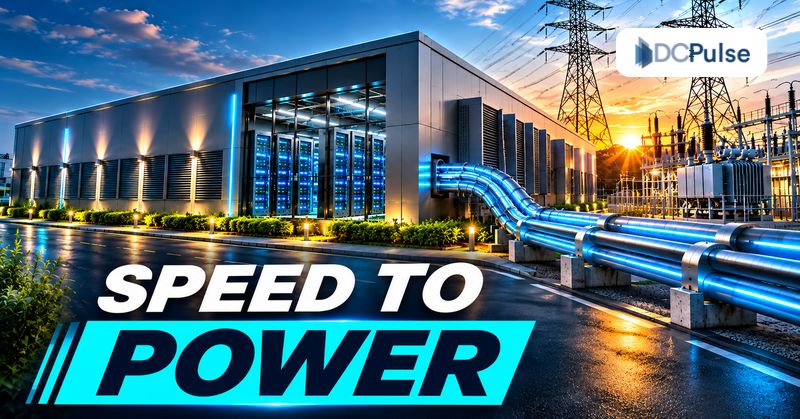
The global data center industry is entering a new phase of infrastructure development, where access to electricity is becoming just as important as access to land, capital, and technology. Growing demand for artificial intelligence (AI), cloud computing, high-performance computing (HPC), and hyperscale infrastructure is increasing the need for large, reliable power supplies. However, electricity networks in several major markets are struggling to expand at the same pace as data center development.
The growing gap between data center construction timelines and electricity infrastructure development is creating a major challenge for operators and developers. A project may have secured land, financing, planning approvals, and equipment, but without sufficient grid capacity, it cannot begin full commercial operations. As a result, speed to power is becoming a critical factor in determining where new data centers are built and how quickly they can enter service.
According to the International Energy Agency (IEA), global data center electricity consumption is projected to increase from approximately 485 TWh in 2025 to 950 TWh by 2030. This expected growth highlights the scale of electricity infrastructure required to support the expanding digital economy.
Rising AI Demand Is Increasing Pressure on Electricity Networks
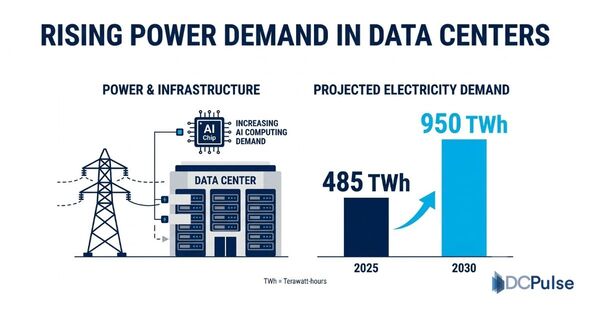
Artificial intelligence is changing the power requirements of modern data centers. Traditional cloud facilities already require substantial electricity to operate servers, storage systems, networking equipment, and cooling infrastructure. However, AI-focused facilities introduce additional requirements because of their high-density computing environments and intensive GPU workloads.
Large-scale AI training and inference operations require continuous electricity to support high-performance computing infrastructure. As technology companies expand their AI capabilities, developers are planning increasingly large data center campuses with substantial power requirements.
The challenge is that electricity demand is growing faster than the ability of many electricity networks to accommodate new large consumers. Grid operators must consider not only the additional energy required but also the location, timing, and concentration of new electricity demand.
The IEA's 2026 analysis also identifies electricity infrastructure and equipment availability as important constraints on the expansion of AI infrastructure. These limitations are making power availability a central consideration in data center investment decisions.
Why the Grid Cannot Expand at the Same Speed
Electricity grid development involves several stages, including feasibility studies, environmental assessments, regulatory approvals, land acquisition, equipment procurement, and construction. These processes can take several years, particularly when new transmission lines and substations are required.
Data center projects, meanwhile, are often developed according to much shorter commercial timelines. Developers want to secure power capacity and bring facilities online as quickly as possible to meet demand from cloud providers, AI companies, and enterprise customers.
According to the IEA's Energy and AI analysis, constructing new transmission lines can take four to eight years in advanced economies. Waiting times for critical grid components, including transformers and cables, have also increased significantly.
This difference between infrastructure development timelines and data center construction schedules creates a growing time-to-power challenge.
In some locations, existing transmission networks do not have sufficient capacity to support additional large-scale electricity consumption. Even when electricity generation is available within a region, the transmission infrastructure may not be capable of delivering that electricity to the proposed data center site.
Consequently, the availability of generation capacity does not automatically guarantee that a data center can receive a grid connection.
Transformers, Substations, and Transmission Lines Become Critical Bottlenecks
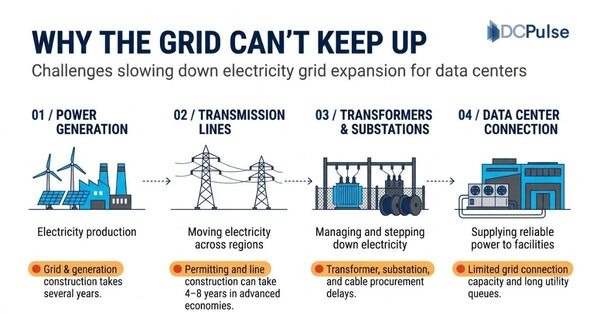
The expansion of data center infrastructure depends on several components beyond electricity generation. High-capacity transformers, switchgear, substations, transmission cables, and distribution equipment are essential for delivering electricity safely and reliably.
However, these components are facing procurement and manufacturing challenges as electricity networks expand to accommodate new demand.
The IEA reported in February 2025 that prices and procurement lead times for essential transmission equipment, including transformers and cables, had nearly doubled over the preceding four years. These supply chain pressures create additional challenges for utilities and infrastructure developers.
Substations are another important part of the problem. Large data center campuses often require dedicated electrical infrastructure to manage high loads and maintain reliable power delivery. Building or upgrading substations requires engineering work, equipment availability, land, and regulatory coordination.
Transmission infrastructure can also require new rights-of-way and agreements with multiple stakeholders. These requirements make grid expansion difficult to accelerate, even when developers are prepared to invest in additional electricity capacity.
For data center operators, delays in any of these areas can affect construction schedules, commissioning, and the overall financial performance of a project.
Power Availability Is Changing Data Center Site Selection
Historically, data center developers evaluated locations based on factors such as land prices, fiber connectivity, tax incentives, customer proximity, and access to renewable energy. These considerations remain important, but electricity availability is increasingly influencing site selection.
Markets with established transmission infrastructure and available power capacity are attracting attention because they can offer a more practical route to development.
According to JLL's 2025 Global Data Center Outlook, power transmission challenges could delay data center developments by four years or more in certain markets. The report also highlights the growing importance of proximity to transmission lines and available electrical capacity when evaluating potential sites.
This shift is encouraging developers to explore locations outside traditional data center hubs. Secondary markets and emerging digital infrastructure regions may offer opportunities where electricity infrastructure can support new developments.
However, moving to a different location does not automatically solve the problem. Developers must evaluate the actual availability of grid capacity, connection timelines, utility investment plans, and future electricity demand before committing to a site.
The result is a more power-focused approach to data center planning, where securing electricity access can become an early development priority rather than a later construction requirement.
On-Site Power Generation Gains Attention
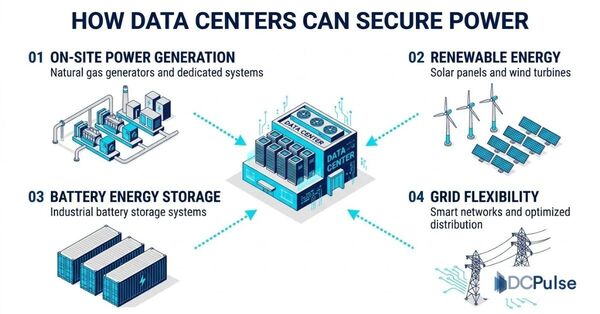
Grid connection delays are encouraging data center operators to examine alternative electricity supply strategies. On-site generation, battery energy storage, and dedicated energy infrastructure are receiving greater attention as developers look for ways to improve power availability.
Natural gas generation is one option being considered for facilities that require dependable electricity and faster access to additional capacity. However, its use introduces considerations around fuel availability, emissions, operating costs, and environmental commitments.
Renewable energy is another important part of the strategy. Solar and wind power purchase agreements can help operators secure renewable electricity and support long-term sustainability objectives. Battery storage can complement variable renewable generation by storing electricity and making it available when required.
Some developers are also exploring nuclear energy and advanced geothermal technologies as potential sources of long-term electricity supply.
Nevertheless, alternative power arrangements do not eliminate every grid-related challenge. On-site generation still requires suitable equipment, fuel or energy resources, permits, and supporting infrastructure. Operators must also consider how these systems will integrate with the wider electricity network.
Grid Flexibility Could Help Accelerate Data Center Connections
Expanding electricity infrastructure is essential, but improving the use of existing grid capacity could also help address immediate constraints.
Grid-enhancing technologies, improved transmission management, battery storage, and flexible electricity consumption can help increase the efficiency of existing networks.
Data centers may also have opportunities to adjust certain workloads according to electricity availability. For example, some non-urgent computing tasks could potentially be shifted to different operating periods or locations when grid conditions are constrained.
However, not all workloads can be interrupted or delayed. Real-time AI inference, financial services, enterprise applications, and critical cloud operations require consistent service availability.
The development of flexible data center operations will therefore depend on workload characteristics, customer requirements, and the technical capabilities of individual facilities.
Better coordination between data center developers, utilities, and grid operators will also be important. Early communication about planned electricity demand can help utilities assess infrastructure requirements and prepare appropriate network upgrades.
What the Power Challenge Means for the Future of Digital Infrastructure
The growing relationship between electricity infrastructure and data center development is reshaping investment decisions across the global digital economy. Power availability is no longer simply an operational consideration. It is becoming a major factor influencing project feasibility, development timelines, and infrastructure competitiveness.
For hyperscale operators and AI infrastructure developers, securing electricity capacity early can help reduce uncertainty and support long-term expansion plans. For utilities, the increasing concentration of large electricity consumers creates a need for improved forecasting, coordinated planning and additional grid investment.
The challenge also presents opportunities for energy companies, transmission developers, equipment manufacturers and energy storage providers. Demand for transformers, switchgear, substations, renewable generation and advanced grid technologies is likely to remain important as electricity networks adapt to changing consumption patterns.
Ultimately, the next phase of data center expansion will depend on more than available land, computing equipment and investment capital. Reliable electricity access will determine how quickly planned facilities can become operational and how effectively the industry can support growing demand for AI, cloud computing and digital services.
The speed-to-power challenge is therefore becoming one of the defining infrastructure issues for the data center industry. Without faster grid development, stronger coordination between utilities and developers, and greater investment in electricity infrastructure, the expansion of digital capacity could face increasing delays.