DCPulse
The intersection of energy infrastructure and digital infrastructure is becoming increasingly important as hyperscale cloud operators and AI developers pursue data center campuses that require large amounts of power alongside land, connectivity, and supporting electrical infrastructure. Against this backdrop, PowerBridge and Liberty Energy have formed a strategic joint venture focused on developing powered data center campuses at the gigawatt scale.
Announced on July 22, 2026, the joint venture brings together PowerBridge’s digital campus development platform with the power generation, energy management, and operational capabilities of Liberty Power Innovations (LPI), a Liberty Energy company. The initial scope centers on the planned Alpha Digital Campus in West Texas, a 2 GW powered campus intended to support hyperscale, AI, and other large-load customers.
Power and Data Center Infrastructure Move Closer Together
Power availability has become an increasingly important consideration in the development of large digital infrastructure projects. For high-density AI and hyperscale facilities, access to substantial electrical capacity is not simply a utility connection issue. It is closely connected with site selection, development schedules, electrical infrastructure, energy management, and the ability to bring computing capacity online.
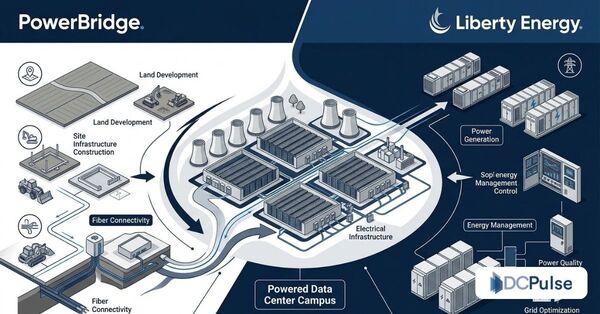
The PowerBridge and Liberty Energy structure addresses these requirements through an integrated development model. PowerBridge contributes its powered campus development assets, including site infrastructure and a regional fiber conduit network, while LPI is expected to design, develop, and operate scalable, modular power generation architecture together with power quality management and grid optimization capabilities.
Such an approach places power generation and data center campus development within the same infrastructure planning framework. For prospective large-load customers, that structure could reduce the number of separate infrastructure relationships required during the development process, although the commercial and regulatory arrangements for the joint venture are still being finalized.
Alpha Digital Campus Becomes the Initial Project
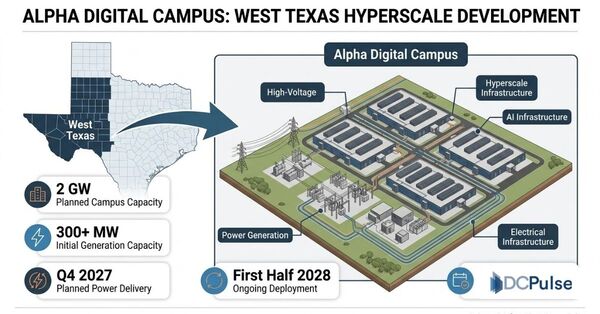
The first project under the joint venture is PowerBridge’s Alpha Digital Campus in West Texas. The planned campus has a total target capacity of 2 GW, positioning it within the scale of developments being pursued for large AI and hyperscale computing workloads.
The initial phase is expected to include more than 300 MW of generation capacity. Power delivery is currently anticipated during the fourth quarter of 2027, with deployment expected to continue through the first half of 2028. These dates are planned targets rather than completed infrastructure milestones and remain subject to the development process and applicable approvals.
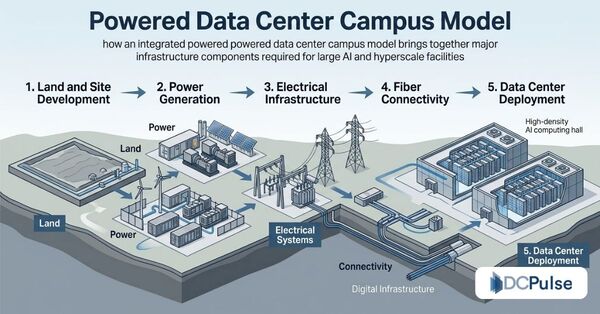
The campus model is significant because power generation is being incorporated into the development strategy rather than treated solely as an external dependency. PowerBridge describes its broader approach as integrating power generation, electrical infrastructure, fiber connectivity, and site development into powered campuses intended for large digital infrastructure deployments.
A Different Development Model for Large Digital Loads
Traditional data center development can involve several interconnected infrastructure processes, including land acquisition, utility interconnection, transmission and distribution planning, electrical equipment procurement, fiber deployment, building construction, and commissioning. The timing of each element can affect when computing infrastructure becomes operational.
The joint venture is designed around a more integrated model. PowerBridge provides the campus development platform, while Liberty Power Innovations supplies power generation and energy management capabilities. The companies have described the arrangement as a repeatable framework that can potentially be applied across additional gigawatt-scale powered campus developments.
For hyperscale and AI operators, the practical relevance lies in coordination. A campus with land, power infrastructure, and connectivity progressing through a unified development structure can provide a clearer pathway from site preparation to data center deployment. The actual benefit will depend on project execution, customer agreements, regulatory approvals, and the availability of supporting infrastructure.
AI Infrastructure Is Increasing the Importance of Power Strategy
AI infrastructure is placing new requirements on data center development because large computing deployments can require substantial electrical capacity and high-density infrastructure. The resulting demand is influencing how developers evaluate sites and how energy companies approach the data center sector.
Liberty Energy’s involvement reflects this broader convergence between energy services and digital infrastructure. Through LPI, the company has been developing distributed power and energy storage capabilities for commercial and industrial customers, data centers, and energy and mining applications.
The PowerBridge partnership therefore extends Liberty’s participation in the digital infrastructure market beyond conventional data center power supply arrangements. Liberty’s second-quarter 2026 disclosure identified the PowerBridge joint venture as part of its expansion into digital infrastructure and large-load power markets.
West Texas Emerges as the Development Platform
West Texas provides the geographic foundation for the initial joint venture project and for PowerBridge’s broader powered campus strategy. The region is already associated with significant energy infrastructure, while the joint venture is positioning new power generation and digital infrastructure development alongside one another.
The Alpha Digital Campus is intended to serve hyperscale, AI, and other large-load customers. Its planned 2 GW scale also illustrates how the definition of a data center campus is expanding from a collection of buildings toward a larger infrastructure ecosystem involving power generation, electrical systems, connectivity, and land development.
For the regional data center market, this model could create a pathway for large computing deployments in locations where power strategy is considered from the earliest stages of campus development. The project's eventual delivery will provide a practical test of how effectively integrated power and campus development can translate into operational digital infrastructure.
Commercial Structure Remains in Development
The joint venture is not yet a completed operational platform across all of its proposed activities. The companies stated that additional commercial agreements and ancillary agreements still need to be finalized, alongside required regulatory approvals. The companies have also cautioned that forward-looking statements regarding the development involve risks and uncertainties.
That distinction is important for data center stakeholders. The announced capacity and planned delivery schedule represent development objectives rather than commissioned IT capacity. Customer commitments, construction progress, power generation deployment, and regulatory milestones will determine how the planned campus develops.
A Broader Shift Toward Powered Campuses
The PowerBridge and Liberty Energy joint venture reflects a wider change in how large-scale digital infrastructure can be developed. Data center projects increasingly require coordinated planning across land, power, connectivity, electrical infrastructure, and computing requirements rather than treating each component as an isolated development activity.
The Alpha Digital Campus provides the first implementation of this model under the new partnership. Its planned 2 GW scale and initial generation phase of more than 300 MW make it a project to watch as AI and hyperscale infrastructure developers continue evaluating alternative approaches to securing power and accelerating campus deployment.
For the wider data center industry, the significance of the partnership will ultimately depend on execution. If the companies can translate the proposed integrated model into delivered power and deployable campus infrastructure, the approach could become another development pathway for large-load digital infrastructure projects. For now, the joint venture establishes a clear strategic alignment between campus development and power generation, with West Texas serving as its first major test.