DCPulse
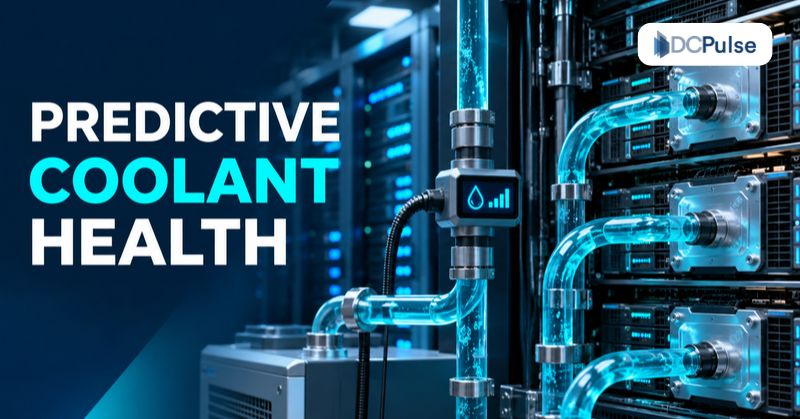
AI data centers are pushing cooling infrastructure beyond traditional operating limits. High-performance GPUs and AI accelerators generate significant heat, increasing demand for direct-to-chip liquid cooling and advanced thermal management systems. While operators focus on temperature, pressure, and coolant flow, another critical factor often receives less attention: coolant health.
Coolant degradation, contamination, and chemical imbalance can affect heat transfer and damage sensitive cooling components. Predictive coolant health monitoring offers a way to identify these problems before they disrupt operations. By combining sensors, fluid analysis, and AI-driven analytics, operators can improve cooling reliability and protect critical AI infrastructure.
Key Takeaways
- Coolant quality directly influences liquid cooling performance and equipment reliability.
- Traditional temperature and flow monitoring cannot independently identify chemical degradation.
- Continuous monitoring of pH, conductivity, turbidity, and particulate levels improves visibility.
- AI analytics can identify abnormal coolant trends and support predictive maintenance.
- Integrated coolant management can reduce operational risks in high-density AI data centers.
Why Coolant Health Matters in AI Data Centers
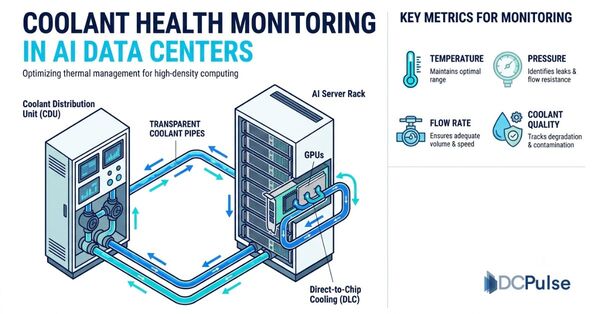
AI infrastructure increasingly relies on liquid cooling to manage the heat generated by high-density computing systems. Direct-to-chip cooling transfers heat from processors through liquid-filled cold plates, while coolant distribution units (CDUs) regulate circulation between technology cooling systems and facility infrastructure.
However, maintaining appropriate coolant quality is essential for reliable operation. Chemical degradation, corrosion, contamination, and particulate accumulation can affect pumps, valves, cold plates, and heat exchangers.
Traditional cooling monitoring primarily measures temperature, pressure, and flow. Although these parameters indicate system performance, they do not necessarily reveal changes in fluid chemistry. A cooling loop may maintain stable temperatures while corrosion inhibitors gradually deteriorate or contamination increases.
ASHRAE's technical guidance emphasizes appropriate fluid quality and material compatibility in liquid-cooled IT environments. This makes coolant condition an important part of cooling infrastructure reliability.
Key Indicators of Coolant Degradation
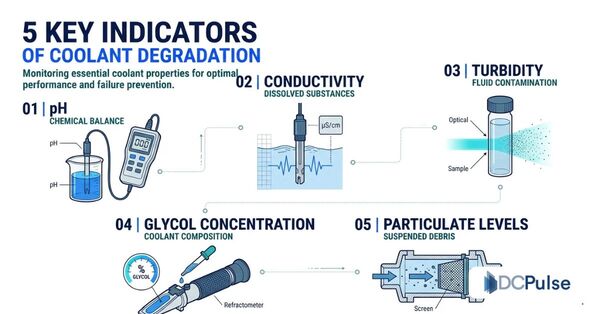
Predictive coolant management requires monitoring parameters that reveal changes in fluid composition and cleanliness. The appropriate measurements depend on whether a system uses water-based coolant, glycol mixtures, or dielectric fluids.
pH: Measures the acidity or alkalinity of coolant. Changes can indicate chemical imbalance, degradation, or potential corrosion risks.
Conductivity: Identifies changes in dissolved ionic substances. Unexpected variations may indicate contamination, dilution, or chemical changes.
Turbidity: Measures suspended particles in the fluid. Increasing turbidity can indicate corrosion products, installation debris, or other contamination.
Glycol concentration: Helps maintain the correct coolant formulation in systems using glycol mixtures. Changes can affect viscosity, heat transfer, and freeze protection.
Particulate levels: Help identify debris that may accumulate in filters, pipes, and narrow cold-plate channels.
Temperature, pressure, and flow measurements should also be considered alongside these indicators. For example, increasing filter differential pressure combined with rising turbidity may indicate contamination and filtration problems.
How Predictive Monitoring Improves Cooling Reliability
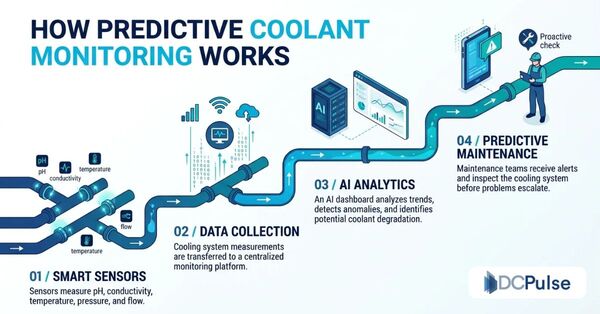
Traditional coolant maintenance often depends on periodic sampling and laboratory testing. Although laboratory analysis remains essential, it provides information only at the time of sampling.
Predictive monitoring adds continuous visibility into changing fluid conditions. Sensors can identify abnormal measurements and generate alerts when parameters move beyond established operating limits.
For example, a gradual increase in conductivity may indicate contamination entering a cooling loop. If turbidity and filter differential pressure also increase, operators can investigate the problem before it affects cooling performance.
This approach supports several operational benefits:
- Early problem detection: Identifies developing contamination and chemical abnormalities.
- Equipment protection: Helps maintain suitable coolant conditions for pumps, cold plates, and heat exchangers.
- Improved maintenance planning: Allows teams to prioritize inspections based on actual system conditions.
- Cooling reliability: Helps identify potential restrictions and fluid-quality problems before they escalate.
Predictive monitoring does not guarantee failure prevention. Instead, it provides earlier warning signals that allow maintenance teams to investigate and take corrective action.
The Role of AI, Sensors, and Data Analytics
AI and advanced analytics can improve how operators interpret coolant monitoring data. Industrial sensors can continuously measure pH, conductivity, temperature, pressure, turbidity, and flow, providing information to centralized monitoring platforms.
These measurements can be integrated with building management systems (BMS), data center infrastructure management (DCIM), and maintenance platforms.
Machine-learning models can analyse historical measurements to identify abnormal operating patterns. For example, simultaneous changes in conductivity, pH, and filter pressure may indicate a developing coolant-quality issue.
AI-based systems can support:
- Anomaly detection across cooling loops.
- Trend analysis and maintenance forecasting.
- Identification of recurring contamination problems.
- Maintenance prioritization across multiple CDUs.
- Improved visibility into cooling system performance.
Digital twins can provide another layer of analysis by combining coolant measurements, equipment performance, thermal loads, and maintenance records within a virtual representation of the cooling infrastructure.
However, predictive models require reliable sensor data, appropriate calibration, and validation against laboratory results. AI should support engineering decisions rather than replace technical inspections.
Building a Predictive Coolant Management Strategy
Implementing predictive coolant monitoring requires a structured approach that combines fluid specifications, sensor deployment, data integration, and maintenance procedures.
- Establish coolant specifications: Define acceptable fluid chemistry, material compatibility, and operating requirements with equipment manufacturers and coolant suppliers.
- Install appropriate sensors: Monitor critical cooling loop parameters at CDUs, supply and return lines, and filtration equipment.
- Develop baseline measurements: Record normal operating conditions to identify meaningful deviations over time.
- Integrate monitoring platforms: Connect sensor information with BMS, DCIM, and maintenance management systems.
- Verify coolant condition: Combine continuous monitoring with periodic laboratory testing to identify chemical changes that inline sensors may not detect.
Operators must also address sensor calibration, cybersecurity, equipment compatibility, and maintenance ownership. Different coolant formulations require different monitoring limits, making universal alarm thresholds unsuitable.
Conclusion
As AI data centers expand, liquid cooling reliability will depend on more than maintaining temperature and flow. Coolant chemistry, contamination, and fluid cleanliness also influence the performance and lifespan of critical cooling components.
Predictive coolant health monitoring provides an additional reliability layer by combining continuous sensing, laboratory verification, and AI-driven analytics. For data center operators, investing in coolant intelligence can support earlier problem detection, better maintenance decisions, and more reliable cooling infrastructure.