DCPulse
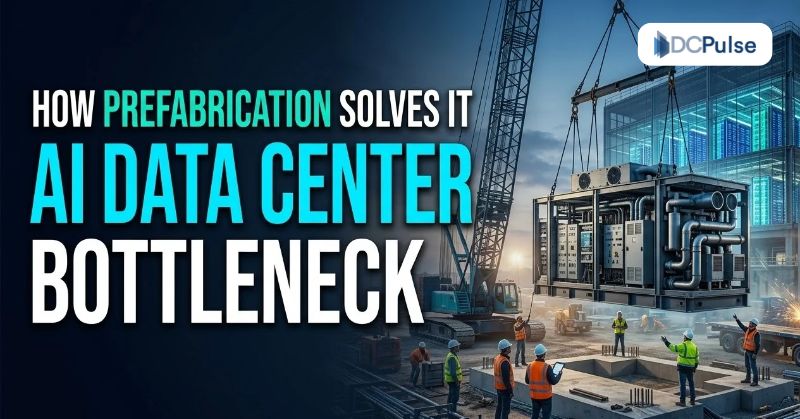
The rapid expansion of artificial intelligence is reshaping the global data center industry, creating unprecedented demand for high-density computing infrastructure. Hyperscale operators, cloud service providers, and AI infrastructure developers are accelerating investments in facilities capable of supporting graphics processing units (GPUs), advanced networking systems, and increasingly power-intensive workloads. However, the construction of these facilities is becoming more complicated as developers face challenges involving equipment availability, power infrastructure, skilled labor, cooling requirements, and lengthy construction schedules.
Traditional data center construction methods are under increasing pressure to accommodate the scale and technical complexity of modern AI infrastructure. Against this backdrop, prefabrication is emerging as an important approach to accelerating data center development. By shifting selected construction and integration activities from the project site to controlled manufacturing environments, developers can streamline installation, improve coordination, and potentially reduce the time required to bring critical infrastructure online.
The Growing Construction Bottleneck in AI Data Centers
The AI infrastructure boom is creating new demands on data center development. Unlike conventional enterprise facilities, AI-focused data centers often require high-density electrical systems, advanced liquid cooling capabilities, specialized power distribution equipment, and high-performance networking infrastructure.
These requirements introduce additional complexity during the design and construction process. Electrical systems must support substantial computing loads, while cooling architectures must manage the heat generated by densely deployed accelerators. Power distribution, backup systems, mechanical infrastructure, and network connectivity also need to be integrated into a coordinated facility design.
Several constraints can affect project delivery. Long procurement cycles for transformers, switchgear, generators, cooling equipment, and other critical components can disrupt construction schedules. Labor shortages and the availability of specialized contractors can create additional pressure, particularly in markets experiencing simultaneous data center development.
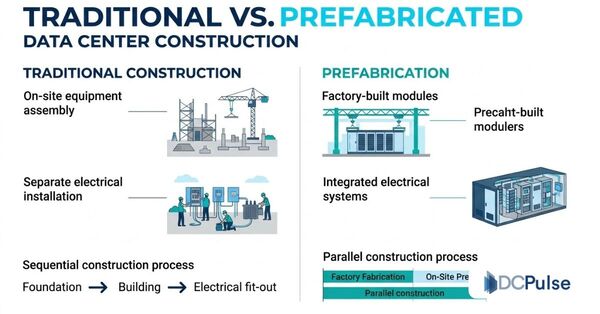
Furthermore, conventional construction frequently requires multiple activities to take place sequentially at the project site. Delays in one workstream can affect subsequent installation and commissioning activities. For developers seeking to deliver AI capacity quickly, these dependencies have become an important infrastructure challenge.
Prefabrication Changes the Data Center Construction Model
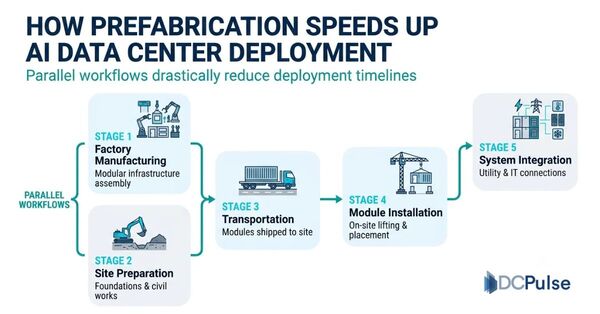
Prefabrication involves manufacturing or assembling infrastructure components away from the final construction site before transporting them for installation. In the data center industry, this approach can cover electrical, mechanical, structural, and modular building systems.
Rather than completing every component individually at the construction location, developers can use factory-built assemblies designed around standardized configurations. These assemblies may include electrical distribution systems, mechanical equipment modules, cooling infrastructure, power rooms, and integrated data center modules.
The manufacturing environment provides greater control over component assembly, inspection, and quality management. It also allows certain activities to progress simultaneously with civil works and site preparation.
This parallel approach is particularly relevant to large AI data center campuses. While foundations, utilities, and site infrastructure are being developed, prefabricated electrical and mechanical modules can be manufactured elsewhere. Once the site is ready, these components can be transported and installed according to the project schedule.
The result is a construction model that can reduce the amount of work required at the site and improve coordination between different infrastructure packages.
Electrical Prefabrication Addresses Power Infrastructure Complexity
Power availability remains one of the most important considerations in AI data center development. High-density computing environments require carefully engineered electrical infrastructure capable of delivering reliable power to critical IT equipment.
Electrical prefabrication can help address some of the installation challenges associated with this requirement. Factory-integrated electrical modules may incorporate switchgear, transformers where appropriate, power distribution equipment, busways, and supporting control systems.
The integration of these components before delivery can simplify on-site installation and provide opportunities for factory inspection and testing. It can also improve coordination between electrical equipment suppliers, engineering teams, and data center developers.
For large-scale campuses, repeatable electrical module designs can support phased deployment. Developers can plan infrastructure packages around individual buildings or capacity phases rather than treating every installation as an entirely separate construction exercise.
However, prefabrication does not eliminate the need for utility connections, grid upgrades, substations, or regulatory approvals. Its value lies primarily in improving the delivery and integration of infrastructure within the boundaries of the development project.
Modular Cooling Supports High-Density AI Infrastructure
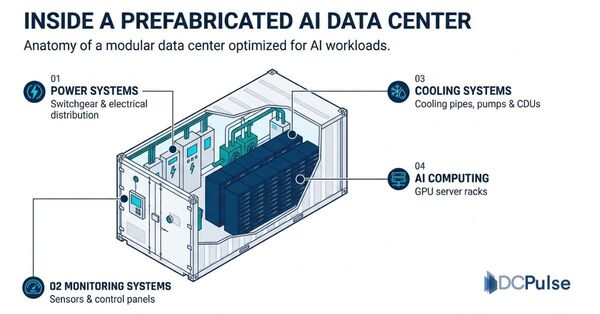
Cooling has become another major consideration as AI workloads increase rack power densities. Traditional air-cooling configurations may not be suitable for every high-performance computing environment, encouraging greater adoption of direct-to-chip liquid cooling and other advanced thermal management technologies.
These systems introduce additional engineering requirements, including coolant distribution units, pumps, piping networks, heat exchangers, and monitoring equipment.
Prefabricated mechanical modules can bring several of these components together into integrated assemblies. Factory-based manufacturing can support more consistent installation practices and allow portions of the cooling system to be inspected before transportation.
Modular cooling infrastructure can also help developers align mechanical capacity with the deployment of IT equipment. In phased projects, cooling modules may be installed as additional computing capacity becomes available, provided the overall design accounts for future expansion and system compatibility.
For AI data center operators, this approach can improve construction coordination and reduce the complexity of assembling interconnected mechanical systems entirely on-site.
Nevertheless, cooling performance depends on the complete facility design. Water availability, heat rejection, ambient conditions, coolant specifications, and redundancy requirements remain essential considerations.
Parallel Construction Accelerates Project Delivery
One of the most important advantages of prefabrication is its ability to support parallel construction activities.
Traditional construction models often involve sequential dependencies between building works, equipment installation, electrical integration, and mechanical commissioning. Prefabricated infrastructure allows some of these activities to progress independently.
For example, electrical distribution modules and cooling assemblies can be manufactured while the building structure and site utilities are under development. This arrangement can reduce the amount of installation work that must be completed after the main facility becomes available.
The approach is particularly useful for hyperscale and AI campuses developed across multiple buildings. Standardized infrastructure packages can be replicated across different phases, subject to project-specific engineering requirements.
However, shorter installation periods do not automatically translate into faster operational readiness. Equipment procurement, transportation, utility availability, integrated systems testing, regulatory approvals, and commissioning remain critical elements of the overall delivery schedule.
The effectiveness of prefabrication therefore depends on early planning and coordination across the entire project lifecycle.
Supply Chain Standardization and Manufacturing Capacity
The growing adoption of prefabricated data center infrastructure is also changing the relationship between data center developers and equipment manufacturers.
Traditional construction relies heavily on coordinating multiple suppliers and contractors at the project site. Prefabrication creates opportunities for manufacturers to deliver more integrated infrastructure packages, combining equipment and engineering services into standardized solutions.
This model can simplify procurement and reduce certain coordination challenges. Repeatable module designs may also support more predictable manufacturing processes across multiple facilities.
However, the approach introduces its own supply chain considerations. Factory capacity, specialized components, transportation logistics, and manufacturing lead times can influence project schedules. Oversized modules may require specialized transportation arrangements, while international projects can face additional customs and logistics requirements.
The availability of manufacturing capacity is therefore becoming an important consideration for developers planning large-scale infrastructure programs.
Implications for Hyperscale Operators and AI Infrastructure Developers
For hyperscale cloud providers and AI infrastructure developers, prefabrication offers a potential pathway toward more repeatable and scalable construction.
Large campuses frequently involve multiple buildings with similar electrical, mechanical, and structural requirements. Standardized modules can help developers establish consistent infrastructure configurations across different development phases.
The approach may also support geographic expansion. Developers can potentially reuse established module designs across different markets while adapting them to local building regulations, climate conditions, grid requirements, and operational standards.
For colocation providers, modular infrastructure can offer greater flexibility when planning capacity expansion around customer demand. Infrastructure can be developed in stages, reducing the need to complete every part of a large facility before initial capacity becomes available.
The benefits are not limited to construction schedules. Factory-based assembly can support quality assurance, improve installation consistency, and make certain infrastructure components easier to inspect and maintain.
Nevertheless, standardized solutions must accommodate the evolving requirements of AI hardware. Changes in rack configurations, power densities, networking architectures, and cooling technologies may require modifications to previously established module designs.
Challenges That Could Limit Wider Adoption
Despite its advantages, prefabrication is not a universal solution to data center construction challenges.
Transportation remains a significant consideration, particularly for large electrical and mechanical modules. Site access, lifting capacity, road restrictions, and installation sequencing must be evaluated before manufacturing begins.
Design flexibility can also become a concern. Projects with unusual site conditions, specialized cooling requirements, or highly customized infrastructure may not benefit equally from standardized modules.
Furthermore, factory manufacturing requires early design coordination. Late-stage engineering changes can create rework, additional costs, or delays if modules have already entered production.
Integration between different manufacturers is another important factor. Electrical, mechanical, monitoring, and control systems must operate together reliably. Factory testing can help identify certain issues, but final integrated systems testing at the completed facility remains essential.
For these reasons, successful prefabrication strategies require collaboration among developers, engineering consultants, equipment manufacturers, construction contractors, and commissioning specialists from the early stages of project planning.
Prefabrication Becomes a Strategic Tool for AI Data Center Expansion
The expansion of AI infrastructure is placing greater pressure on the speed, scalability, and reliability of data center construction. Power constraints, specialized cooling requirements, equipment procurement, and construction labor availability are making conventional delivery models increasingly difficult to scale.
Prefabrication offers an alternative by moving selected infrastructure activities into controlled manufacturing environments and enabling multiple construction workstreams to progress simultaneously. Electrical rooms, cooling assemblies, power distribution systems, and modular data center components can be prepared before they reach the final development site.
For the global data center industry, the significance of this approach extends beyond faster installation. It represents a shift toward more industrialized infrastructure development, where standardized engineering, manufacturing capacity, and coordinated supply chains become central to digital infrastructure delivery.
As AI workloads continue to influence data center design, prefabrication is likely to remain an important construction strategy for developers seeking to expand capacity efficiently. Its success, however, will depend on the ability to balance standardization with technological flexibility, while addressing the underlying challenges of power availability, equipment supply, and infrastructure integration.