DCPulse
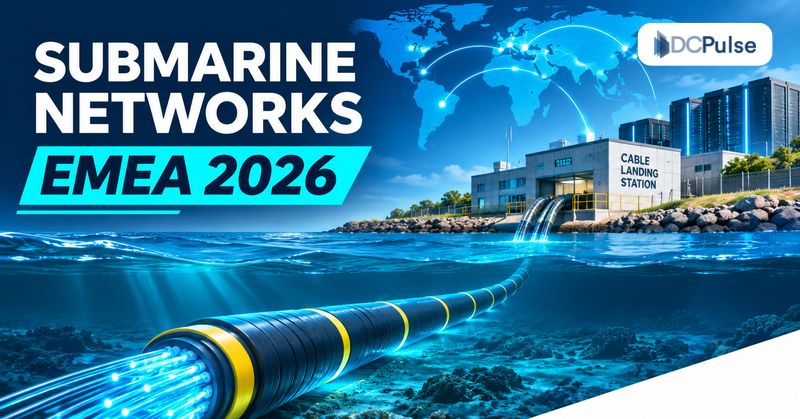
The growing demand for artificial intelligence (AI), cloud computing, and international data exchange is increasing the importance of submarine cable infrastructure. These undersea fiber-optic networks connect continents, support global digital services, and provide the connectivity foundation for hyperscale data centers, telecommunications networks, and cloud platforms.
Against this backdrop, Submarine Networks EMEA 2026 brought together industry leaders, infrastructure operators, investors, technology providers, and policymakers in London on May 27-28, 2026. Organized by Total Telecom, the event focused on the changing requirements of subsea connectivity, including AI-driven network demand, infrastructure investment, cable security, and emerging connectivity hubs.
The discussions reflected a broader industry shift: submarine cables are no longer viewed simply as telecommunications infrastructure. They are increasingly strategic digital assets that influence data center locations, international connectivity, digital sovereignty, and the resilience of the global internet.
Key Takeaways
- AI is changing subsea investment: Growing AI workloads are influencing cable capacity requirements, route planning, and infrastructure investment.
- Cable security is gaining importance: Physical protection, monitoring technologies, and geopolitical risks are becoming central industry priorities.
- Data centers and subsea networks are converging: Cable landing stations and connectivity hubs are increasingly important to hyperscale and cloud infrastructure.
- EMEA connectivity opportunities are expanding: Europe, the Middle East, and Africa offer opportunities for new cable routes, landing stations, and international digital corridors.
- Infrastructure resilience requires collaboration: Governments, operators, investors, and technology providers must coordinate to protect critical subsea networks.
Submarine Networks EMEA 2026: Event Highlights and Industry Priorities
The 2026 edition of Submarine Networks EMEA took place at the Business Design Centre in London, bringing together more than 1,250 senior industry participants and 150 speakers, according to the event announcement published by Total Telecom on May 18, 2026.
The program included keynote discussions, technical presentations, networking opportunities, and updates on global cable projects and connectivity hubs. It addressed the commercial, technological, and geopolitical developments influencing the future of subsea infrastructure.
One of the central discussions examined how artificial intelligence is changing the subsea industry. The program also introduced dedicated security sessions and educational content designed to help professionals understand the engineering, commercial, regulatory, and operational aspects of submarine cable networks.
Key themes included:
- AI-driven changes in subsea network planning.
- Global submarine cable investment opportunities.
- Infrastructure protection and risk assessment.
- Development of regional connectivity hubs.
- Cable engineering, maintenance, and regulation.
- Industry skills development and international collaboration.
AI and Cloud Computing Are Reshaping Subsea Connectivity
The expansion of AI infrastructure is increasing demand for high-capacity, reliable international connectivity. Hyperscale cloud providers, AI infrastructure companies, and telecommunications operators require networks capable of moving large volumes of data between geographically distributed data centers and computing facilities.
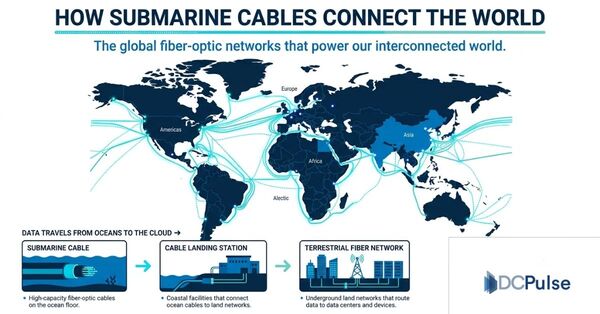
Submarine cables provide the international connectivity required to support these services. According to the International Telecommunication Union (ITU), submarine cables carry more than 99% of international data flows, making them fundamental to global digital infrastructure.
AI workloads are also influencing where new subsea infrastructure is developed. Cable routes connecting major cloud regions, data center markets, and emerging digital hubs can become strategically important as companies expand their computing capacity across different regions.
The Growing Relationship Between Data Centers and Cable Landing Stations
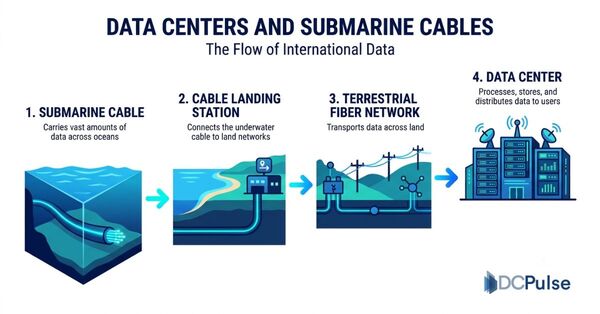
A cable landing station (CLS) is a coastal facility where submarine fiber-optic cables connect to terrestrial telecommunications networks. These facilities provide the transition point between international subsea connectivity and inland fiber infrastructure.
Their proximity to data centers can improve access to international network routes, carrier ecosystems, and low-latency connectivity. This relationship is encouraging infrastructure developers to consider data centers, cable landing stations, and terrestrial fiber networks as interconnected components of digital infrastructure planning.
For example, the proposed AI-powered data center and open cable landing station development by Sify in Visakhapatnam, India, illustrates how operators are exploring the integration of computing infrastructure and international connectivity.
Subsea Cable Security and Network Resilience Become Industry Priorities
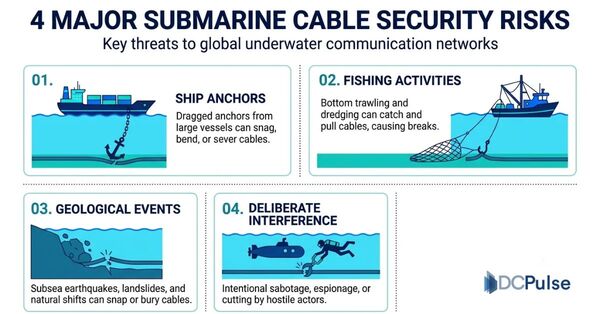
As international dependence on submarine cables increases, protecting these networks has become a major concern for governments and infrastructure operators. Subsea cables are exposed to accidental damage from fishing activities, ship anchors, underwater geological events, equipment failures, and potential deliberate interference.
The ITU reported in February 2026 that more than 200 submarine cable faults occur globally each year. These incidents can disrupt telecommunications, financial services, cloud connectivity, and other essential digital operations.
The European Commission has increased its focus on cable security through coordinated risk assessments, infrastructure mapping, and investment initiatives.
Its October 2025 report on the security and resilience of EU submarine cable infrastructure examined network vulnerabilities, risk assessment methods, and stress-testing approaches. In February 2026, the Commission also published a Cable Security Toolbox outlining measures to improve prevention, detection, response, recovery, and deterrence.
The European assessment identified 236 operational submarine cables landing on the European continent and EU outermost regions as of April 2025. Of these, 200 had at least one landing station in an EU member state. The report also documented the expansion of combined submarine cable capacity connecting EU member states and external markets, from 318 Tbit/s in 2010 to 3,755 Tbit/s in 2024.
Technologies Supporting Subsea Infrastructure Security
The 2026 conference introduced a dedicated Subsea Security Summit alongside its main program. Discussions covered technologies and strategies for protecting submarine networks, including:
- Fiber sensing: Detecting physical disturbances along cable routes through changes in optical signals.
- Automatic Identification System (AIS) tracking: Monitoring vessel movements near sensitive cable infrastructure.
- Satellite monitoring: Improving maritime surveillance and awareness around critical cable corridors.
- Risk assessment: Identifying vulnerable routes, landing stations, and infrastructure dependencies.
These technologies can improve early detection and incident response, although effective protection also requires coordinated maintenance, repair capabilities, regulatory support, and international cooperation.
EMEA Connectivity Hubs Create New Data Center Opportunities
The Europe, Middle East, and Africa region is becoming increasingly important for international digital connectivity. Its position between major global markets creates opportunities for new submarine cable routes, terrestrial fiber networks, cable landing stations, and interconnected data center facilities.
Countries with strategic coastal locations and established telecommunications ecosystems can attract infrastructure investment by improving access to international connectivity. Emerging markets are also exploring new cable routes to reduce dependence on existing hubs and strengthen regional digital infrastructure.
Africa and the Middle East Gain Connectivity Importance
Africa's growing digital economy is creating demand for improved international bandwidth, regional connectivity, and local data center infrastructure. Submarine cable systems connecting African markets with Europe, the Middle East, and Asia can support cloud adoption, financial services, enterprise networks, and digital platforms.
The Middle East is also developing as an important connectivity corridor. Its geographic position between Europe, Asia, and Africa makes it relevant to international cable routing and data center expansion.
At the conference, regional connectivity and investment were among the program's important themes. Sparkle, for example, participated in a panel examining strategies for strengthening Middle Eastern digital infrastructure, while its representatives also discussed geopolitics and the submarine cable industry.
Data Center and Subsea Infrastructure Integration
The growing relationship between cable landing stations and data centers is creating opportunities for integrated digital infrastructure developments.
- NEXTDC SC2, Australia: A planned 6 MW edge and colocation facility in Maroochydore, positioned adjacent to the Sunshine Coast International Submarine Cable landing station.
- Nongsa-Changi Cable, Indonesia-Singapore: A subsea connectivity development involving Telin, Nongsa Digital Park, and BW Digital, designed to improve cross-border connectivity for AI-ready data centers.
- Sify Visakhapatnam, India: A proposed 50 MW AI-powered edge data center integrated with an open cable landing station.
These developments demonstrate why cable connectivity is becoming an important consideration in data center site selection. Facilities with access to multiple international routes and diverse terrestrial fiber connections can offer advantages for cloud providers, enterprises, and hyperscale operators.
Investment, Collaboration, and the Future of Global Subsea Infrastructure
The expansion of AI, cloud computing, and digital services is increasing the need for investment across the submarine cable ecosystem. Funding is required not only for new cable systems but also for landing stations, terrestrial backhaul, network equipment, repair vessels, and infrastructure security.
The investment environment is also changing. Hyperscale technology companies are playing a larger role in supporting international connectivity infrastructure, while telecommunications operators, specialist cable developers, and governments continue to contribute through partnerships and regional investment programmes. The ITU's Global Connectivity Report 2025 highlights the increasing strategic importance of submarine cables and the role of investment in strengthening global connectivity.
Key Priorities for the Subsea Industry
The discussions at Submarine Networks EMEA 2026 highlight several priorities for future infrastructure development:
- Capacity expansion: New cable systems and upgrades to existing networks will be important for supporting growing international bandwidth requirements.
- Route diversity: Additional cable routes can reduce dependence on individual corridors and improve network resilience during outages.
- Improved security: Monitoring systems, risk assessments, and coordinated response mechanisms will become increasingly important.
- Regional connectivity: Emerging markets across Africa and the Middle East can benefit from investment in cable landing stations and terrestrial fiber infrastructure.
- Data center integration: Closer coordination between subsea cable developers, cloud providers, and data center operators can improve international connectivity and infrastructure planning.
For investors and operators, these priorities create opportunities across the infrastructure value chain. However, projects must also account for permitting, marine surveys, environmental considerations, financing, geopolitical risks, and the long timelines associated with subsea cable construction.
Conclusion
Submarine Networks EMEA 2026 highlighted the changing role of subsea infrastructure in the global digital economy. Discussions around AI-driven connectivity, cable security, regional investment, and infrastructure resilience reflected the growing complexity of international digital networks.
As hyperscale data centers and cloud platforms expand, submarine cables will remain essential to connecting computing infrastructure across continents. The integration of cable landing stations, terrestrial fiber networks, and strategically located data centers will also influence future digital infrastructure investment.
For the global data center industry, the key takeaway is that connectivity infrastructure must grow alongside computing capacity. Continued investment in secure, diverse, and high-capacity subsea networks will be important for supporting AI, cloud computing, and the next phase of global digital transformation.