Pranav Hotkar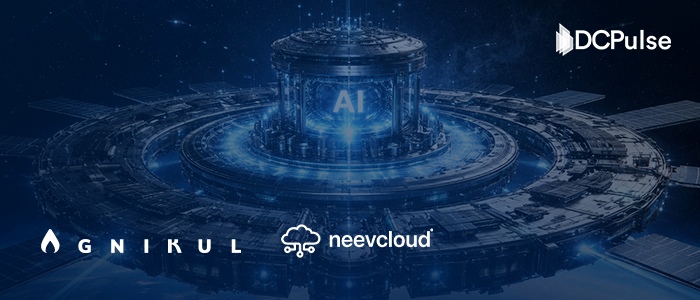
Chennai, India - February 13, 2026 - Agnikul Cosmos has partnered with NeevCloud to develop what the companies describe as India’s first AI-powered data center platform in space, aiming to host compute infrastructure in low Earth orbit (LEO) as early as 2026.
Under the collaboration, NeevCloud’s AI SuperCloud platform will be integrated into a modified upper stage of Agnikul’s Agnibaan launch vehicle. Unlike traditional rockets whose upper stages burn up or remain as debris, Agnikul’s patented design allows the upper stage to function as an orbital platform capable of hosting payloads, including AI inferencing systems.
The partners plan to conduct a proof-of-concept mission before the end of 2026, with commercial-scale operations targeted for 2027. The initiative envisions deploying a network of more than 600 orbital edge data centers over the next three years, creating a distributed constellation of AI compute nodes in space.
The proposed orbital data centers are designed primarily for AI inference workloads, where real-time processing and low-latency responses are critical. By situating compute infrastructure in LEO, the companies aim to reduce terrestrial bottlenecks related to land availability, power constraints, and cooling requirements. Space’s naturally cold environment could provide passive thermal advantages, potentially lowering energy consumption compared to traditional ground-based facilities.
NeevCloud said the space-based platform could support applications in defense, maritime operations, remote sensing, disaster response, and other latency-sensitive sectors. The companies also argue that hosting AI infrastructure in orbit could enhance data sovereignty and resilience by diversifying physical infrastructure beyond terrestrial networks.
For Agnikul, the partnership expands its business model beyond launch services into orbital infrastructure. The Chennai-based startup has previously focused on small satellite launch capabilities and additive manufacturing technologies. Leveraging its convertible upper-stage design to host persistent compute infrastructure represents a strategic shift toward integrated space systems.
Industry analysts note that while space-based data centers remain largely experimental, growing global demand for AI processing capacity is pushing companies to explore unconventional infrastructure models. Challenges remain, including radiation hardening, maintenance logistics, connectivity integration with terrestrial networks, and regulatory oversight.
If successful, the Agnikul-NeevCloud initiative would position India among the early movers in orbital AI infrastructure, potentially establishing a new frontier in the global data center market.
.jpg)