Pranav Hotkar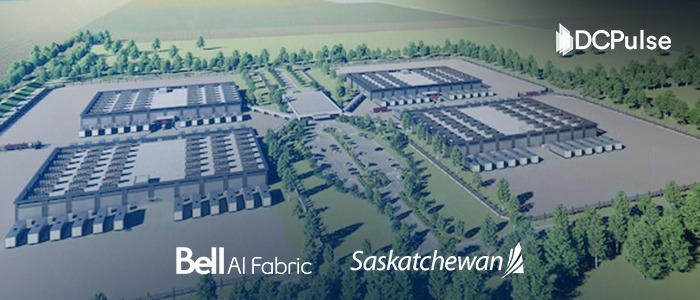
Regina, Canada - March 16, 2026 - Bell Canada has announced a major expansion into AI infrastructure with plans to build a 300MW hyperscale data center campus in Saskatchewan, marking one of the largest digital infrastructure investments in the country to date.
The project, located near Regina, forms a cornerstone of Bell’s AI Fabric strategy, its national initiative to deliver high-performance, sovereign AI compute. Construction is expected to begin in spring 2026, with the first phase slated to go live in the first half of 2027 and full build-out targeted by the end of that year.
Designed specifically for artificial intelligence workloads, the campus will support both training and inference at scale. Early tenants include CoreWeave and Cerebras Systems, signaling strong demand for specialized compute infrastructure. Notably, the entire capacity has already been pre-leased, underscoring the accelerating race for AI-ready data center capacity globally.
“This is our largest-ever investment in Saskatchewan and a critical step in building Canada’s AI future,” said Mirko Bibic, President and CEO of Bell. “It will deliver the high-performance compute needed to innovate at speed while keeping data and capabilities within our borders.”
A key aspect of the development is its focus on sovereign AI, with a portion of capacity reserved for domestic enterprises and government use. This aligns with broader global efforts to localize data processing and reduce reliance on foreign cloud providers.
The facility will be built on a greenfield site spanning roughly 160 acres and connected to Bell’s national fiber network, with regional support from SaskTel. Infrastructure design includes a closed-loop cooling system that eliminates the need for municipal water, alongside potential waste heat recovery integration.
Backed by an estimated investment of approximately CAD 1.7 billion, the project is expected to generate up to USD 12 billion in economic impact. It will create hundreds of construction jobs and support long-term operational and indirect employment in the region.
Beyond scale, the announcement reflects a broader shift: traditional telecom operators like Bell are increasingly positioning themselves as AI infrastructure providers, leveraging network assets and regional presence to compete in the next wave of digital growth.
As demand for compute continues to surge, Bell’s Saskatchewan campus highlights how geography, power availability, and sovereign control are becoming as critical as silicon in shaping the future of AI.