Pranav Hotkar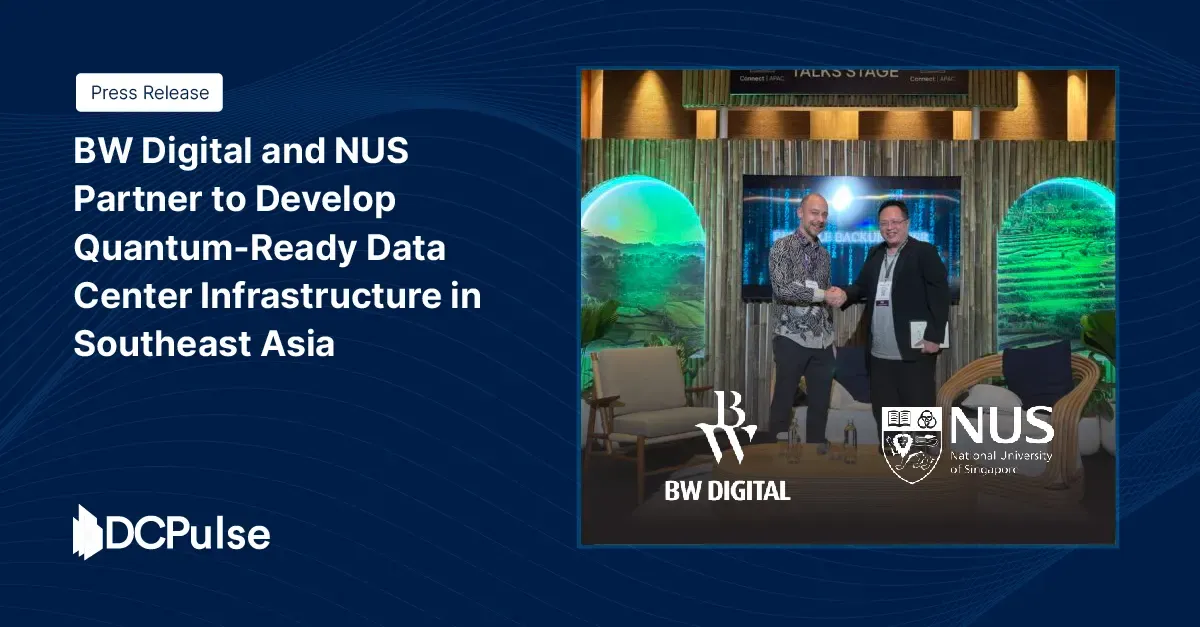
Singapore - June 11, 2026 - BW Digital and the National University of Singapore’s College of Design and Engineering (NUS CDE) have formed a new research partnership focused on developing quantum-ready data center infrastructure, highlighting growing industry efforts to prepare digital infrastructure for the next generation of advanced computing technologies.
The collaboration will focus on designing infrastructure systems capable of supporting future quantum computing workloads alongside conventional AI and hyperscale cloud environments. BW Digital said the initiative aims to accelerate the development of scalable and energy-efficient digital infrastructure tailored for Southeast Asia’s rapidly expanding data center market.
According to the announcement, the partnership will explore next-generation cooling technologies, energy systems, advanced materials, and infrastructure architectures required for future quantum and high-performance computing deployments. The research will also examine how quantum computing systems could eventually integrate into existing hyperscale and AI-focused facilities.
“Quantum computing will introduce entirely new infrastructure requirements for data centers,” BW Digital said in the release, noting that current facilities were largely designed around traditional cloud and enterprise workloads rather than highly specialized quantum environments.
Quantum computing systems typically require highly controlled operating environments, including ultra-low-temperature cooling systems, vibration isolation, electromagnetic shielding, and advanced power management technologies. Industry analysts believe these requirements could significantly reshape future data center architecture if quantum computing scales commercially over the next decade.
The partnership comes as Southeast Asia experiences a major expansion in AI and hyperscale infrastructure investment. Operators across the region are rapidly deploying new facilities to support generative AI, cloud services, accelerated computing, and sovereign digital infrastructure initiatives.
BW Digital has been actively expanding its digital infrastructure footprint across Asia-Pacific markets, including subsea cable systems and data center developments. The company is also developing the Hawaiki Nui subsea cable project aimed at strengthening trans-Pacific connectivity between the Asia-Pacific and North America.
NUS researchers involved in the initiative said the collaboration will combine academic research with commercial infrastructure expertise to evaluate practical approaches for supporting future high-density compute environments.
The announcement reflects a broader shift within the digital infrastructure industry as operators begin exploring long-term implications of emerging technologies such as quantum computing, photonic networking, and advanced AI systems. While large-scale commercial quantum deployments remain in early stages, infrastructure providers are increasingly studying how future facilities may need to evolve to accommodate specialized compute architectures.
Industry-wide, data center operators are already redesigning facilities around liquid cooling, higher power densities, and advanced thermal management systems to support AI workloads. Quantum computing could introduce an additional layer of infrastructure complexity requiring new approaches to cooling, facility engineering, and energy efficiency.
Southeast Asia has emerged as one of the fastest-growing global markets for digital infrastructure investment because of rising cloud adoption, increasing internet usage, and strong regional demand for AI services. Singapore, in particular, remains a major connectivity and infrastructure hub despite ongoing land and power constraints affecting new data center development.
The BW Digital-NUS partnership underscores how infrastructure providers are beginning to plan beyond current AI demand cycles toward future generations of compute technologies that may fundamentally reshape digital infrastructure design.