Pranav Hotkar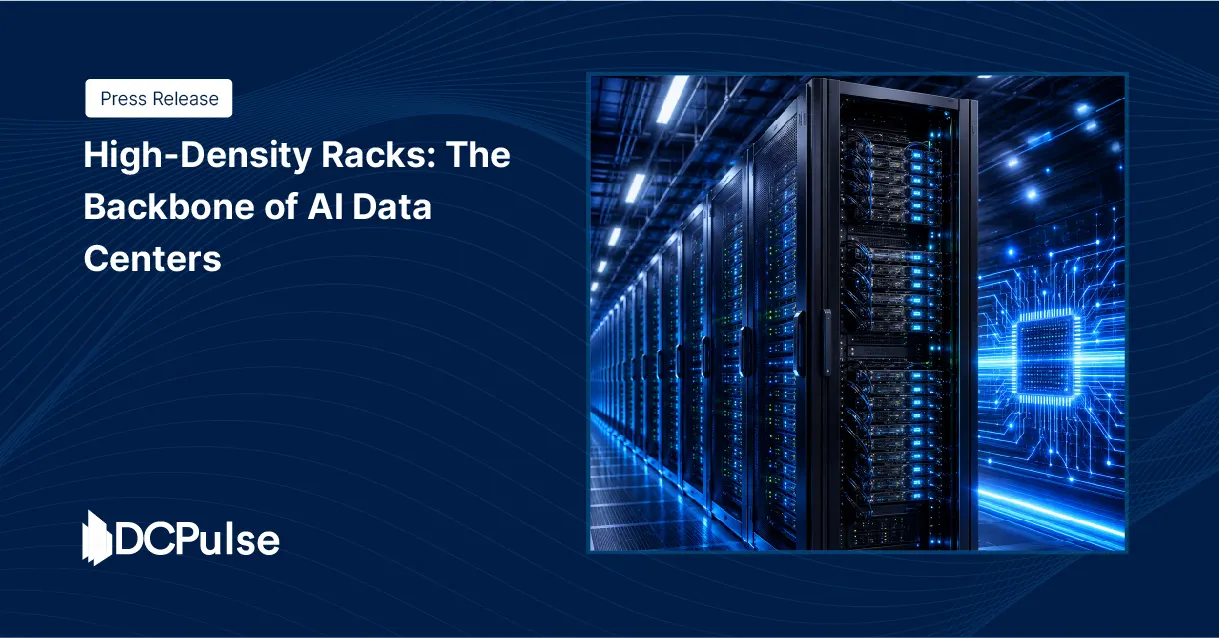
The rise of AI is not just increasing compute demand; it is compressing it into smaller, more powerful physical spaces.
Traditional data center racks were designed for moderate, predictable workloads. But modern AI infrastructure, powered by GPUs and high-performance accelerators, is pushing power densities to levels that were once considered impractical.
Today, racks supporting AI workloads can exceed 50 kW, 80 kW, or even 100 kW per rack, fundamentally changing how data centers are designed and operated.
This shift is not incremental; it is structural.
Higher density means more power, more heat, and greater complexity within the same footprint. It challenges conventional approaches to cooling, power delivery, and floor design, forcing operators to rethink core infrastructure assumptions.
At the same time, it enables something critical:
The ability to deliver massive computational power in compact environments, supporting the rapid scaling of AI workloads.
The result is clear.
High-density racks are no longer a niche requirement; they are becoming the foundation of modern AI data centers, redefining the limits of infrastructure performance and efficiency.
What Does the Current Landscape of High-Density Racks Look Like?
The current landscape of high-density racks is defined by a gradual but accelerating shift from low-density legacy deployments to higher-density configurations driven by modern workloads.
Historically, most data centers operated at relatively low densities. According to the Uptime Institute, average rack density was around ~8.4 kW per rack in 2020, with the majority of deployments still below 10 kW.
Historical Average Rack Density (kW per Rack)
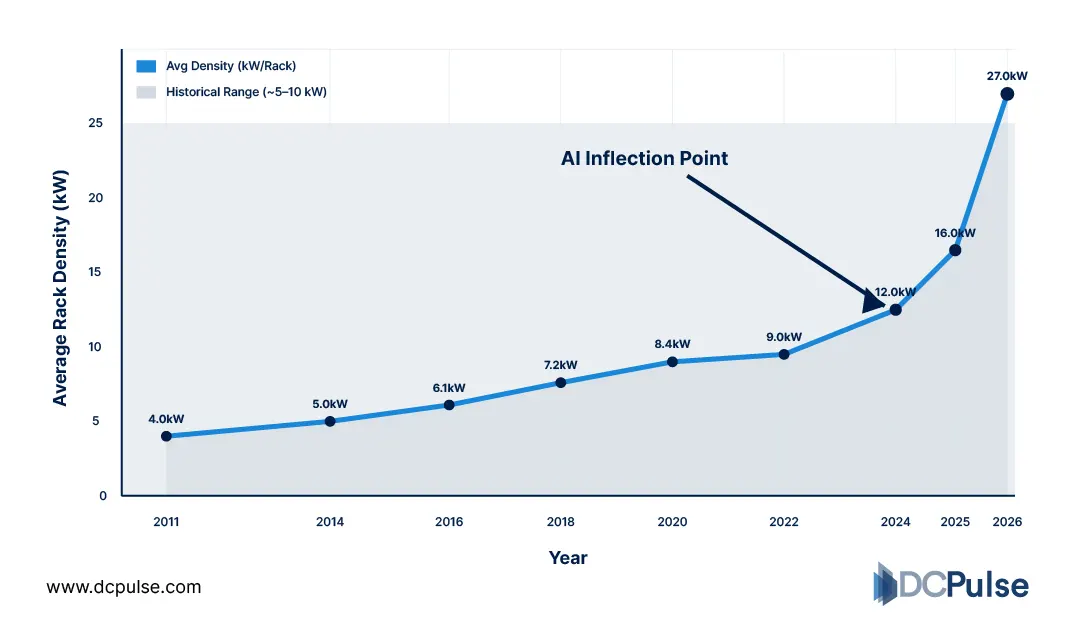
Recent data shows this is changing, but slowly. The 2025 Uptime Institute survey indicates that most operators now deploy racks in the 10–30 kW range, with modal averages still in single-digit to low double-digit kW levels.
However, higher-density deployments are emerging at the top end. Uptime research highlights that racks above 20-25 kW are becoming more common, and beyond this range, traditional cooling approaches begin to face efficiency challenges.
Adoption and Average Density of High-Density Racks
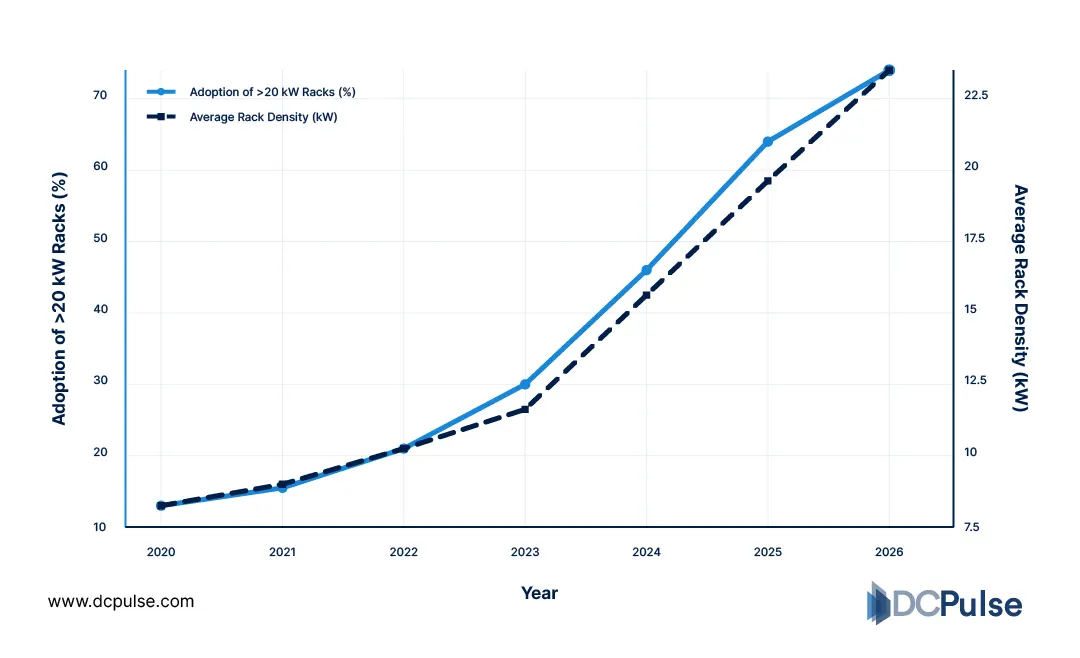
Ultimately, a smaller segment of facilities, particularly those supporting AI and high-performance computing, are deploying racks with capacities exceeding 30 kW, although these remain a minority of total deployments.
The pattern is clear; the current landscape is not uniformly high-density, it is bifurcated, with most data centers operating at moderate densities while a growing segment pushes toward high-density, AI-driven infrastructure limits.
What Innovations Are Enabling High-Density Rack Deployments?
The rise of high-density racks is being enabled by coordinated advances in cooling technologies, power delivery systems, and AI-optimized hardware design, all responding to rapidly increasing thermal and energy demands.
The most critical enabler is advanced cooling, particularly liquid-based systems. As rack densities exceed 20-25 kW, traditional air cooling becomes less efficient, making liquid cooling solutions, such as direct-to-chip, more practical and effective for higher loads.
Cooling Efficiency and PUE vs. Rack Density
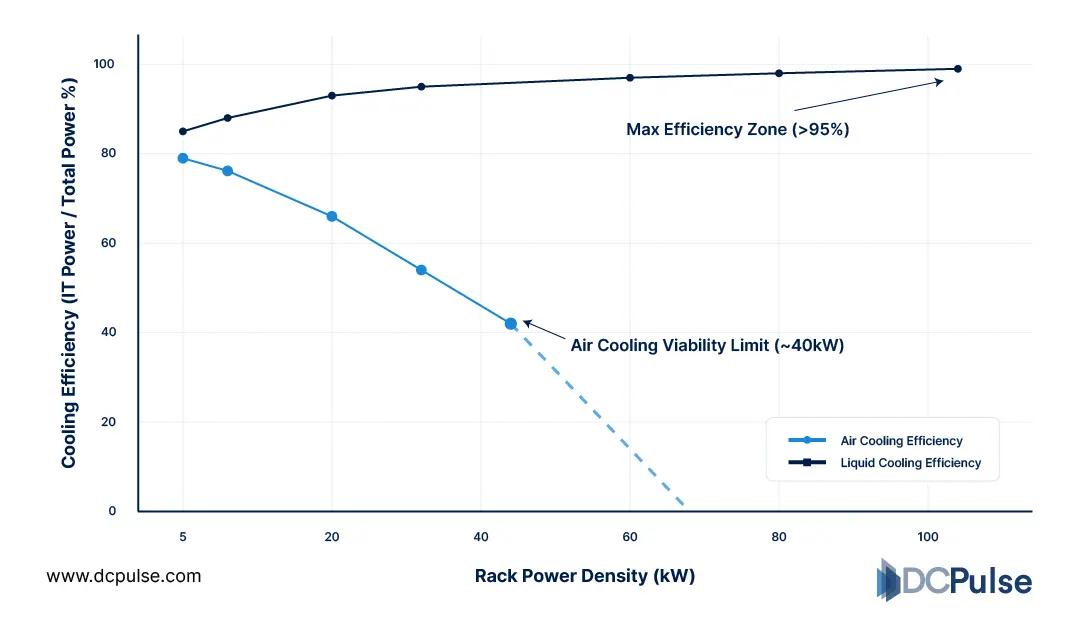
This transition is essential because modern AI environments are already pushing densities far beyond traditional limits. Industry insights show that racks are now routinely deployed at 50-60 kW, with some AI systems exceeding 100 kW per rack, requiring fundamentally different thermal management approaches.
Power infrastructure is evolving in parallel. High-density racks require significantly higher power delivery capacity, with operators redesigning electrical distribution to support concentrated loads while maintaining reliability and redundancy.
Power Demand Scaling per Rack (kW)
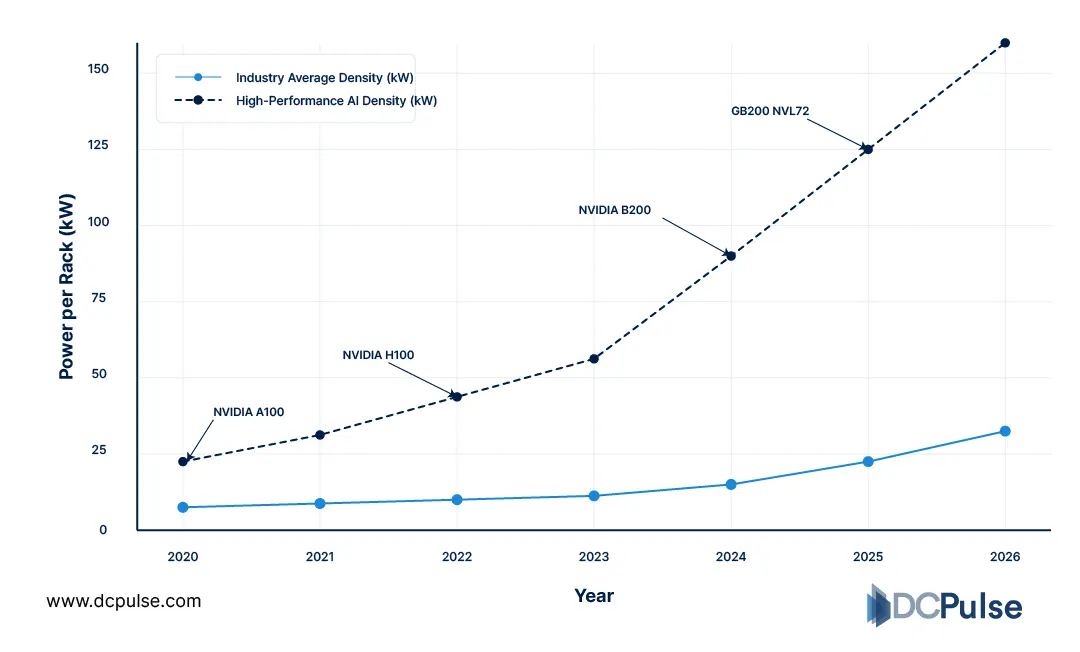
At the system level, AI workloads are driving tighter hardware integration. Uptime Institute data shows that densities above 30 kW are strongly associated with HPC and AI workloads, reflecting how modern compute architectures are designed for high-performance, high-density environments.
The shift is clear; high-density racks are not enabled by a single breakthrough; they are the result of integrated innovation across cooling, power, and compute design, allowing data centers to support the extreme demands of AI-driven infrastructure.
Who Is Driving the Adoption of High-Density Racks?
The adoption of high-density racks is being driven by a converging ecosystem of hyperscale operators, AI workloads, and infrastructure expansion strategies, all responding to unprecedented compute demand.
At the demand level, AI is the primary catalyst. Industry analysis shows that compute-intensive workloads, such as machine learning and large-scale AI training, are directly increasing rack power density requirements and forcing infrastructure redesign.
AI Workload Growth vs. Rack Density Scaling
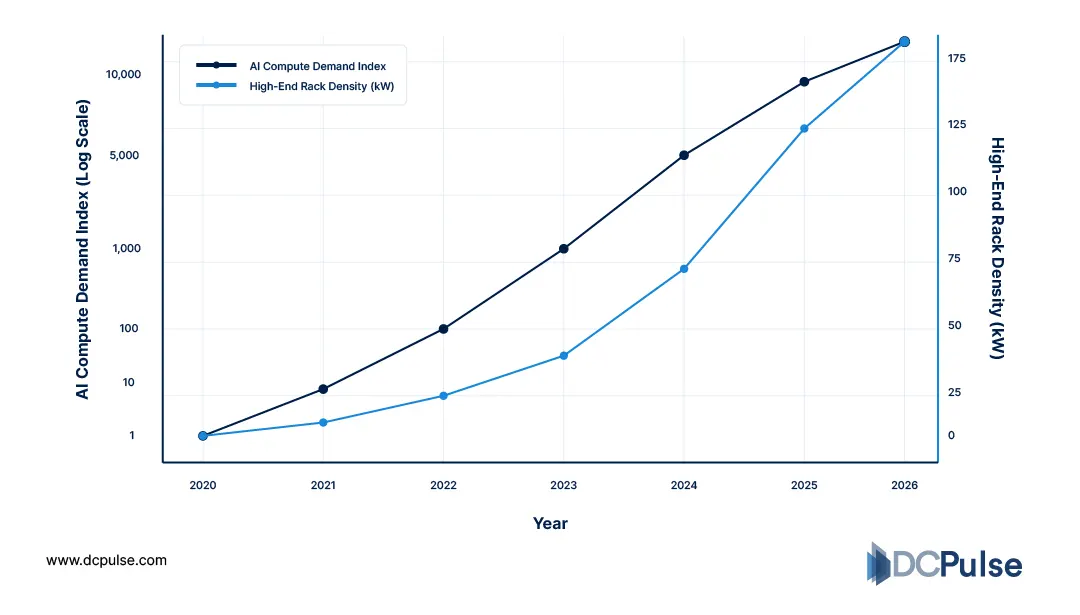
At the infrastructure level, operators are scaling facilities specifically for high-density deployments. According to AFCOM’s 2026 State of the Data Center report, average facility size has already increased to ~38 MW, reflecting a structural shift toward larger, AI-ready environments designed from the outset for dense compute loads.
At the end, AI-focused environments are pushing density boundaries. Industry insights from Schneider Electric highlight that racks are now routinely deployed at 50–60 kW, with some AI systems exceeding 100 kW per rack, illustrating how hyperscale and AI operators are leading the transition.
However, adoption is still concentrated. Uptime Institute data shows that over 80% of facilities still operate below 30 kW, with high-density racks primarily deployed in specialized AI and HPC environments rather than across the entire industry.
The implication is clear;
High-density rack adoption is being driven not by the entire industry, but by a leading edge of AI-focused operators, whose requirements are pushing infrastructure limits and forcing the broader ecosystem to evolve.
Will High-Density Racks Define the Future of Data Center Infrastructure?
High-density racks are set to become a defining feature of next-generation data centers, but their adoption will be selective rather than universal.
As AI workloads continue to scale, the need for concentrated compute power will only increase. High-density racks enable this by delivering significantly more performance within a smaller footprint, making them essential for hyperscale and AI-driven environments.
However, this shift comes with trade-offs. Higher densities introduce greater complexity in cooling, power delivery, and operational management. Not all facilities are equipped to handle these requirements, particularly legacy data centers designed for lower-density workloads.
As a result, the future will likely be hybrid. High-density racks will dominate in AI-focused and high-performance environments, while traditional racks will continue to support fewer intensive workloads.
This creates a more diversified infrastructure landscape, where different density levels coexist based on workload requirements.
The direction is clear; high-density racks will not replace traditional infrastructure entirely, but they will become the backbone of AI-driven data centers, shaping how future facilities are designed, scaled, and optimized for performance.