Pranav Hotkar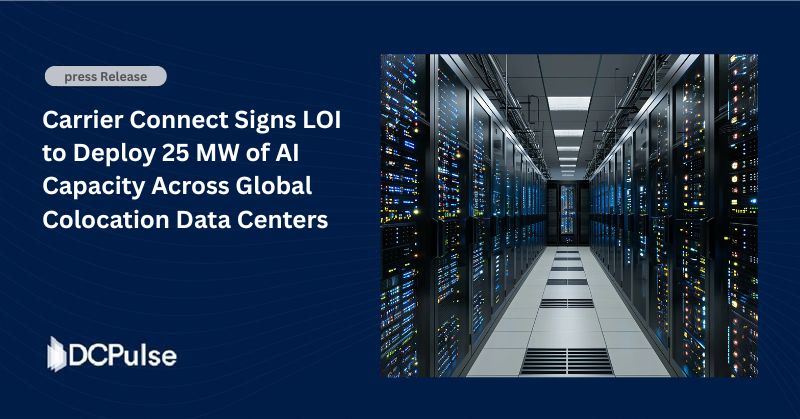
Vancouver, Canada - July 13, 2026 - Carrier Connect Data Solutions has signed a non-binding letter of intent (LOI) to deliver up to 25 MW of AI computing capacity for a single enterprise customer, marking another step in the company's strategy to expand its international colocation platform for artificial intelligence workloads. The deployment is expected to take place across Carrier Connect's global network of data centers over the next 12 months.
The customer, whose identity remains confidential under a non-disclosure agreement, is expected to utilize capacity distributed across multiple facilities rather than a single campus. Carrier Connect said the agreement establishes a framework for future purchase orders, with deployments to proceed on a site-by-site basis as commercial terms are finalized. The LOI is non-binding and remains subject to negotiation and execution of definitive agreements.
If the full 25 MW is deployed, the company estimates the project could generate approximately CUD 95 million in annual recurring revenue, based on the indicative pricing outlined in the agreement. Each purchase order would require a three-month retained deposit, with pricing tailored to the location and technical requirements of individual deployments.
The announcement builds on Carrier Connect's broader strategy of assembling an international portfolio of Tier II and Tier III carrier-neutral data centers to support AI, cloud, and enterprise workloads. Over the past year, the company has expanded through acquisitions and planned purchases, including data center assets in Saint John, New Brunswick, a facility in Rochester, New York, and network infrastructure acquired through Morewave Communication. The company currently operates facilities in Canada and Australia while continuing to evaluate additional expansion opportunities.
For the data center industry, the agreement highlights a growing trend toward distributed AI deployments. Rather than concentrating compute capacity within a single hyperscale campus, some enterprises are leveraging multiple colocation facilities to improve geographic reach, network resilience, and deployment flexibility. This approach also enables providers to bring AI infrastructure online more quickly by utilizing existing data center capacity instead of waiting for new campuses to be completed.
The announcement reflects continued momentum in the AI colocation market, where demand for GPU-ready infrastructure is driving investment across both hyperscale and regional facilities. As enterprises seek faster access to AI computing resources, operators with established carrier-neutral data center networks are increasingly positioning themselves as alternatives to purpose-built hyperscale campuses.
Although the LOI does not guarantee future deployments, it signals growing customer interest in securing dedicated AI infrastructure through colocation providers. Should the agreement progress into executed purchase orders, the 25 MW deployment would represent one of Carrier Connect's largest AI infrastructure commitments to date and further strengthen its position in the rapidly expanding market for AI-ready data center services.