Pranav Hotkar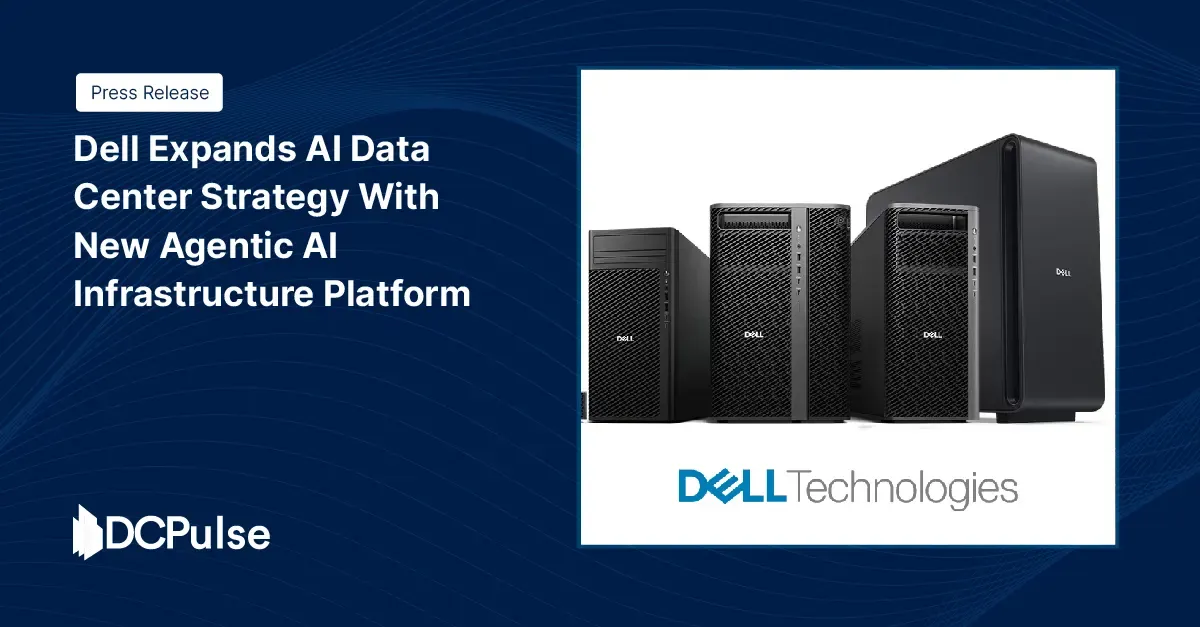
Las Vegas, Nevada, USA - May 18, 2026 - Dell Technologies has expanded its AI infrastructure portfolio with a new "deskside-to-data-center" strategy focused on helping enterprises deploy production-scale agentic AI workloads across on-premises and hybrid environments. The announcement was made during Dell Technologies World 2026 in Las Vegas and places AI-ready data center infrastructure at the center of the company’s next growth phase.
The company introduced Dell Deskside Agentic AI as part of its broader Dell AI Factory with the NVIDIA platform, enabling organizations to deploy autonomous AI workflows locally while scaling them into enterprise data center environments. Dell said the approach is designed to address rising concerns around latency, data sovereignty, governance, and infrastructure cost management tied to cloud-only AI deployments.
A major focus of the announcement centered on AI data center infrastructure and the operational shift from AI experimentation to production deployment. Dell unveiled new rack-scale infrastructure, storage, orchestration, and networking enhancements intended to support increasingly dense GPU clusters and enterprise-scale AI workloads.
Among the key infrastructure launches was Dell PowerRack, a turnkey rack-scale platform integrating compute, storage, and networking systems for high-density AI deployments. Dell also expanded support for NVIDIA AI architectures, including NVIDIA AI-Q 2.0 and Open-Shell infrastructure frameworks aimed at improving scalability and orchestration across enterprise AI environments.
The company said enhancements to the Dell AI Data Platform now allow organizations to index billions of unstructured files and build governed AI pipelines more efficiently, helping enterprises accelerate AI model deployment inside data center environments. Dell added that more than 5,000 customers are already using Dell AI Factory infrastructure globally.
Dell’s broader AI infrastructure strategy increasingly emphasizes private and hybrid AI deployments, where enterprises maintain greater control over workloads, data governance, and security. The company said modern AI environments require tightly integrated infrastructure stacks spanning servers, storage, networking, orchestration, and cooling systems.
The announcement also reflects accelerating demand for AI-ready data center infrastructure globally. As enterprises deploy larger GPU clusters and agentic AI systems, operators are facing rising pressure around power density, thermal management, and infrastructure scalability. Dell has been working closely with NVIDIA and Schneider Electric on next-generation AI factory architectures involving liquid cooling, high-density rack systems, and advanced power infrastructure.
Industry analysts increasingly view agentic AI as a major driver of future infrastructure demand because autonomous AI systems require persistent, low-latency compute environments capable of handling continuous reasoning, orchestration, and inference operations at scale.