Pranav Hotkar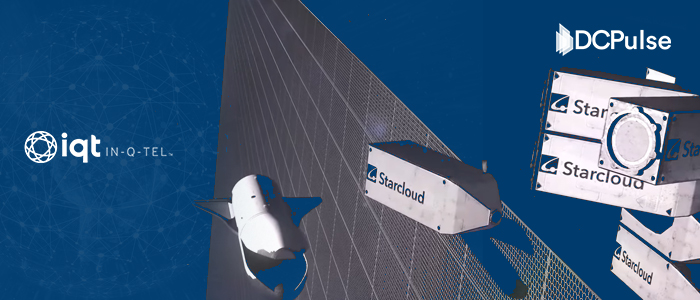
August 8, 2025- It wasn’t a press conference or a glossy press release. Instead, the news slipped into public view through a short post by Starcloud’s co-founder and CEO, Philip Johnston. In it, he revealed that IN-Q-Tel, the venture arm linked to the U.S. intelligence community, had become a strategic investor in his company’s mission to put high-performance data centers into orbit.
Philip Johnston, co-founder and CEO of Starcloud, announced the news in a social media post, saying:
“I am excited to share that Starcloud has received a strategic investment from IQT, In-Q-Tel, the not-for-profit strategic investor that identifies, evaluates, and leverages emerging commercial technologies for the U.S. national security community and its allies. This strategic partnership between Starcloud and IQT will help accelerate Starcloud's development of orbital data centers, providing customer satellites with high-performance on-orbit AI compute capabilities.”
For Starcloud, it was more than an investment. For IN-Q-Tel, it was a bet on the future of computing far above Earth.
Starcloud, which until recently was known as Lumen Orbit, has been working toward an ambitious goal: to build a distributed network of very low Earth orbit satellites capable of hosting GPU-powered data centers. The idea is to use vast solar arrays to run compute workloads in space, free from the environmental constraints of terrestrial facilities.
The company has publicly claimed that its architecture could deliver a 40 megawatt orbital data center for just USD 8.2 million and aims to deploy five gigawatts of solar power in orbit, covering an area of roughly four square kilometers.
To date, Starcloud has raised more than USD 20 million from prominent venture investors, including Y Combinator, Andreessen Horowitz, NFX, Fuse.VC, Soma Capital, and Sequoia Capital. Adding IN-Q-Tel to that list brings a different dimension, one that ties the company’s vision directly to U.S. national security interests.
Founded in 1999 and funded by the CIA, IN-Q-Tel operates as a non-profit venture capital firm focused on technologies that can serve intelligence and defense needs. Its portfolio spans artificial intelligence, advanced communications, cybersecurity, quantum computing, and now, space-based data infrastructure.
Although neither Starcloud nor IN-Q-Tel has disclosed the size or terms of the investment, the addition of Starcloud to IN-Q-Tel’s official portfolio confirms the deal. For intelligence agencies, the appeal of data centers in space is clear. Such infrastructure could offer secure, resilient, and globally accessible computing capabilities without relying on vulnerable terrestrial networks.
Operating in very low Earth orbit also means reduced latency compared to traditional satellite constellations, enabling near real-time data processing for both civilian and defense applications.
Starcloud’s next major milestone is the planned launch of its Starcloud-2 commercial satellite next year. The spacecraft will carry a GPU cluster, persistent storage, and proprietary power and thermal systems, all within a small satellite platform.
It’s intended to serve as a proof of concept for the company’s orbital compute model and a stepping stone toward its much larger solar-powered deployments.
For now, the investment announcement remains limited to Johnston’s social post and the quiet update to IN-Q-Tel’s portfolio listings. Yet the implications are hard to ignore.
This is not just a startup chasing a futuristic vision. It is now a company whose ambitions align with the strategic priorities of the U.S. intelligence community. And as other players explore the possibilities of space-based computing, IN-Q-Tel’s early move on Starcloud may prove to be as much about timing as technology.
What began as a short message on social media could mark the dawn of an era when the cloud is not just above us, but far beyond us.

.jpg)