Pranav Hotkar
Data centers have long been measured by how much power they consume. Now, they’re increasingly being judged by how much water they use.
Behind the rapid expansion of cloud and AI infrastructure lies a less visible reality: cooling these systems often depends on vast amounts of water. In many facilities, evaporative cooling systems draw heavily from local water supplies, quietly tying digital growth to physical resource strain, especially in regions already facing scarcity.
But that equation is starting to change.
As AI workloads surge and sustainability pressures intensify, a new design philosophy is emerging, one that aims to remove water from the equation entirely. Water-free data centers, once considered impractical, are now being actively explored and deployed using advanced air cooling, closed-loop systems, and alternative thermal strategies.
This shift is not just about efficiency. It reflects a broader rethinking of what “sustainable infrastructure” means in a world where both compute demand and environmental constraints are rising in parallel.
The question is no longer whether data centers can reduce water usage.
It’s whether they can eliminate it altogether.
How Much Water Do Data Centers Really Use Today?
Water consumption in data centers has emerged as a core sustainability metric. Cooling systems, particularly evaporative towers, are the main drivers, withdrawing and losing water to carry heat away from servers. The industry measures this using Water Usage Effectiveness (WUE), which calculates liters of water per kilowatt-hour (L/kWh) of IT load. Many data centers report around 1.8 L/kWh, though some high-efficiency facilities achieve lower figures.
Average Water Usage Effectiveness (WUE) by Data Center Type (2026)
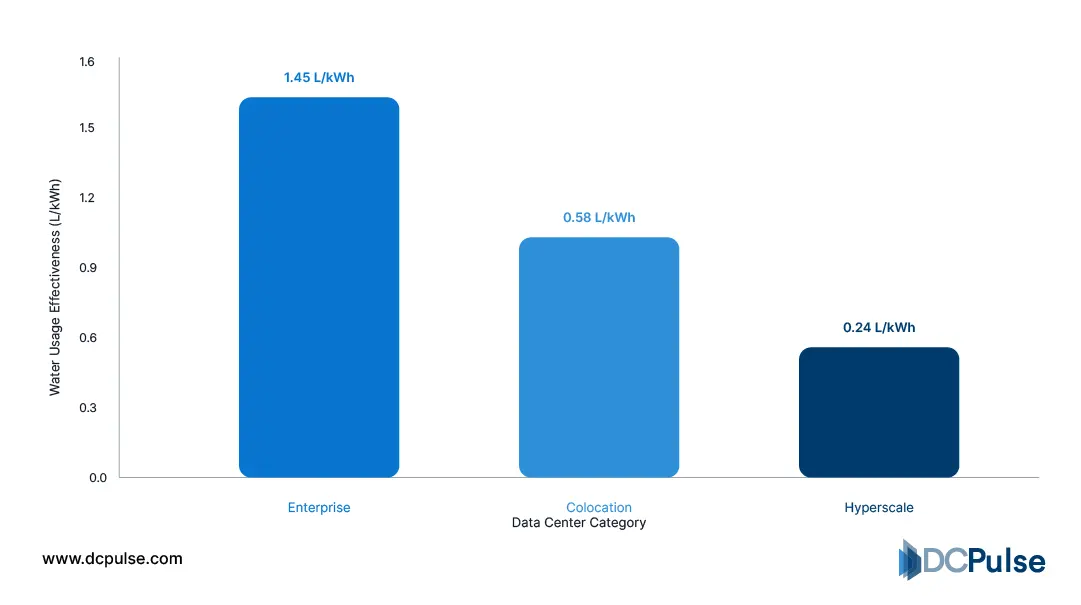
Water demand is not uniform. Climatic conditions, cooling system design, and facility location heavily influence consumption. Arid regions often rely on high-efficiency evaporative systems, whereas cooler climates can use “free cooling” techniques to reduce or eliminate water consumption.
Map - Data Center Hubs vs. Regional Water Stress (2026)
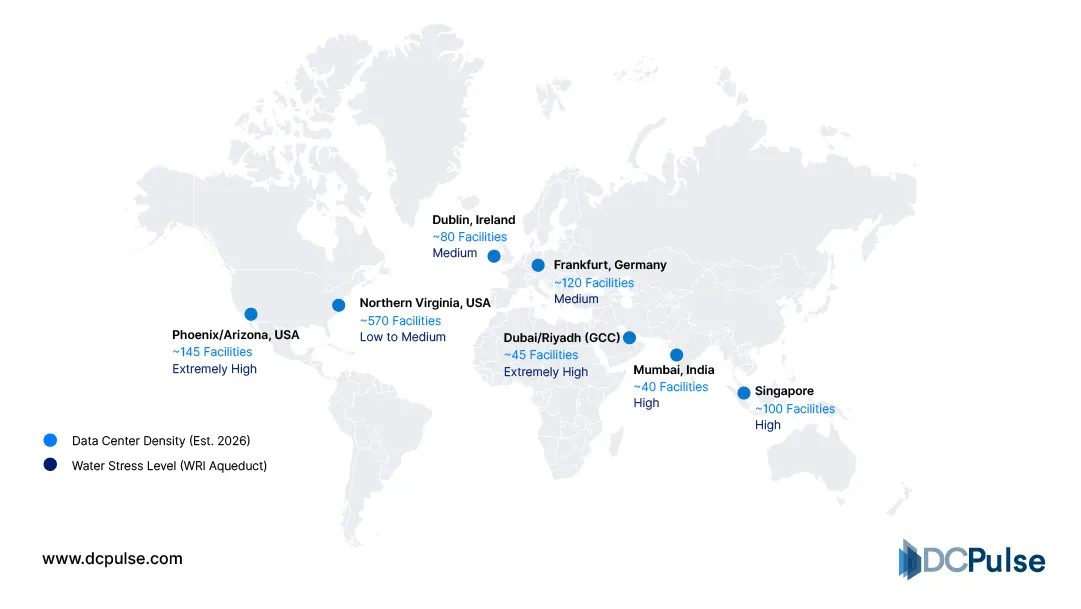
Hyperscale campuses can withdraw hundreds of thousands of gallons daily, totaling millions or billions annually. Beyond on-site use, indirect water consumption occurs via electricity generation, particularly in regions dependent on thermoelectric power plants, which require water for steam and cooling.
Breakdown of Total Water Usage (Direct vs. Indirect) – 2026
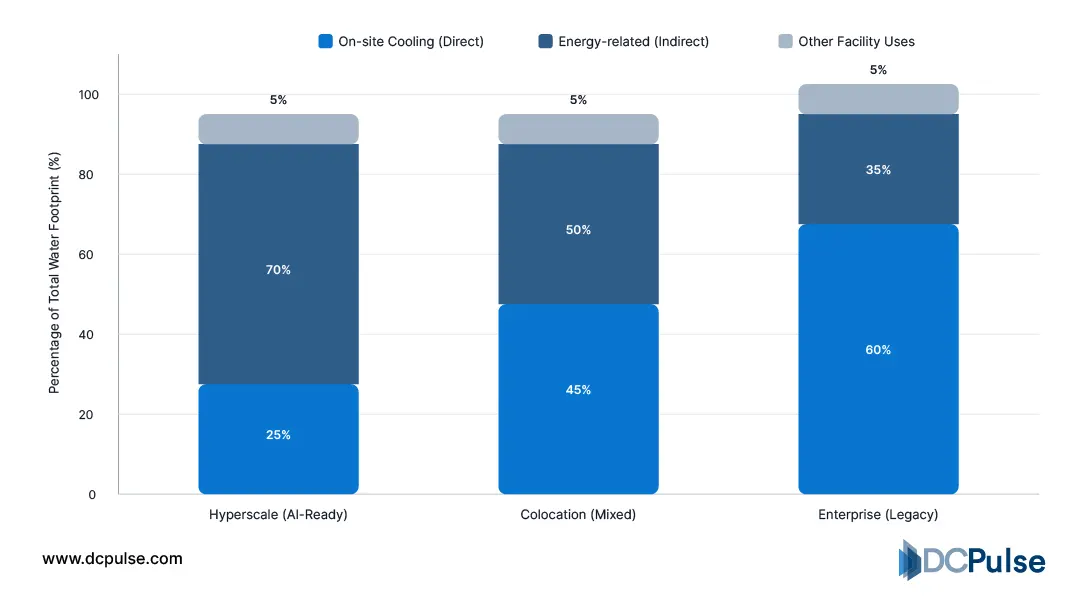
Over the past decade, WUE has improved gradually, but growth in compute-intensive AI workloads is outpacing efficiency gains. Water remains a critical limiting factor for sustainable data center operation.
Rethinking Cooling Facilities Without Water
As pressure mounts to reduce water consumption, data center cooling is undergoing a fundamental shift, from evaporative systems to technologies that minimize or eliminate water use altogether. The transition is being driven by both efficiency gains and the need to operate sustainably in water-stressed regions.
Advanced air cooling remains the first layer of this shift. While traditional air systems struggle at higher densities, optimized airflow designs and rear-door heat exchangers are extending their viability without requiring water. However, their limits become apparent as rack densities continue to rise. TechTarget notes that air cooling becomes increasingly inefficient compared to liquid-based systems at higher thermal loads.
Cooling Efficiency (PUE) vs. Rack Density (2026 Benchmarks)
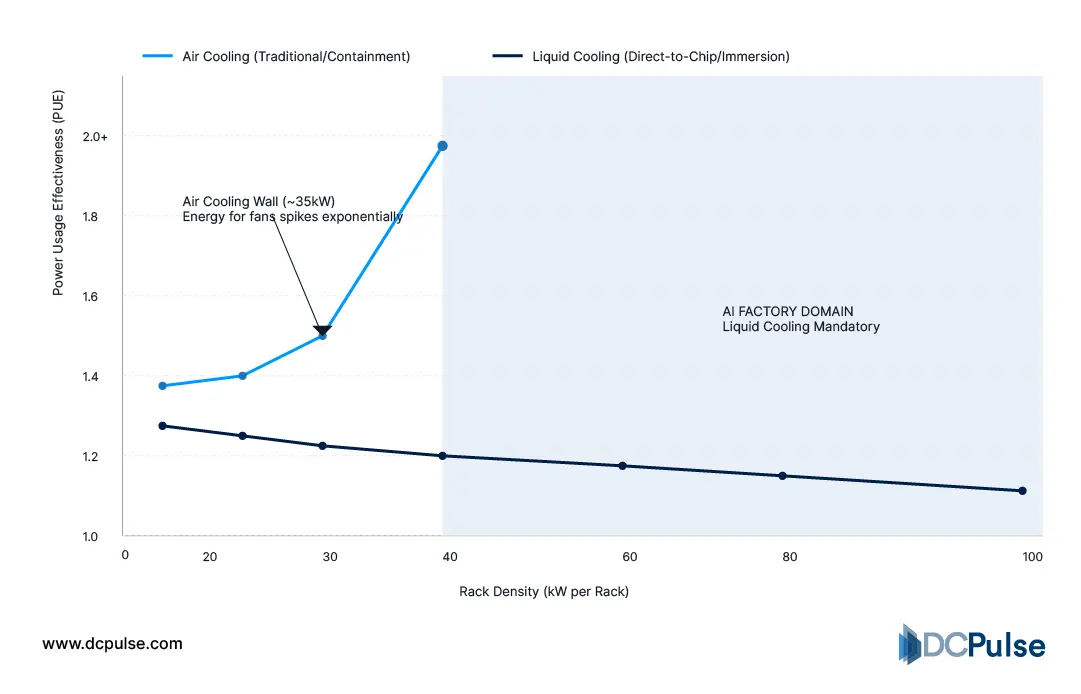
Closed-loop liquid cooling is emerging as a key alternative. These systems circulate coolant within sealed loops, rejecting heat through dry coolers without evaporation. This allows significantly higher heat removal while avoiding direct water consumption.
Immersion cooling takes this further by submerging hardware in dielectric fluids, enabling highly efficient heat transfer. Research shows that such systems can reduce cooling energy consumption by up to 50% while supporting higher densities.
Cooling Methods Resource Consumption Comparison (2026)
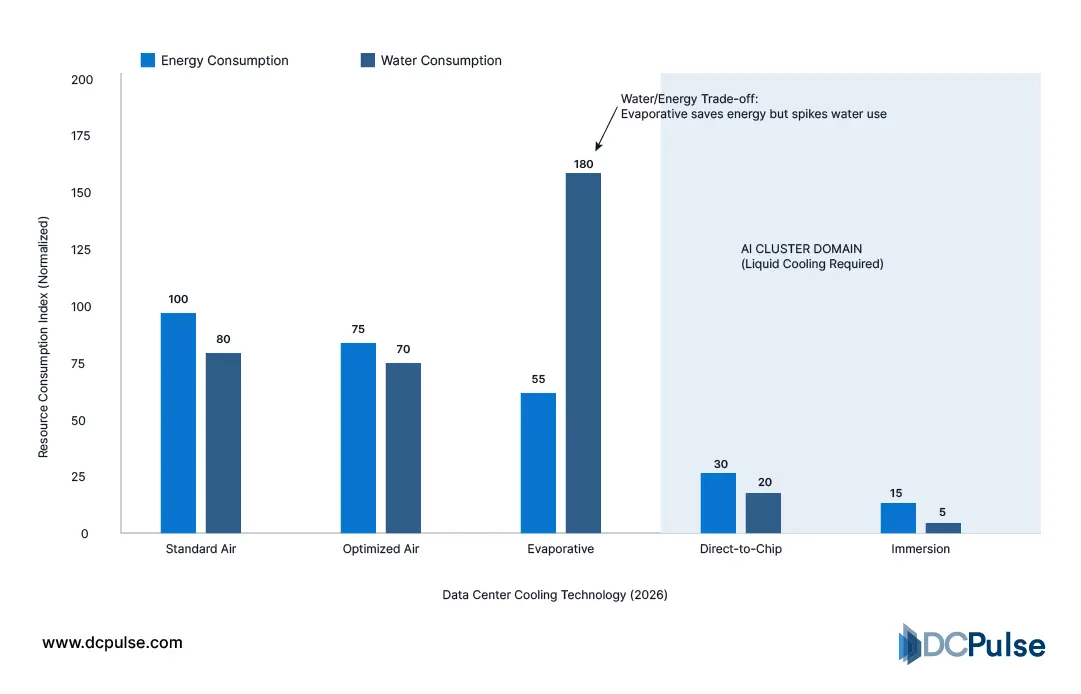
Industry analysis also indicates that immersion cooling can reduce water usage by as much as 95-98%, making it one of the most viable paths toward water-free data centers. Energy Solutions
Water Usage Comparison (Evaporative vs. Immersion) - 2026
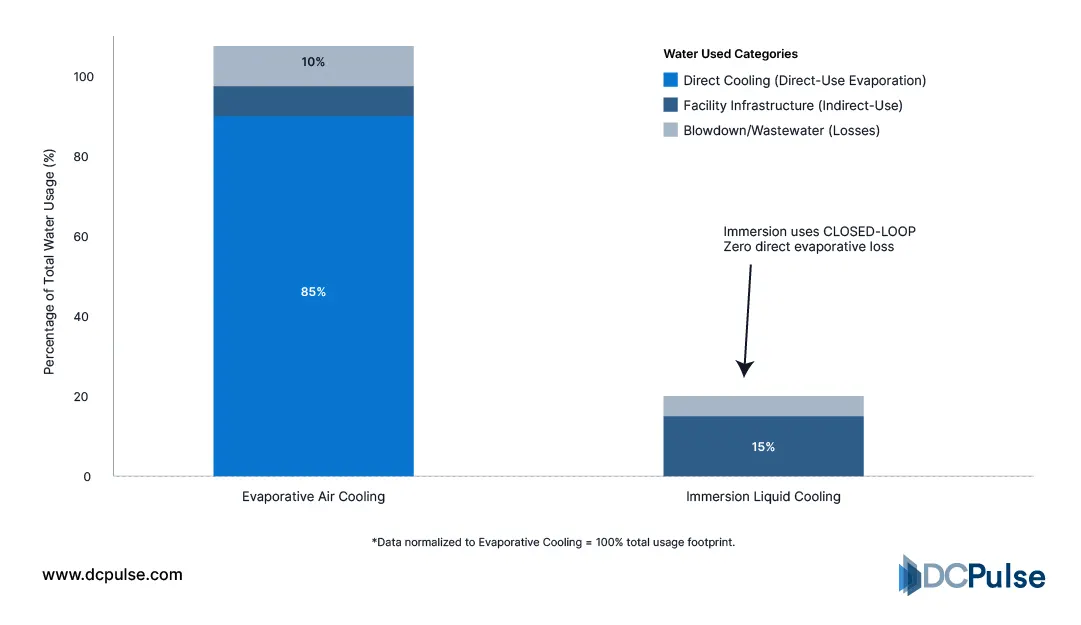
Together, these approaches signal a clear transition: cooling is no longer just about removing heat efficiently but doing so without consuming water, redefining the foundation of sustainable data center design.
Who’s Going Water-Free? Inside the Industry Shift
The push toward water-free data centers is no longer experimental; it is being driven by infrastructure limits, sustainability pressure, and the rapid rise of AI workloads. Across the industry, operators are actively shifting away from water-intensive cooling toward closed-loop and waterless systems.
At a global level, the scale of the challenge is becoming clear. Research shows that data center water demand could reach hundreds of millions of gallons per day in the coming years if current trends continue, placing significant strain on local water systems.
Projected Global Data Center Water Demand (2024-2030)
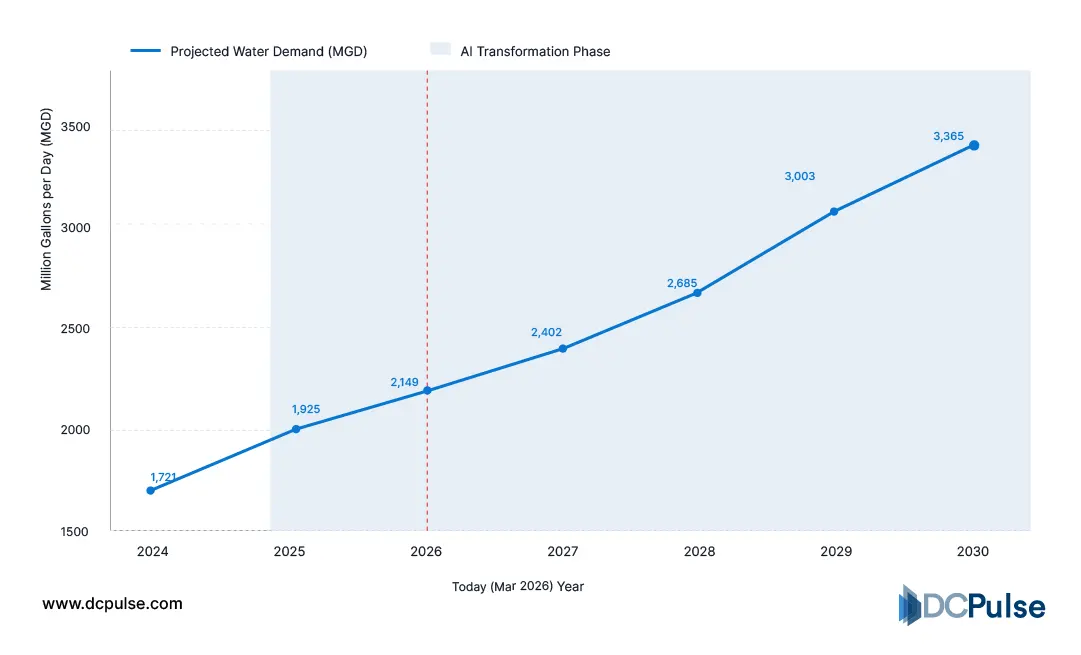
This pressure is accelerating the adoption of alternative cooling strategies. Industry analysis highlights that traditional air cooling is increasingly unable to support modern high-density workloads, while liquid-based systems, particularly closed-loop designs, offer higher efficiency with significantly lower water dependency.
High-Density Data Center Cooling Adoption Shift (2018-2026)
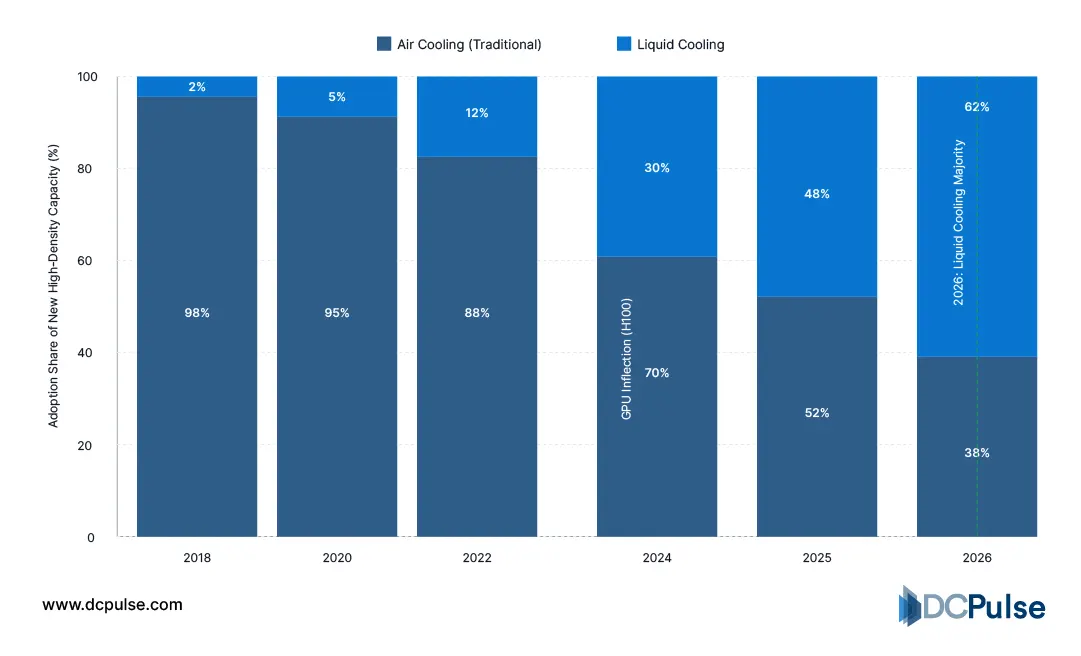
At the same time, newer approaches such as immersion cooling are gaining traction. Academic research shows these systems can reduce cooling energy consumption by around 50% while enabling higher rack densities, making them attractive for next-generation AI deployments.
Even at the policy and planning level, water is becoming a limiting factor. Recent reporting highlights how water availability is now influencing where data centers can be built, pushing operators toward dry cooling and waterless designs despite higher upfront costs.
What emerges is a clear industry shift: water is no longer just a resource; it is a constraint. And in response, the data center industry is rapidly moving toward designs that can operate without it.
Can Data Centers Truly Go Water-Free?
The short answer is yes, but not universally, and not without trade-offs.
Technically, water-free data centers are already achievable. Advances in air cooling, closed-loop liquid systems, and immersion technologies have proven that heat can be managed without relying on evaporative water loss. In controlled environments and cooler climates, these approaches can operate efficiently while eliminating one of the industry’s most strained resources.
However, the challenge is not just technological; it is systemic. Water-free designs often come with higher energy requirements, especially when replacing evaporative cooling with dry systems. This creates a trade-off between water conservation and power efficiency, forcing operators to balance two critical sustainability metrics rather than optimizing just one.
Geography also plays a decisive role. In water-scarce regions, the shift toward water-free infrastructure is becoming a necessity rather than a choice. In other areas, where water is more readily available, hybrid approaches may continue to dominate due to cost and efficiency advantages.
Ultimately, the transition is less about eliminating water everywhere and more about using it intelligently where it matters most. As infrastructure scales to meet AI demand, the future of sustainable data centers will depend on how effectively operators can align cooling strategies with local resource realities.