Pranav Hotkar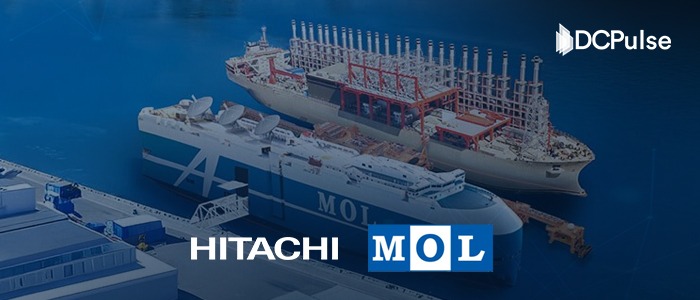
Tokyo, Japan - March 30, 2026 - Hitachi and Mitsui O.S.K. Lines (MOL) have announced a joint initiative to develop offshore floating data centres by converting used vessels, targeting the growing power and cooling demands of artificial intelligence (AI) workloads.
The project will repurpose decommissioned ships into data centre platforms equipped to host high-density computing systems. By reusing existing maritime assets, the companies aim to reduce construction costs and shorten deployment timelines compared to building new offshore facilities, while also aligning with circular economy principles.
According to the companies, the floating data centers will operate offshore and leverage seawater for cooling, significantly improving energy efficiency compared to conventional land-based systems. The facilities are also expected to integrate renewable energy sources, including offshore wind power, to reduce reliance on grid electricity and lower carbon emissions.
Hitachi will contribute its expertise in digital infrastructure, energy management systems, and advanced data centre technologies, while MOL will lead vessel conversion, offshore operations, and marine engineering. The collaboration is designed to combine industrial and maritime capabilities to deliver scalable infrastructure for AI-driven computing.
The companies said the initiative addresses key constraints facing data centre expansion, including limited land availability, rising energy consumption, and increasing cooling requirements driven by AI workloads. Offshore deployment enables proximity to renewable energy generation and provides a stable thermal environment for efficient heat dissipation.
In addition to technical benefits, the use of converted ships allows for modular deployment, enabling incremental capacity expansion based on demand. The approach is expected to support faster rollout of infrastructure while maintaining operational flexibility.
The companies also plan to study optimal deployment locations, operational frameworks, and connectivity requirements to ensure reliable integration with terrestrial networks. Future phases will explore standardization and scalability of ship-based data centre designs.
Industry observers note that the initiative reflects a broader shift toward alternative data centre architectures as operators seek sustainable solutions for AI infrastructure growth. By combining vessel reuse, renewable energy integration, and seawater cooling, the project positions offshore environments as a viable option for next-generation data centre development.
With AI demand accelerating globally, the partnership aims to establish a new model for energy-efficient, scalable infrastructure while extending the lifecycle of maritime assets and reducing environmental impact.


.jpg)