Pranav Hotkar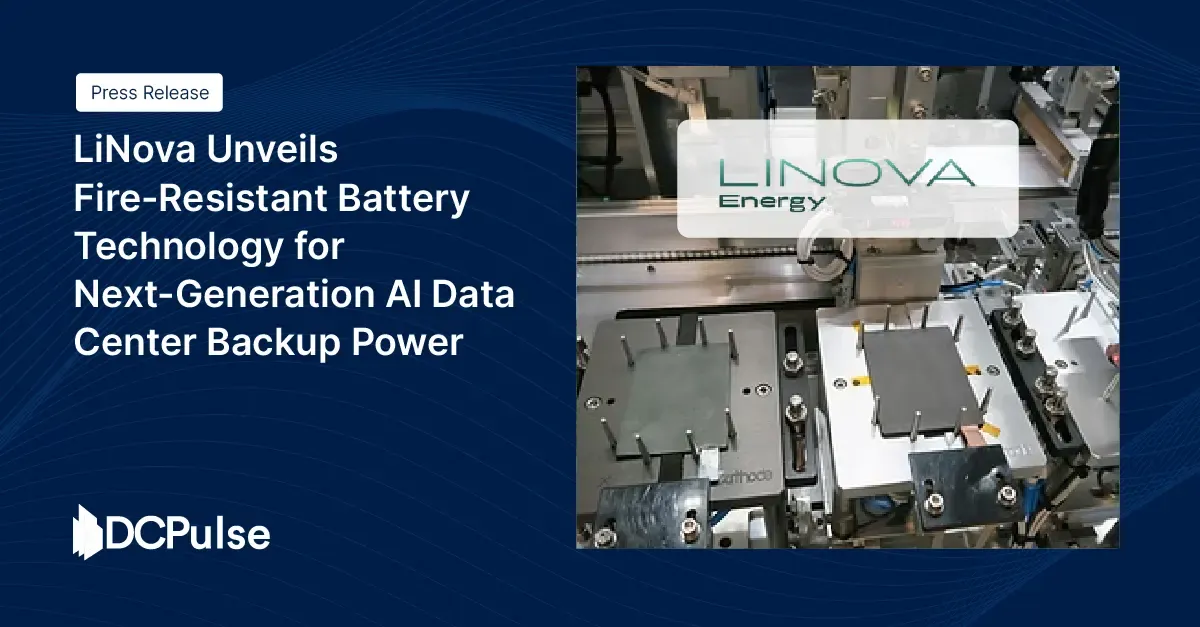
Monrovia, California - June 24, 2026 - LiNova Energy has introduced a new battery cell designed specifically for AI data center backup power, unveiling a metal-free cathode technology that the company says eliminates thermal runaway at the cell level while delivering the high-power performance required for mission-critical digital infrastructure.
The new platform, branded PolyPower, targets battery backup units (BBUs) used in modern AI servers and hyperscale data centers, where uninterrupted power is essential for protecting GPU clusters and maintaining service availability during power disturbances. Unlike conventional lithium-ion batteries that rely on metal-oxide cathodes, LiNova's technology uses a proprietary polymer cathode that does not release oxygen under high temperatures, a key factor behind thermal runaway and battery fires. Instead, the material evolves carbon dioxide, significantly reducing fire risk, according to the company.
As AI workloads continue driving higher rack densities, data center operators are reevaluating backup power systems alongside advances in cooling and electrical infrastructure. Battery backup units have become increasingly important in AI servers, providing short-duration power that bridges the gap between utility outages and generator startup while protecting sensitive computing hardware. Higher-power AI clusters, however, place greater demands on battery performance and safety than traditional enterprise workloads.
LiNova said PolyPower combines high power density with lower material costs by eliminating nickel, cobalt, and other critical minerals commonly used in conventional cathodes. The company also said its polymer cathode can be manufactured using existing lithium-ion production lines and sourced from widely available chemical precursors, reducing supply chain exposure and geopolitical risks associated with critical battery materials.
The battery has already undergone third-party evaluation at the University of California, San Diego, where researchers tested its ability to deliver rapid power under demanding operating conditions. Additional material- and cell-level validation by Saft North America reportedly found no evidence of thermal runaway during abuse testing, supporting LiNova's claims of improved intrinsic safety compared with conventional lithium-ion chemistries.
LiNova developed the platform in collaboration with a hyperscale data center operator to address the evolving requirements of AI infrastructure. The company said pouch-format cells are now available for customer testing, with cylindrical versions expected in the third quarter of 2026. Integration into hyperscaler-grade battery backup units is planned for the fourth quarter, allowing operators to evaluate the technology in production-like AI environments.
The launch reflects a broader trend across the data center industry, where operators are seeking safer and more resilient energy storage technologies as AI campuses continue to scale. Alongside investments in liquid cooling, high-density power distribution, and dedicated generation, battery innovation is emerging as another critical component of next-generation AI infrastructure. If LiNova's technology performs as expected in commercial deployments, it could offer operators a new approach to balancing power density, operational safety, and supply chain resilience in future AI-ready facilities.

.jpg)